
Gold hunter finds 17-kg rock in Australia, tries to break it open. Scientists reveal it was a meteorite
Researchers identified the object as the Maryborough meteorite, named after the nearby town.
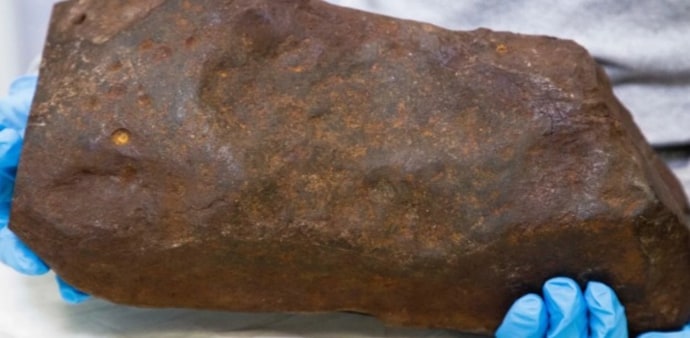
- Nov 30, 2026,
- Updated Nov 30, 2026 4:00 AM IST
A man in Australia spent years believing a heavy rock he found while searching for gold could contain a valuable nugget. He tried a rock saw, angle grinder, drill, acid and even a sledgehammer to break it open. But the 17-kilogram rock refused to crack. Years later, scientists found that he was holding something far rarer than the gold he was looking for — a meteorite that dates back around 4.6 billion years, according to a report by ScienceAlert.
David Hole found the unusual reddish rock in May 2015 while prospecting with a metal detector at Maryborough Regional Park in Victoria, Australia. The area is part of Victoria’s historic Goldfields region, making him believe there could be gold inside.
He tried everything to open the rock
Hole took the rock home and spent years trying to break it. Nothing worked.
The rock had a sculpted and dimpled surface, a feature that scientists say can form when a meteorite heats up and melts on the outside while passing through Earth’s atmosphere.
Eventually, Hole took the rock to the Melbourne Museum for identification.
“I've looked at a lot of rocks that people think are meteorites,” Melbourne Museum geologist Dermot Henry told Channel 10 News.
Don't Miss: Up to 710 satellites can be above you after dark: Here’s what the numbers show
Henry said that after examining thousands of suspected meteorites during his 37 years at the museum, only two had turned out to be genuine. This was one of them.
Scientists found a 4.6-billion-year-old space rock
Researchers identified the object as the Maryborough meteorite, named after the nearby town. It was classified as an H5 ordinary chondrite, a type of stony meteorite rich in iron. The original specimen weighed 17 kg, although the main museum specimen now weighs 15.9 kg after a 680-gram slice was removed for study.
“If you saw a rock on Earth like this, and you picked it up, it shouldn't be that heavy,” Bill Birch, a geologist and curator emeritus at Melbourne Museum, explained.
The meteorite is around 4.6 billion years old and contains tiny crystallised mineral droplets called chondrules.
Rarer than gold, but no public price tag
The Maryborough meteorite is considered extremely rare. It is only the 17th meteorite recorded in Victoria and the second-largest single chondritic mass found in the state, behind a 55-kg specimen called Kulnine.
“This is only the 17th meteorite found in Victoria, whereas there's been thousands of gold nuggets found,” Henry told Channel 10 News.
That is why scientists describe the discovery as more valuable than gold in terms of its rarity and scientific importance. There is no publicly reported monetary valuation for the Maryborough meteorite.
“Meteorites provide the cheapest form of space exploration. They transport us back in time, providing clues to the age, formation, and chemistry of our Solar System (including Earth),” Henry said.
Scientists believe the meteorite most probably came from the asteroid belt between Mars and Jupiter. Carbon dating suggests it has been on Earth for less than 1,000 years.
The meteorite is now part of the Museums Victoria collection.