
‘In just 4 days!’: ISRO celebrates cowpea seed germination in space, paves way for future space farming
The cowpea seeds are housed in a closed-box system with active thermal control, where passive measurements — such as camera imaging, oxygen and carbon dioxide levels, temperature, relative humidity, and soil moisture — are being monitored.
- Jan 4, 2025,
- Updated Jan 4, 2025 9:21 PM IST
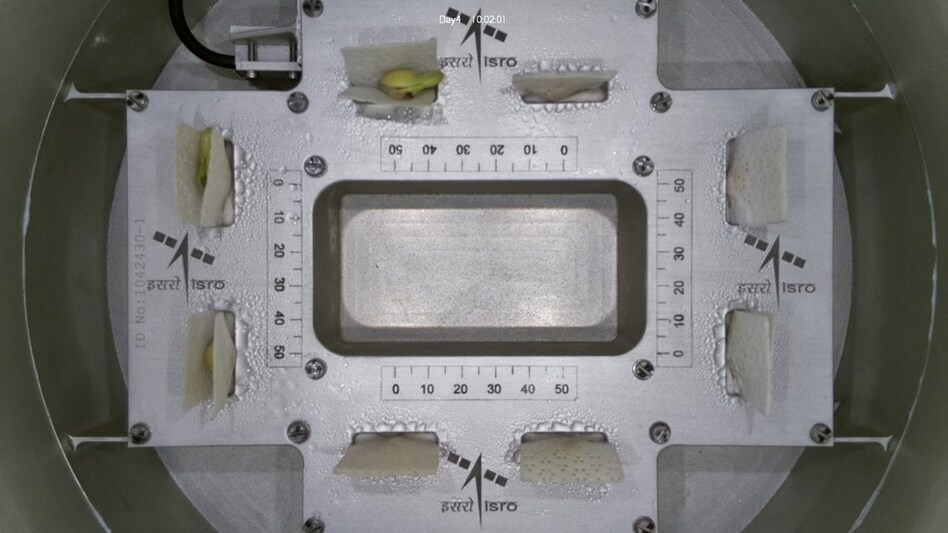
An excited ISRO announced that cowpea seeds it launched into space aboard the PSLV-C60 POEM-4 platform have successfully germinated under microgravity conditions. The seeds began sprouting just four days after the mission’s launch.
As part of the Compact Research Module for Orbital Plant Studies (CROPS) experiment conducted by the Vikram Sarabhai Space Centre (VSSC), eight cowpea seeds were sent to space to explore plant growth in microgravity. This experiment is pivotal in understanding how plants develop in space, especially for future long-term missions.
“Life sprouts in space!” ISRO shared in a post on X on January 4, confirming that the cowpea seeds had sprouted within four days and that leaves were expected soon.
The PSLV-C60 mission, which launched on the night of December 30, successfully placed two SpaDeX satellites into orbit. The fourth stage of the rocket, carrying the POEM-4 platform, has been orbiting Earth at an altitude of 350 km since December 31, 2024, with 24 onboard experiments.
The CROPS experiment aims to examine how plants adapt and grow in the unique conditions of space, which is crucial for sustaining plant life on extended space missions. The controlled environment, with active thermal regulation, simulates the conditions plants might face during long-duration space travel.
The experiment, which spans five to seven days, is designed to demonstrate seed germination and plant growth to the two-leaf stage in microgravity. The cowpea seeds are housed in a closed-box system with active thermal control, where passive measurements — such as camera imaging, oxygen and carbon dioxide levels, temperature, relative humidity, and soil moisture — are being monitored.
In a separate update, ISRO also shared a ‘selfie video’ from the chaser satellite involved in the space docking experiment, which is currently orbiting Earth at an altitude of 470 km. The chaser satellite is expected to dock with the target satellite on Tuesday, a significant milestone that would make India only the fourth country to achieve this advanced space technology, joining Russia, the US and China.
The Space Docking Experiment is a pivotal mission for India, showcasing orbital docking technology vital for future human spaceflights and satellite servicing. The SpaDeX mission serves as a cost-effective demonstration of in-space docking with two small spacecraft launched by PSLV.
An excited ISRO announced that cowpea seeds it launched into space aboard the PSLV-C60 POEM-4 platform have successfully germinated under microgravity conditions. The seeds began sprouting just four days after the mission’s launch.
As part of the Compact Research Module for Orbital Plant Studies (CROPS) experiment conducted by the Vikram Sarabhai Space Centre (VSSC), eight cowpea seeds were sent to space to explore plant growth in microgravity. This experiment is pivotal in understanding how plants develop in space, especially for future long-term missions.
“Life sprouts in space!” ISRO shared in a post on X on January 4, confirming that the cowpea seeds had sprouted within four days and that leaves were expected soon.
The PSLV-C60 mission, which launched on the night of December 30, successfully placed two SpaDeX satellites into orbit. The fourth stage of the rocket, carrying the POEM-4 platform, has been orbiting Earth at an altitude of 350 km since December 31, 2024, with 24 onboard experiments.
The CROPS experiment aims to examine how plants adapt and grow in the unique conditions of space, which is crucial for sustaining plant life on extended space missions. The controlled environment, with active thermal regulation, simulates the conditions plants might face during long-duration space travel.
The experiment, which spans five to seven days, is designed to demonstrate seed germination and plant growth to the two-leaf stage in microgravity. The cowpea seeds are housed in a closed-box system with active thermal control, where passive measurements — such as camera imaging, oxygen and carbon dioxide levels, temperature, relative humidity, and soil moisture — are being monitored.
In a separate update, ISRO also shared a ‘selfie video’ from the chaser satellite involved in the space docking experiment, which is currently orbiting Earth at an altitude of 470 km. The chaser satellite is expected to dock with the target satellite on Tuesday, a significant milestone that would make India only the fourth country to achieve this advanced space technology, joining Russia, the US and China.
The Space Docking Experiment is a pivotal mission for India, showcasing orbital docking technology vital for future human spaceflights and satellite servicing. The SpaDeX mission serves as a cost-effective demonstration of in-space docking with two small spacecraft launched by PSLV.