
India's Skyroot Aerospace takes a page from Elon Musk's playbook, begins work on reusable rocket
Chandana has previously said that 70-80 percent of the company's future demand is expected to come from international customers.
- Jul 22, 2026,
- Updated Jul 22, 2026 6:12 PM IST
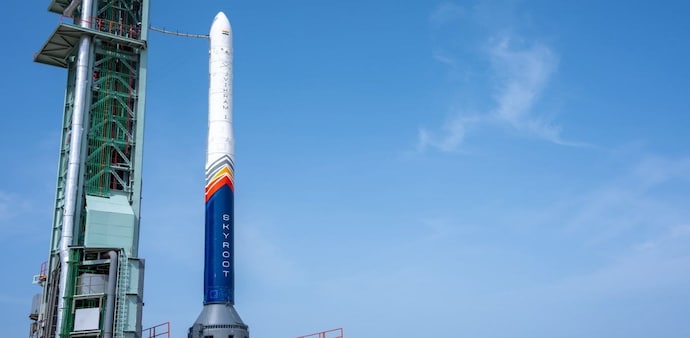
Fresh off the successful orbital launch of Vikram-1, Skyroot Aerospace has already started work on a much larger reusable rocket, signalling the next stage of the Hyderabad-based startup's ambitions in the commercial space sector.
The company, which made history with India's first privately developed rocket to reach orbit, plans to continue focusing on the Vikram launch vehicle in the near term while developing a reusable system for the future.
"We're already developing a reusable vehicle," Skyroot co-founder and chief executive Pawan Kumar Chandana told Moneycontrol. "It will be a much larger rocket, and that will come in a few years."
The remarks offer the first glimpse into Skyroot's long-term plans following the maiden orbital flight of Vikram-1.
For now, however, the company remains focused on scaling the Vikram family of rockets. Chandana said the seven-storey-tall Vikram-1 was deliberately designed as an expendable launch vehicle because it caters to a specific segment of the launch market.
Don't Miss: 'MoD should partner with Skyroot': Ex-Army Commander wants Indian military to dominate LEO surveillance
"Our market is very clear," he said. "We're the 'cab to space'! Customers come to us when they need a dedicated launch into a specific orbit."
Unlike heavy-lift launch providers that carry multiple satellites on rideshare missions, Skyroot is targeting customers that require precise orbital insertion for smaller payloads.
Chandana has previously said that 70-80 percent of the company's future demand is expected to come from international customers, where dedicated launch opportunities remain limited.
He added that reusable rockets become commercially viable at larger scales.
"As rockets become bigger, the hardware becomes much more expensive. That's where reusability starts making commercial sense," he said.
Even as it develops its next-generation launch vehicle, Skyroot is preparing for another Vikram-1 mission.
According to Chandana, the company hopes to conduct the next flight later this year. Before that, engineers will analyse data from the maiden mission to assess whether any design changes are necessary.
"The hardware is already in the last stage of manufacturing," he said. "We'll study the flight data, see if any improvements are needed, and then decide whether the next mission is another demonstration or our first commercial launch."
Fresh off the successful orbital launch of Vikram-1, Skyroot Aerospace has already started work on a much larger reusable rocket, signalling the next stage of the Hyderabad-based startup's ambitions in the commercial space sector.
The company, which made history with India's first privately developed rocket to reach orbit, plans to continue focusing on the Vikram launch vehicle in the near term while developing a reusable system for the future.
"We're already developing a reusable vehicle," Skyroot co-founder and chief executive Pawan Kumar Chandana told Moneycontrol. "It will be a much larger rocket, and that will come in a few years."
The remarks offer the first glimpse into Skyroot's long-term plans following the maiden orbital flight of Vikram-1.
For now, however, the company remains focused on scaling the Vikram family of rockets. Chandana said the seven-storey-tall Vikram-1 was deliberately designed as an expendable launch vehicle because it caters to a specific segment of the launch market.
Don't Miss: 'MoD should partner with Skyroot': Ex-Army Commander wants Indian military to dominate LEO surveillance
"Our market is very clear," he said. "We're the 'cab to space'! Customers come to us when they need a dedicated launch into a specific orbit."
Unlike heavy-lift launch providers that carry multiple satellites on rideshare missions, Skyroot is targeting customers that require precise orbital insertion for smaller payloads.
Chandana has previously said that 70-80 percent of the company's future demand is expected to come from international customers, where dedicated launch opportunities remain limited.
He added that reusable rockets become commercially viable at larger scales.
"As rockets become bigger, the hardware becomes much more expensive. That's where reusability starts making commercial sense," he said.
Even as it develops its next-generation launch vehicle, Skyroot is preparing for another Vikram-1 mission.
According to Chandana, the company hopes to conduct the next flight later this year. Before that, engineers will analyse data from the maiden mission to assess whether any design changes are necessary.
"The hardware is already in the last stage of manufacturing," he said. "We'll study the flight data, see if any improvements are needed, and then decide whether the next mission is another demonstration or our first commercial launch."