
ISRO, JAXA to partner for Chandrayaan-5, says PM Modi. Details on lunar mission here
The partnership is expected to enhance technological capabilities in both nations and provide practical applications on Earth.
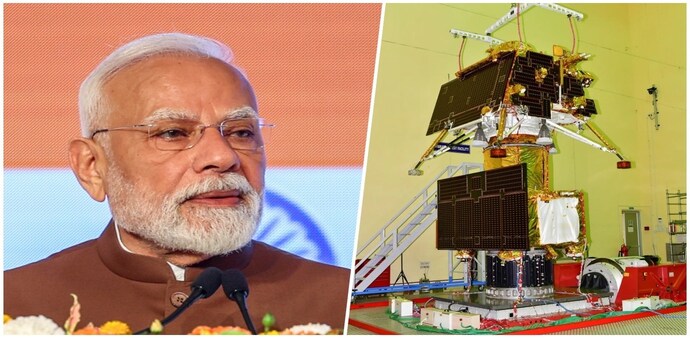
- Aug 29, 2025,
- Updated Aug 29, 2025 6:33 PM IST
In a landmark development for space exploration, India and Japan have announced a partnership for the Chandrayaan-5 mission. The collaboration was confirmed by Prime Minister Narendra Modi during the 15th India-Japan Annual Summit in Tokyo.
"For cooperation in Chandrayaan 5 Mission, we welcome the agreement between ISRO and JAXA. Our active cooperation will cross the boundaries of the earth and become a symbol of humanity's progress in space," said PM Modi in his address.
PM Modi expressed his enthusiasm for the joint mission, stating, "I am glad that India and Japan are joining hands for the next edition of the Chandrayaan series or the LUPEX (Lunar Polar Exploration) mission." The mission intends to explore the Moon's south pole, expanding our understanding of the lunar surface.
PM Modi emphasised the broader impact of this cooperation, saying, "I am confident that our scientific teams will be working together to push the boundaries of space science. And, our partnership in space will not only expand horizons above us, but also improve lives around us."
The partnership is expected to enhance technological capabilities in both nations and provide practical applications on Earth.
Here's what we know about Chandrayaan-5 so far
- This is the fifth mission in India's Chandrayaan series and the first one to involve JAXA.
- Approved by India on March 10, 2025, this Indo-Japanese project is part of a roadmap aiming for Indian astronauts on the Moon by 2040.
- It follows Chandrayaan-4, set for launch in 2027 as India’s first lunar sample return mission.
- The Chandrayaan-5 would be launched aboard JAXA's H-324L rocket and will carry a lander developed by ISRO.
- The mission's main objective is to probe the Moon's south polar region, especially permanently shadowed areas that are believed to harbour water and water-ice.
- The LUPEX has a 6.5-tonne payload, including a 250kg rover, which is 10 times heavier than Chandrayaan-3's Pragyan rover.
- It is designed for rigorous surface analysis and scientific experiments. The payload will include instruments from ISRO, JAXA, NASA, and the European Space Agency, focused on the volatile-rich lunar polar region.
- Its rover is equipped with tools like water analysers, spectrometers, a ground-penetrating radar, and a 1.5-meter drill. Chandrayaan-5's rover will sample lunar regolith to assess water content and its potential for future use.
- The rover is expected to operate for 100 days and is likely to extend its mission to a full year based on its performance.
- While ISRO will handle the lander and contribute key scientific tools, its international partners will add advanced instrumentation such as neutron and mass spectrometers.
In a landmark development for space exploration, India and Japan have announced a partnership for the Chandrayaan-5 mission. The collaboration was confirmed by Prime Minister Narendra Modi during the 15th India-Japan Annual Summit in Tokyo.
"For cooperation in Chandrayaan 5 Mission, we welcome the agreement between ISRO and JAXA. Our active cooperation will cross the boundaries of the earth and become a symbol of humanity's progress in space," said PM Modi in his address.
PM Modi expressed his enthusiasm for the joint mission, stating, "I am glad that India and Japan are joining hands for the next edition of the Chandrayaan series or the LUPEX (Lunar Polar Exploration) mission." The mission intends to explore the Moon's south pole, expanding our understanding of the lunar surface.
PM Modi emphasised the broader impact of this cooperation, saying, "I am confident that our scientific teams will be working together to push the boundaries of space science. And, our partnership in space will not only expand horizons above us, but also improve lives around us."
The partnership is expected to enhance technological capabilities in both nations and provide practical applications on Earth.
Here's what we know about Chandrayaan-5 so far
- This is the fifth mission in India's Chandrayaan series and the first one to involve JAXA.
- Approved by India on March 10, 2025, this Indo-Japanese project is part of a roadmap aiming for Indian astronauts on the Moon by 2040.
- It follows Chandrayaan-4, set for launch in 2027 as India’s first lunar sample return mission.
- The Chandrayaan-5 would be launched aboard JAXA's H-324L rocket and will carry a lander developed by ISRO.
- The mission's main objective is to probe the Moon's south polar region, especially permanently shadowed areas that are believed to harbour water and water-ice.
- The LUPEX has a 6.5-tonne payload, including a 250kg rover, which is 10 times heavier than Chandrayaan-3's Pragyan rover.
- It is designed for rigorous surface analysis and scientific experiments. The payload will include instruments from ISRO, JAXA, NASA, and the European Space Agency, focused on the volatile-rich lunar polar region.
- Its rover is equipped with tools like water analysers, spectrometers, a ground-penetrating radar, and a 1.5-meter drill. Chandrayaan-5's rover will sample lunar regolith to assess water content and its potential for future use.
- The rover is expected to operate for 100 days and is likely to extend its mission to a full year based on its performance.
- While ISRO will handle the lander and contribute key scientific tools, its international partners will add advanced instrumentation such as neutron and mass spectrometers.