
NASA invites people worldwide to mark Voyager 1's one light-day milestone; check how to take part
Participants can use a dedicated online tool on their smartphones or tablets to flash the letters V-G-R, Voyager's call sign, in Morse code
- Nov 14, 2026,
- Updated Nov 14, 2026 12:10 AM IST
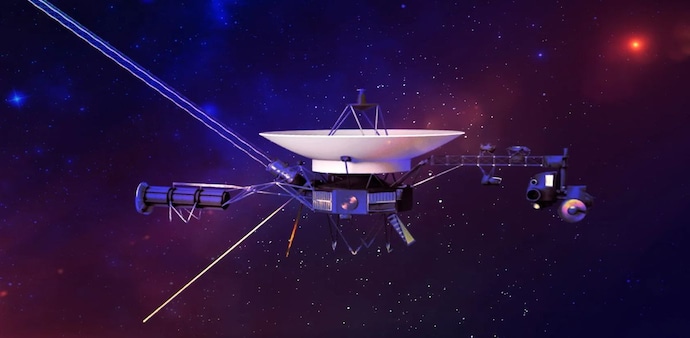
NASA has invited people around the world to participate in a unique celebration as Voyager 1, the farthest human-made object from Earth, approaches a historic milestone by travelling one light-day away from our planet.
Launched in 1977, Voyager 1 is expected to reach the milestone on Wednesday, November 18, when it will be more than 16 billion miles (25.9 billion kilometres) from Earth. At this distance, light travelling from Earth would take approximately 24 hours to reach the spacecraft, highlighting the extraordinary scale of its journey into deep space.
According to NASA, the milestone will be marked through two events designed to engage the public and celebrate nearly five decades of space exploration.
NASA's 'Shine Bright for Voyager' campaign
The first event, titled Shine Bright for Voyager's Light-Day, will take place after sunset on Tuesday, November 17. NASA is encouraging people worldwide to shine lights towards the sky, creating a symbolic wave of golden light to celebrate humanity's farthest-reaching spacecraft.
Participants can use a dedicated online tool on their smartphones or tablets to flash the letters V-G-R, Voyager's call sign, in Morse code. Alternatively, they can use a flashlight, phone light, lantern or other light source to send the signal manually.
NASA has also encouraged participants to capture photographs and videos of their signals and share them on social media, tagging the agency. The initiative aims to bring people together to recognise the spacecraft's remarkable journey across the universe.
DON'T MISS: Want to become an astronaut? NASA opens applications; check eligibility and deadline
NASA to host Voyager mission discussion
The second event will take place on Thursday, November 19, at 12 pm EST (9 am PST). NASA's Jet Propulsion Laboratory (JPL) in Southern California will host a moderated discussion featuring mission officials, scientists and agency leadership.
The discussion will cover the status of Voyager 1 and its twin, Voyager 2, the scientific observations they continue to make in interstellar space, and the challenges of operating spacecraft across such vast distances. A question-and-answer session with media representatives and other audience members will follow.
NASA will also offer a preview of its upcoming Voyager documentary, scheduled for release in 2027 to mark the mission's 50th anniversary.
ALSO READ: NASA unveils X-70 Fractal experimental aircraft: What makes it special and what will it test?
Voyager's continuing scientific legacy
Voyager 1 and Voyager 2 were launched to explore the outer planets during a rare planetary alignment. Voyager 1 entered interstellar space in 2012, followed by Voyager 2 in 2018.
Both spacecraft continue to provide valuable observations of the region beyond the heliosphere, the protective bubble formed by the Sun's particles and magnetic fields.