
Nobel Chemistry Prize 2026 goes to Henri B. Kagan, Kenso Soai. What is asymmetric autocatalysis?
Their work centres on chirality, a fundamental property of many molecules. Chiral molecules exist in two mirror-image forms, known as enantiomers
- Oct 7, 2026,
- Updated Oct 7, 2026 3:32 PM IST
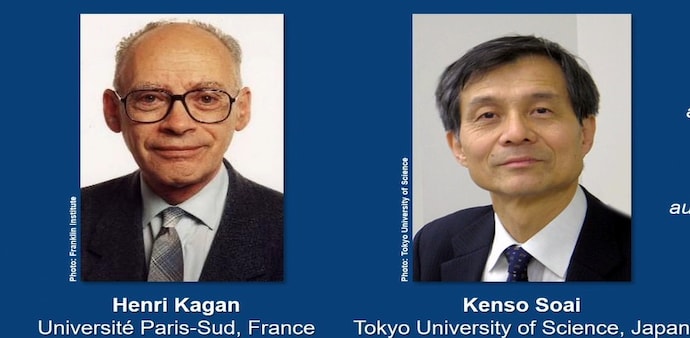
French chemist Henri B. Kagan and Japanese chemist Kenso Soai have been awarded the 2026 Nobel Prize in Chemistry for pioneering discoveries on non-linear effects and asymmetric autocatalysis in organic synthesis.
The Royal Swedish Academy of Sciences announced the award on Wednesday, recognising research that has advanced scientists’ understanding of how chemical reactions can favour one of two mirror-image forms of a molecule.
Their work centres on chirality, a fundamental property of many molecules. Chiral molecules exist in two mirror-image forms, known as enantiomers. Although these forms have the same chemical composition, they can behave very differently in biological systems. This makes the ability to selectively produce one form particularly important in pharmaceuticals, medicine and organic chemistry.
Henri B. Kagan and non-linear effects
Kagan, a French pioneer of asymmetric catalysis, demonstrated that the relationship between the composition of a chiral catalyst and the chirality of the resulting product does not necessarily follow a simple, linear pattern.
In conventional thinking, a small difference in the proportion of one molecular form in a catalyst would be expected to produce a similarly small difference in the final product. Kagan’s research showed that this assumption can be wrong.
His studies revealed that a catalyst with only a small excess of one mirror-image form can sometimes generate a product with a much larger degree of molecular asymmetry. This phenomenon became known as a non-linear effect.
Research involving Kagan in the late 1980s and 1990s helped establish the importance of these effects in asymmetric synthesis. The discovery showed chemists that relatively small amounts of a chiral catalyst could be used to selectively produce larger quantities of a preferred molecular form.
This has particular significance for the pharmaceutical industry, where producing the correct enantiomer can be critical because different mirror-image molecules may interact differently with the human body.
Kenso Soai and asymmetric autocatalysis
Japanese chemist Kenso Soai, a professor at the Tokyo University of Science, was recognised for his pioneering work on asymmetric autocatalysis.
Autocatalysis occurs when a product of a chemical reaction also acts as a catalyst, helping produce more of the same product. Soai demonstrated that this mechanism could amplify an extremely small initial imbalance in molecular handedness, eventually generating highly enriched chiral compounds.
ALSO READ: Nobel Prize in Physics 2026: Francis Halzen wins for IceCube Neutrino Observatory work
His research became particularly famous through what is now known as the Soai reaction. It remains one of the most powerful experimental examples of asymmetric autocatalysis.
Beyond synthetic chemistry, Soai’s work has also attracted interest in questions surrounding the origin of biological homochirality, the predominance of one molecular handedness in living organisms. Scientists have explored whether similar amplification mechanisms could have helped explain how small initial asymmetries in prebiotic chemistry became amplified in nature.
Together, Kagan’s work on non-linear effects and Soai’s research on asymmetric autocatalysis showed how tiny molecular imbalances can be amplified into much larger chemical asymmetries, providing important insights for modern synthesis and the study of molecular chirality.
French chemist Henri B. Kagan and Japanese chemist Kenso Soai have been awarded the 2026 Nobel Prize in Chemistry for pioneering discoveries on non-linear effects and asymmetric autocatalysis in organic synthesis.
The Royal Swedish Academy of Sciences announced the award on Wednesday, recognising research that has advanced scientists’ understanding of how chemical reactions can favour one of two mirror-image forms of a molecule.
Their work centres on chirality, a fundamental property of many molecules. Chiral molecules exist in two mirror-image forms, known as enantiomers. Although these forms have the same chemical composition, they can behave very differently in biological systems. This makes the ability to selectively produce one form particularly important in pharmaceuticals, medicine and organic chemistry.
Henri B. Kagan and non-linear effects
Kagan, a French pioneer of asymmetric catalysis, demonstrated that the relationship between the composition of a chiral catalyst and the chirality of the resulting product does not necessarily follow a simple, linear pattern.
In conventional thinking, a small difference in the proportion of one molecular form in a catalyst would be expected to produce a similarly small difference in the final product. Kagan’s research showed that this assumption can be wrong.
His studies revealed that a catalyst with only a small excess of one mirror-image form can sometimes generate a product with a much larger degree of molecular asymmetry. This phenomenon became known as a non-linear effect.
Research involving Kagan in the late 1980s and 1990s helped establish the importance of these effects in asymmetric synthesis. The discovery showed chemists that relatively small amounts of a chiral catalyst could be used to selectively produce larger quantities of a preferred molecular form.
This has particular significance for the pharmaceutical industry, where producing the correct enantiomer can be critical because different mirror-image molecules may interact differently with the human body.
Kenso Soai and asymmetric autocatalysis
Japanese chemist Kenso Soai, a professor at the Tokyo University of Science, was recognised for his pioneering work on asymmetric autocatalysis.
Autocatalysis occurs when a product of a chemical reaction also acts as a catalyst, helping produce more of the same product. Soai demonstrated that this mechanism could amplify an extremely small initial imbalance in molecular handedness, eventually generating highly enriched chiral compounds.
ALSO READ: Nobel Prize in Physics 2026: Francis Halzen wins for IceCube Neutrino Observatory work
His research became particularly famous through what is now known as the Soai reaction. It remains one of the most powerful experimental examples of asymmetric autocatalysis.
Beyond synthetic chemistry, Soai’s work has also attracted interest in questions surrounding the origin of biological homochirality, the predominance of one molecular handedness in living organisms. Scientists have explored whether similar amplification mechanisms could have helped explain how small initial asymmetries in prebiotic chemistry became amplified in nature.
Together, Kagan’s work on non-linear effects and Soai’s research on asymmetric autocatalysis showed how tiny molecular imbalances can be amplified into much larger chemical asymmetries, providing important insights for modern synthesis and the study of molecular chirality.