
Pakistan launches China-backed 6 Earth-observation satellites in 16 months, now watching Indian territory
Crucially, the launches began before the Pahalgam attack and India's subsequent military response. The pace, the technology, and the Chinese backing involved suggest this is not a reactive development; it is a strategic one
- Jun 10, 2026,
- Updated Jun 10, 2026 11:18 AM IST
The military standoff following Operation Sindoor may have de-escalated on the ground, but a more silent and consequential competition has been building in orbit.
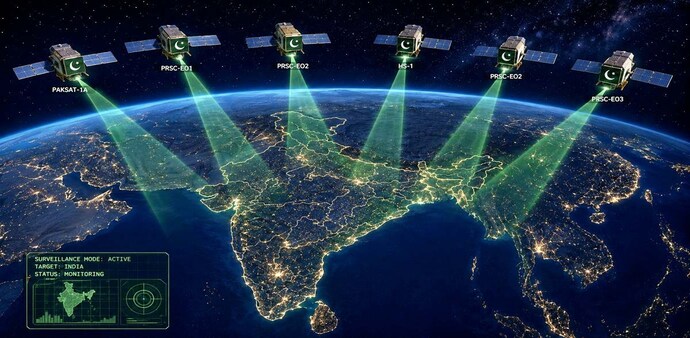
In the 16 months between January 2025 and April 2026, Pakistan launched six Earth-observation satellites, a burst of activity that stands in stark contrast to the handful of satellites it had launched across the preceding six decades since establishing SUPARCO in 1961.
Crucially, the launches began before the Pahalgam attack and India's subsequent military response. The pace, the technology, and the Chinese backing involved suggest this is not a reactive development; it is a strategic one.
What the constellation can do
The six satellites launched include optical imaging, hyperspectral, and remote-sensing platforms. Taken individually, each is significant. Taken together, analysts say they represent something more consequential.
Rear Admiral Sudhir Pillai, a former flag officer of the Indian Navy, offered a pointed assessment in a blog post analysing the launches. "The constellation that has emerged from this sixteen-month burst is not a civilian earth observation system that happens to have military applications on the side. Its orbital architecture, its sensor complement, and above all its institutional provenance tell a different and more consequential story," he wrote.
The constellation is reportedly capable of capturing high-resolution imagery, detecting changes on the ground, identifying camouflaged objects, and conducting persistent surveillance over areas of strategic interest. Pakistan's hyperspectral satellite HS-1, launched in October 2025, adds a further layer, as it can distinguish between materials and identify objects that escape conventional optical sensors. More recent satellites, such as PRSC-EO2 and PRSC-EO3, incorporate advanced imaging and AI-assisted data processing.
China's role
China's fingerprints are visible across the entire programme. Several satellites were launched aboard Chinese rockets, while others were developed through collaborations between Pakistani and Chinese entities. Analysts believe the partnership extends well beyond launch services into technology transfer, satellite design, and data-sharing arrangements.
A particularly telling case is PRSC-EO3, launched in April 2026. Independent analysis by US-based space situational awareness firm COMSPOC found the satellite had been placed in an orbit specifically optimised for repeated observations over South Asia rather than global coverage, allowing more frequent passes over Pakistan, northern India, and Jammu and Kashmir, potentially enabling multiple observations per day.
Combined with China's own Earth-observation networks, including the Yaogan and Gaofen satellite series, the arrangement could significantly enhance Pakistan's intelligence-gathering picture of Indian military deployments, infrastructure, and strategic activity across the subcontinent.
Why this matters for India
The development arrives at a sensitive moment. ISRO has faced setbacks in recent years involving strategic satellite missions, including failures affecting Earth-observation and navigation programmes. While India remains a considerably more advanced space power overall, analysts warn that strategic attention must keep pace with the rapidly evolving military-space capabilities taking shape in the neighbourhood.
The broader implication for defence planners is one that is increasingly hard to ignore: future conflicts in South Asia may be shaped as much by who controls information from orbit as by the weapons deployed on the ground.
The military standoff following Operation Sindoor may have de-escalated on the ground, but a more silent and consequential competition has been building in orbit.
In the 16 months between January 2025 and April 2026, Pakistan launched six Earth-observation satellites, a burst of activity that stands in stark contrast to the handful of satellites it had launched across the preceding six decades since establishing SUPARCO in 1961.
Crucially, the launches began before the Pahalgam attack and India's subsequent military response. The pace, the technology, and the Chinese backing involved suggest this is not a reactive development; it is a strategic one.
What the constellation can do
The six satellites launched include optical imaging, hyperspectral, and remote-sensing platforms. Taken individually, each is significant. Taken together, analysts say they represent something more consequential.
Rear Admiral Sudhir Pillai, a former flag officer of the Indian Navy, offered a pointed assessment in a blog post analysing the launches. "The constellation that has emerged from this sixteen-month burst is not a civilian earth observation system that happens to have military applications on the side. Its orbital architecture, its sensor complement, and above all its institutional provenance tell a different and more consequential story," he wrote.
The constellation is reportedly capable of capturing high-resolution imagery, detecting changes on the ground, identifying camouflaged objects, and conducting persistent surveillance over areas of strategic interest. Pakistan's hyperspectral satellite HS-1, launched in October 2025, adds a further layer, as it can distinguish between materials and identify objects that escape conventional optical sensors. More recent satellites, such as PRSC-EO2 and PRSC-EO3, incorporate advanced imaging and AI-assisted data processing.
China's role
China's fingerprints are visible across the entire programme. Several satellites were launched aboard Chinese rockets, while others were developed through collaborations between Pakistani and Chinese entities. Analysts believe the partnership extends well beyond launch services into technology transfer, satellite design, and data-sharing arrangements.
A particularly telling case is PRSC-EO3, launched in April 2026. Independent analysis by US-based space situational awareness firm COMSPOC found the satellite had been placed in an orbit specifically optimised for repeated observations over South Asia rather than global coverage, allowing more frequent passes over Pakistan, northern India, and Jammu and Kashmir, potentially enabling multiple observations per day.
Combined with China's own Earth-observation networks, including the Yaogan and Gaofen satellite series, the arrangement could significantly enhance Pakistan's intelligence-gathering picture of Indian military deployments, infrastructure, and strategic activity across the subcontinent.
Why this matters for India
The development arrives at a sensitive moment. ISRO has faced setbacks in recent years involving strategic satellite missions, including failures affecting Earth-observation and navigation programmes. While India remains a considerably more advanced space power overall, analysts warn that strategic attention must keep pace with the rapidly evolving military-space capabilities taking shape in the neighbourhood.
The broader implication for defence planners is one that is increasingly hard to ignore: future conflicts in South Asia may be shaped as much by who controls information from orbit as by the weapons deployed on the ground.