
Rare reversal: After years of sinking, land in Delhi's Dwarka lifting again
Land subsidence in Dwarka has not only stopped but reversed in certain parts
- Oct 30, 2025,
- Updated Oct 30, 2025 6:56 PM IST
In a rare reversal, land in Dwarka, once one of Delhi's most groundwater-stressed areas, is rising again. According to research by ISRO, IIT Kanpur, IIT (ISM) Dhanbad, and the University of Miami, satellite data from October 2014 to October 2023 reveals that the land, which had been sinking for years as aquifers ran dry, has started to lift-an early sign of groundwater recovery.
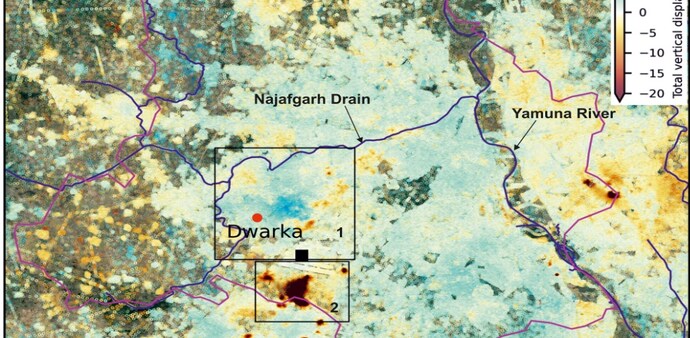
For years, southwest Delhi's Dwarka area experienced gradual land subsidence, as its aquifers ran dry. However, recent findings suggest a rare but promising shift. The study, titled InSAR Reveals Recovery of Stressed Aquifer Systems in Parts of Delhi, India, published in Water Resources Research, found that land subsidence in Dwarka has not only stopped but reversed in certain parts. The research shows that since mid-2016, the land in Dwarka has lifted by 5 to 10 centimetres, with a rise of up to 2 centimetres per year across nearly 4 square kilometres of land.
The researchers, including scientists from ISRO and IITs, said this upward shift in land levels is indicative of refilling underground aquifers, signaling that groundwater is slowly recovering. The study highlighted that groundwater storage in Dwarka increased by roughly 2-7 billion litres annually between 2016 and 2023, enough to meet the water needs of an entire Delhi neighbourhood or fill hundreds of Olympic-sized swimming pools.
The research points to the significant impact of Delhi's 2016 groundwater policy, which imposed restrictions on new borewells, mandated rainwater harvesting, and required housing projects to incorporate recharge structures. This policy, the study suggests, has likely contributed to the stabilization of Delhi's overdrawn aquifers.
Groundwater levels across the city rose by more than 1.5 metres between 2018 and 2021, despite a drop in rainfall during that period. "The sustained rise in groundwater level during 2018-2021, despite decreasing rainfall, provides strong evidence for substantial recovery of groundwater resources through improved management," the paper noted.
However, the situation remains mixed across the region. In contrast to the positive trends in Dwarka, areas such as Faridabad are facing worsening conditions. The study found that land subsidence in Faridabad has accelerated, with the sinking rate doubling from about 2 cm per year before 2017 to nearly 4-5 cm per year since. This alarming trend is attributed to continued over-extraction of groundwater for domestic and industrial use.
Elsewhere, in Gurgaon, the pace of land sinking has slowed significantly. Between 2014 and 2018, the city's central areas experienced subsidence of 15 cm per year. Since 2018, this rate has reduced to around 10 cm annually, with the southern parts seeing a decline from 6 cm per year to just 2 cm per year. The study explained that this slowdown in subsidence indicates that the underground water system is stabilizing, likely due to a reduction in extraction and an increase in recharge.
(With inputs from PTI)
In a rare reversal, land in Dwarka, once one of Delhi's most groundwater-stressed areas, is rising again. According to research by ISRO, IIT Kanpur, IIT (ISM) Dhanbad, and the University of Miami, satellite data from October 2014 to October 2023 reveals that the land, which had been sinking for years as aquifers ran dry, has started to lift-an early sign of groundwater recovery.
For years, southwest Delhi's Dwarka area experienced gradual land subsidence, as its aquifers ran dry. However, recent findings suggest a rare but promising shift. The study, titled InSAR Reveals Recovery of Stressed Aquifer Systems in Parts of Delhi, India, published in Water Resources Research, found that land subsidence in Dwarka has not only stopped but reversed in certain parts. The research shows that since mid-2016, the land in Dwarka has lifted by 5 to 10 centimetres, with a rise of up to 2 centimetres per year across nearly 4 square kilometres of land.
The researchers, including scientists from ISRO and IITs, said this upward shift in land levels is indicative of refilling underground aquifers, signaling that groundwater is slowly recovering. The study highlighted that groundwater storage in Dwarka increased by roughly 2-7 billion litres annually between 2016 and 2023, enough to meet the water needs of an entire Delhi neighbourhood or fill hundreds of Olympic-sized swimming pools.
The research points to the significant impact of Delhi's 2016 groundwater policy, which imposed restrictions on new borewells, mandated rainwater harvesting, and required housing projects to incorporate recharge structures. This policy, the study suggests, has likely contributed to the stabilization of Delhi's overdrawn aquifers.
Groundwater levels across the city rose by more than 1.5 metres between 2018 and 2021, despite a drop in rainfall during that period. "The sustained rise in groundwater level during 2018-2021, despite decreasing rainfall, provides strong evidence for substantial recovery of groundwater resources through improved management," the paper noted.
However, the situation remains mixed across the region. In contrast to the positive trends in Dwarka, areas such as Faridabad are facing worsening conditions. The study found that land subsidence in Faridabad has accelerated, with the sinking rate doubling from about 2 cm per year before 2017 to nearly 4-5 cm per year since. This alarming trend is attributed to continued over-extraction of groundwater for domestic and industrial use.
Elsewhere, in Gurgaon, the pace of land sinking has slowed significantly. Between 2014 and 2018, the city's central areas experienced subsidence of 15 cm per year. Since 2018, this rate has reduced to around 10 cm annually, with the southern parts seeing a decline from 6 cm per year to just 2 cm per year. The study explained that this slowdown in subsidence indicates that the underground water system is stabilizing, likely due to a reduction in extraction and an increase in recharge.
(With inputs from PTI)