
The coldest place on the ISS isn't space — it's where tomorrow's discoveries are kept
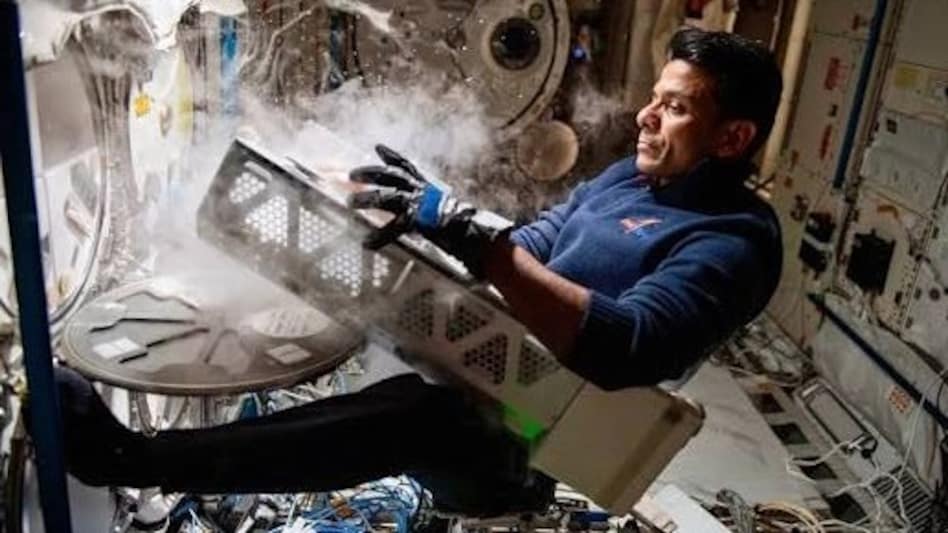
Astronaut and ISRO Gaganyatri Shubhanshu Shukla highlighted the importance of the system in a post on X, explaining why biological samples collected in orbit must be stored at ultra-low temperatures before returning to Earth.
- Jul 2, 2026,
- Updated Jul 2, 2026 2:34 PM IST
Space experiments do not end when astronauts finish collecting data. For many biological investigations aboard the International Space Station (ISS), the most critical phase begins after the observations are complete — keeping samples unchanged until they reach scientists on Earth. That is where MELFI, the Minus Eighty-Degree Laboratory Freezer for the ISS, plays a crucial role.
Astronaut and ISRO Gaganyatri Shubhanshu Shukla highlighted the importance of the system in a post on X, explaining why biological samples collected in orbit must be stored at ultra-low temperatures before returning to Earth.
"How do you bring science back from space without compromising the results?" Shukla wrote. "That is where MELFI (Minus Eighty-Degree Laboratory Freezer for ISS) comes in."
He explained that many biological experiments aboard the ISS do not conclude in orbit. Instead, researchers on Earth perform detailed laboratory analyses after the samples are returned. To ensure the findings remain scientifically valid, astronauts transfer the specimens into MELFI, where they are preserved at around -80°C.
What is MELFI?
MELFI, short for Minus Eighty-Degree Laboratory Freezer for the International Space Station, is an advanced cold-storage system developed by the European Space Agency (ESA) for use aboard the ISS. It serves as a temperature-controlled repository for biological and life-science samples, including blood, saliva, urine, microbial cultures, plant material and other research specimens collected during space missions.
The freezer consists of four independently controlled, vacuum-insulated compartments (dewars), each capable of operating at different temperatures depending on experiment requirements. Together, they provide about 300 litres of storage capacity, allowing scientists to preserve multiple experiments simultaneously.
Why does MELFI store samples at -80°C?
According to Shukla, the answer lies in biology. Even below the freezing point, biological and biochemical reactions do not stop completely. At temperatures such as -10°C or the -20°C commonly used in laboratory freezers, slow chemical changes can continue over time. These subtle changes may alter proteins, enzymes, DNA, cells or other biological material, potentially affecting the accuracy of scientific analysis.
Cooling samples to around -80°C dramatically slows these processes, preserving them in a state that is as close as possible to how they existed aboard the ISS. This helps ensure that any differences observed by researchers on Earth are the result of spaceflight itself — not changes that occurred during storage or transport.
As Shukla noted, "Sometimes, the most important part of a space experiment isn't just conducting it in space — it's making sure the science makes it safely back to Earth."
More than just a freezer
While MELFI is often described as a freezer, it is a sophisticated piece of scientific infrastructure. The system is designed not only to preserve samples during their stay aboard the ISS but also to maintain them under controlled temperatures until they can be transported back to Earth for detailed examination.
NASA says the freezer supports a broad range of life-science research and can preserve samples throughout their journey between Earth and the ISS, significantly expanding the station's scientific capabilities. Depending on mission requirements, the insulated compartments can be configured for different temperature settings, allowing multiple experiments with varying storage needs to be housed in a single unit.
Many discoveries from the ISS cannot be confirmed using equipment available in orbit alone. Sophisticated genomic sequencing, molecular analysis, pathology studies and other advanced laboratory techniques are carried out only after samples return to Earth.
Without a system like MELFI, valuable biological specimens could degrade before scientists have the opportunity to analyse them, reducing the reliability of months — or even years — of research.
Space experiments do not end when astronauts finish collecting data. For many biological investigations aboard the International Space Station (ISS), the most critical phase begins after the observations are complete — keeping samples unchanged until they reach scientists on Earth. That is where MELFI, the Minus Eighty-Degree Laboratory Freezer for the ISS, plays a crucial role.
Astronaut and ISRO Gaganyatri Shubhanshu Shukla highlighted the importance of the system in a post on X, explaining why biological samples collected in orbit must be stored at ultra-low temperatures before returning to Earth.
"How do you bring science back from space without compromising the results?" Shukla wrote. "That is where MELFI (Minus Eighty-Degree Laboratory Freezer for ISS) comes in."
He explained that many biological experiments aboard the ISS do not conclude in orbit. Instead, researchers on Earth perform detailed laboratory analyses after the samples are returned. To ensure the findings remain scientifically valid, astronauts transfer the specimens into MELFI, where they are preserved at around -80°C.
What is MELFI?
MELFI, short for Minus Eighty-Degree Laboratory Freezer for the International Space Station, is an advanced cold-storage system developed by the European Space Agency (ESA) for use aboard the ISS. It serves as a temperature-controlled repository for biological and life-science samples, including blood, saliva, urine, microbial cultures, plant material and other research specimens collected during space missions.
The freezer consists of four independently controlled, vacuum-insulated compartments (dewars), each capable of operating at different temperatures depending on experiment requirements. Together, they provide about 300 litres of storage capacity, allowing scientists to preserve multiple experiments simultaneously.
Why does MELFI store samples at -80°C?
According to Shukla, the answer lies in biology. Even below the freezing point, biological and biochemical reactions do not stop completely. At temperatures such as -10°C or the -20°C commonly used in laboratory freezers, slow chemical changes can continue over time. These subtle changes may alter proteins, enzymes, DNA, cells or other biological material, potentially affecting the accuracy of scientific analysis.
Cooling samples to around -80°C dramatically slows these processes, preserving them in a state that is as close as possible to how they existed aboard the ISS. This helps ensure that any differences observed by researchers on Earth are the result of spaceflight itself — not changes that occurred during storage or transport.
As Shukla noted, "Sometimes, the most important part of a space experiment isn't just conducting it in space — it's making sure the science makes it safely back to Earth."
More than just a freezer
While MELFI is often described as a freezer, it is a sophisticated piece of scientific infrastructure. The system is designed not only to preserve samples during their stay aboard the ISS but also to maintain them under controlled temperatures until they can be transported back to Earth for detailed examination.
NASA says the freezer supports a broad range of life-science research and can preserve samples throughout their journey between Earth and the ISS, significantly expanding the station's scientific capabilities. Depending on mission requirements, the insulated compartments can be configured for different temperature settings, allowing multiple experiments with varying storage needs to be housed in a single unit.
Many discoveries from the ISS cannot be confirmed using equipment available in orbit alone. Sophisticated genomic sequencing, molecular analysis, pathology studies and other advanced laboratory techniques are carried out only after samples return to Earth.
Without a system like MELFI, valuable biological specimens could degrade before scientists have the opportunity to analyse them, reducing the reliability of months — or even years — of research.