
This 24-carat pink diamond from India just sold for ₹1,300 crore: Know why it is called the ‘Mona Lisa’ of diamonds
The diamond is a Type-IIa stone, an extremely rare category that contains no measurable nitrogen or boron impurities
- Nov 13, 2026,
- Updated Nov 13, 2026 5:00 AM IST
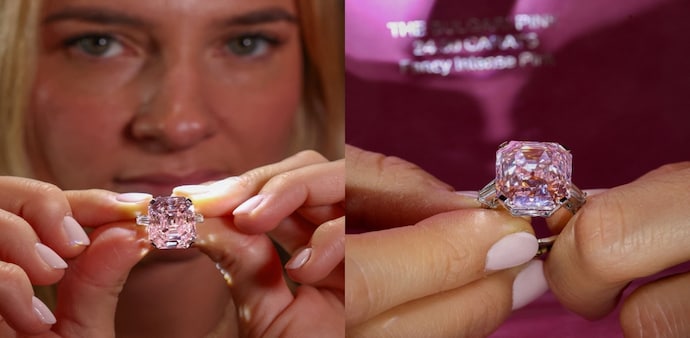
A rare 24-carat pink diamond known as the ‘Bulgari Pink’ has sold for $14.6 million (around ₹1,300 crore) at an auction in Geneva. The emerald-cut diamond, described as the ‘Mona Lisa of pink diamonds’, had remained in the same private family collection for more than 70 years, The Daily Mail reported on Wednesday.
The diamond was bought from India’s famous Golconda mines in the 1950s. The mines were also the source of some of history’s most celebrated diamonds, including the Koh-i-Noor set in the Queen Mother’s crown.
The diamond is a Type-IIa stone, an extremely rare category that contains no measurable nitrogen or boron impurities. It is also classified as ‘Fancy Intense Pink’, a highly sought-after colour grade.
Dr Wuyi Wang, senior vice-president of research and identification at the Gemological Institute of America, said: 'Pink diamonds are rare, but one of this size and quality is very rare among gemstones.
'Most of the natural pink diamonds examined by GIA are less than a single carat.
'The Bulgari Pink is 24.00 carats, with a Fancy Intense Pink color and VVS2 clarity.'
The stone was bought by the seller’s great grandparents in the 1950s and later taken to Bulgari in Rome to be set.
Ahead of the Christie’s Geneva auction, Max Fawcett, the auction house’s global head of jewellery, called it ‘the Mona Lisa of pink diamonds’.
Diamond sells within expected range
The diamond had been expected to fetch 10-15 million Swiss francs (£8.8million-£13.3million). It eventually sold for 12.1 million Swiss francs, or $14.6 million.
Christie’s said Bulgari was emerging as a major destination for collectors in the 1950s, when Rome was becoming a centre of post-war glamour.
Don't Miss: ‘Supercharging our weather..’: WMO says coming months will see exceptionally high temperatures
The diamond’s colour is linked to nitrogen vacancy centres. Dr Wang said: 'Its color is caused by nitrogen vacancy centers, a truly special feature of natural pink diamonds.
'Its emerald cut, with broad, open facets reveals rather than conceals the diamond's internal characteristics, making this a captivating example of nature's ability to create something extraordinary.'
Another rare pink diamond found in Botswana
The auction comes shortly after a 37.4-carat half-pink diamond was discovered in Botswana.
The diamond is one inch long and has a ‘sharp’ boundary between its dusky pink and colourless sections. Experts believe it could become one of the most important pink diamonds in history.
Oded Mansori, co-founder of diamond-cutting firm HB Antwerp, said: 'This stone has the potential to become one of the most important pink diamonds ever polished.
'Its intensely rich coloration is a testament to the geological uniqueness of the Karowe Mine.
'And our deep understanding of the manufacturing process will allow us to capture its vibrant color to the fullest extent possible.'
Lab-grown diamonds use a small ‘seed’ diamond as a base. The seed is placed in a vacuum chamber, after which hydrogen and methane gas are heated to 3,000°C (5,400°F) to create plasma.
Carbon atoms released from methane collect on the seed and copy the crystal structure of natural diamond.
Artificial stones grow at around 0.0002 inches (0.006mm) an hour.