
Vikram-1 launch today: What the mission is about, launch date, time, objectives, its significance for India
Vikram-1 is more than just another rocket launch — it is India’s private space sector stepping into orbit for the first time, with Skyroot Aerospace aiming to prove that small satellites can reach space faster, cheaper and with homegrown technology.
- Jul 18, 2026,
- Updated Jul 18, 2026 7:00 AM IST
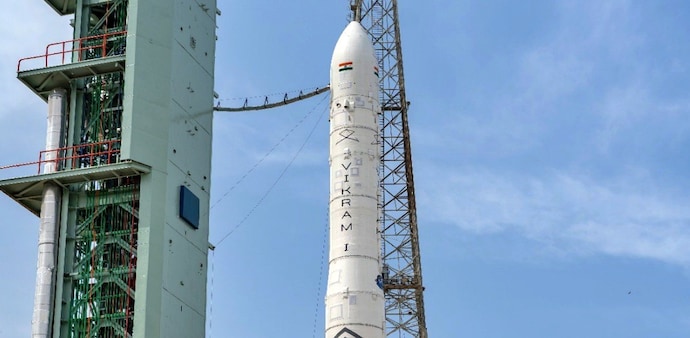
India’s space sector is poised for another milestone as Skyroot Aerospace prepares to launch Vikram-1, the country’s first privately developed orbital rocket, under its maiden mission named Mission Aagaman. The launch is scheduled for July 18 at 11:30 am IST from the First Launch Pad at the Satish Dhawan Space Centre in Sriharikota, Andhra Pradesh.
DO CHECKOUT | 'Vikram-1 will prove our commercial product': Skyroot Aerospace CEO Pawan Kumar Chandana as start-up gears up for lift-off
Vikram-1: India’s first private orbital rocket
Vikram-1 is India’s first privately developed orbital rocket, built by Skyroot Aerospace to carry small satellites into low Earth orbit. Designed for commercial launches, it marks a major step in India’s private space sector and is meant to offer a faster, more flexible launch option for small payloads.
The rocket features a lightweight, all-carbon-composite structure and utilizes advanced 3D-printed liquid engines, making it lighter, faster to manufacture, and highly cost-effective.
What the mission is about
Vikram-1 is designed to carry small satellites into low Earth orbit, with reports saying it can place payloads of up to 450 kg into orbit. The mission has been framed as a test flight, meant to prove the rocket’s systems in real launch conditions rather than simply marking a symbolic debut.
MUST READ: India's first private orbital rocket launches July 18—here's everything about Vikram-1
What Vikram-1 aims to prove
According to reports, Mission Aagaman will gather critical in-flight data on the rocket’s propulsion, stage separation, navigation, avionics, stability, and overall performance. Skyroot says the goal is to validate how the vehicle behaves from liftoff through ascent, helping engineers refine future launches and commercial operations.
Why it matters for India
The launch is significant because it marks the arrival of India’s private sector into orbital launch capability. Analysts say a successful mission would strengthen India’s position in the global small-satellite launch market and show that Indian startups can independently build and fly orbital rockets.
A bigger space milestone
Named after Dr. Vikram Sarabhai, the rocket also carries symbolic value for India’s space program. If successful, Vikram-1 could accelerate commercial space services in India and reinforce the country’s broader push to open the sector to private industry.
India’s space sector is poised for another milestone as Skyroot Aerospace prepares to launch Vikram-1, the country’s first privately developed orbital rocket, under its maiden mission named Mission Aagaman. The launch is scheduled for July 18 at 11:30 am IST from the First Launch Pad at the Satish Dhawan Space Centre in Sriharikota, Andhra Pradesh.
DO CHECKOUT | 'Vikram-1 will prove our commercial product': Skyroot Aerospace CEO Pawan Kumar Chandana as start-up gears up for lift-off
Vikram-1: India’s first private orbital rocket
Vikram-1 is India’s first privately developed orbital rocket, built by Skyroot Aerospace to carry small satellites into low Earth orbit. Designed for commercial launches, it marks a major step in India’s private space sector and is meant to offer a faster, more flexible launch option for small payloads.
The rocket features a lightweight, all-carbon-composite structure and utilizes advanced 3D-printed liquid engines, making it lighter, faster to manufacture, and highly cost-effective.
What the mission is about
Vikram-1 is designed to carry small satellites into low Earth orbit, with reports saying it can place payloads of up to 450 kg into orbit. The mission has been framed as a test flight, meant to prove the rocket’s systems in real launch conditions rather than simply marking a symbolic debut.
MUST READ: India's first private orbital rocket launches July 18—here's everything about Vikram-1
What Vikram-1 aims to prove
According to reports, Mission Aagaman will gather critical in-flight data on the rocket’s propulsion, stage separation, navigation, avionics, stability, and overall performance. Skyroot says the goal is to validate how the vehicle behaves from liftoff through ascent, helping engineers refine future launches and commercial operations.
Why it matters for India
The launch is significant because it marks the arrival of India’s private sector into orbital launch capability. Analysts say a successful mission would strengthen India’s position in the global small-satellite launch market and show that Indian startups can independently build and fly orbital rockets.
A bigger space milestone
Named after Dr. Vikram Sarabhai, the rocket also carries symbolic value for India’s space program. If successful, Vikram-1 could accelerate commercial space services in India and reinforce the country’s broader push to open the sector to private industry.