
Voyager 1 reaches 1 light-day from Earth, a first for any human-made object. Here’s what we know so far
Voyager 1's journey is expected to continue for thousands of years, even after its plutonium power supply stops working.
- Nov 18, 2026,
- Updated Nov 18, 2026 12:11 PM IST
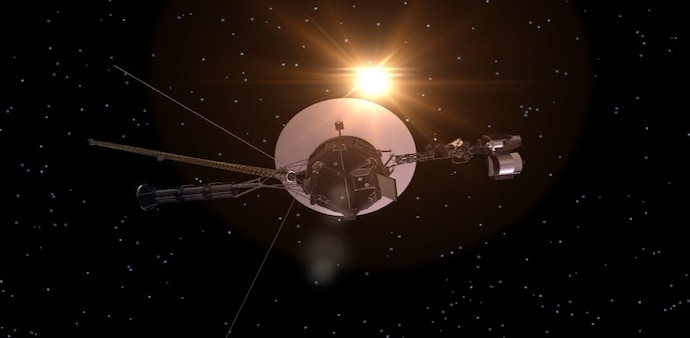
NASA's Voyager 1 has become the first human-made object to travel one light-day away from Earth, reaching a distance of about 26 billion kilometres after nearly 49 years in space. At this distance, even a simple message to the spacecraft takes about two days to travel there and back, Deutsche Welle reported on Monday.
Launched in 1977, Voyager 1 reached the one light-day mark on November 18, 2026, at 11:16 a.m. Central European Time. A light-day is the distance light travels in 24 hours, or about 26 billion kilometres.
In other words, light can cover this distance in one day, while Voyager 1 took 49 years, two months and 11 days to reach it.
The spacecraft is currently travelling at around 61,000 km/h or 38,000 mph.
How did Voyager 1 travel so far?
Voyager 1 was launched at a time when Jupiter, Saturn, Uranus and Neptune were in a rare alignment. Such an alignment happens only once every 176 years.
The spacecraft was sent to study the outer planets. After completing its original mission, Voyager 1 used the gravity of Jupiter and Saturn to gain speed.
It flew close to the two planets, where their powerful gravity pulled and accelerated the spacecraft before sending it on a new path. This helped Voyager 1 reach the speed at which it is travelling today.
Don't Miss: NASA invites people worldwide to mark Voyager 1's one light-day milestone; check how to take part
In 1990, Voyager 1 took the only portrait of the solar system from outside it ever made by a spacecraft. The image was captured on Valentine's Day from beyond Neptune.
In 2012, Voyager 1 became the first human-made object to reach interstellar space.
Voyager 1 is still sending data
Even after nearly five decades in space, Voyager 1 continues its journey and sends data back to scientists on Earth.
"If you want to say 'hello' to Voyager, you send your message and then you go home and you wait two days before you finally get a response," says Suzanne Dodd, the mission's project manager at NASA's Jet Propulsion Laboratory.
But the wait does come with a response. The spacecraft continues to send back data that scientists can study.
"[It's] still working great, sending back data from a region of space no other human-made craft has ever explored," says Kareem Badaruddin, the mission manager at JPL.
Where is Voyager 1 going?
Voyager 1's journey is expected to continue for thousands of years, even after its plutonium power supply stops working.
In about 40,000 years, the spacecraft is expected to pass by the star Gliese 445, which is more than 17 light-years away from Earth.
A light-year is the distance light travels in one year. Voyager 1 will take about 18,000 years to reach the one light-year milestone.
NASA has described Voyager 1 as being destined to wander the Milky Way "perhaps eternally".
Voyager 1 carries a message from Earth
Voyager 1 is also carrying one of the most famous messages humanity has sent into space, the Golden Record.
There are two Golden Records, one on Voyager 1 and another on Voyager 2, which was part of the same 1970s mission. The records are protected by a gold aluminium cover.
The phonographic record contains soundbites representing languages and cultures from around the world. It was created as a message from Earth for any extraterrestrial life that might find it.
However, it is considered very unlikely that any intelligent lifeform will ever receive the record or know how to play it.
If an extraterrestrial civilisation does find the record and manages to play it, the first voice it hears will be a controversial one.
That voice belongs to Kurt Waldheim, who served as UN Secretary-General from 1972 to 1981 and as Austrian President from 1986 to 1992.
Waldheim's concealed wartime past as a German army officer in the Balkans came to light about a decade after Voyager 1 was launched. It was alleged that Waldheim had participated in Nazi crimes.