
What happens when lead is crashed at the speed of light? Scientist makes a shocking discovery
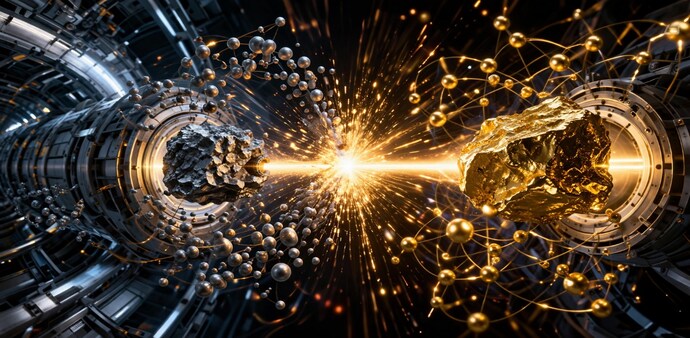
The experiment involved smashing lead ions together at nearly the speed of light to recreate the extreme conditions of the early universe.
- Apr 3, 2026,
- Updated Apr 3, 2026 7:30 AM IST
Scientists at CERN's Large Hadron Collider (LHC) have made a remarkable discovery: they have accidentally turned lead into gold, according to a report by WION.
This unprecedented achievement occurred during an experiment designed to recreate conditions similar to the Big Bang, marking a significant moment in the quest for understanding the universe.
What is CERN?
The European Organisation for Nuclear Research, better known as CERN, is one of the world’s leading centres for scientific research.
Established in 1954 near Geneva, on the border of France and Switzerland, it brings together scientists and engineers from dozens of countries to explore the fundamental nature of matter and the universe. CERN operates the largest particle physics laboratory in the world, providing powerful accelerators and detectors used to study subatomic particles and the forces that shape the cosmos.
The myth until now
For centuries, alchemists and kings sought the impossible dream of transforming base metals into gold, a pursuit that laid the groundwork for the field of chemistry. Despite numerous attempts, this idea remained a myth—until now. Thanks to cutting-edge technology, CERN has turned this ancient fantasy into reality.
High-energy collision leads to gold formation
The experiment involved crashing lead ions together at almost the speed of light to mimic the extreme conditions of the early universe. The aim was to learn about the first moments after the Big Bang. However, what the researchers didn’t expect was that lead would turn into gold during the collision.
The whole process
At the heart of the experiment, lead atoms underwent a dramatic change. The intense heat—reaching one trillion degrees—caused protons and neutrons to be stripped from the lead. This shift in the atomic structure caused the lead to change its atomic number, resulting in the formation of gold. Though only a microscopic amount of gold was produced, the breakthrough has far-reaching implications.
Harnessing the Power of Stars
In the experiment, lead atoms went through a dramatic change. The extreme heat, reaching one trillion degrees, stripped away protons and neutrons from the lead. This change in the atomic structure caused the lead to transform into gold. Although only a tiny amount of gold was created, the discovery has huge implications.
What is the Big Bang?
The Big Bang is the event that started the universe. It suggests that the universe began as a tiny, hot, and dense point, and then expanded very quickly. As it expanded, it cooled down, and over billions of years, stars, galaxies, and planets formed.
The Big Bang wasn't an explosion in space, but rather an expansion of space itself. Scientists study this event and the energy it left behind to learn about how the universe began and how it has changed over time.
Scientists at CERN's Large Hadron Collider (LHC) have made a remarkable discovery: they have accidentally turned lead into gold, according to a report by WION.
This unprecedented achievement occurred during an experiment designed to recreate conditions similar to the Big Bang, marking a significant moment in the quest for understanding the universe.
What is CERN?
The European Organisation for Nuclear Research, better known as CERN, is one of the world’s leading centres for scientific research.
Established in 1954 near Geneva, on the border of France and Switzerland, it brings together scientists and engineers from dozens of countries to explore the fundamental nature of matter and the universe. CERN operates the largest particle physics laboratory in the world, providing powerful accelerators and detectors used to study subatomic particles and the forces that shape the cosmos.
The myth until now
For centuries, alchemists and kings sought the impossible dream of transforming base metals into gold, a pursuit that laid the groundwork for the field of chemistry. Despite numerous attempts, this idea remained a myth—until now. Thanks to cutting-edge technology, CERN has turned this ancient fantasy into reality.
High-energy collision leads to gold formation
The experiment involved crashing lead ions together at almost the speed of light to mimic the extreme conditions of the early universe. The aim was to learn about the first moments after the Big Bang. However, what the researchers didn’t expect was that lead would turn into gold during the collision.
The whole process
At the heart of the experiment, lead atoms underwent a dramatic change. The intense heat—reaching one trillion degrees—caused protons and neutrons to be stripped from the lead. This shift in the atomic structure caused the lead to change its atomic number, resulting in the formation of gold. Though only a microscopic amount of gold was produced, the breakthrough has far-reaching implications.
Harnessing the Power of Stars
In the experiment, lead atoms went through a dramatic change. The extreme heat, reaching one trillion degrees, stripped away protons and neutrons from the lead. This change in the atomic structure caused the lead to transform into gold. Although only a tiny amount of gold was created, the discovery has huge implications.
What is the Big Bang?
The Big Bang is the event that started the universe. It suggests that the universe began as a tiny, hot, and dense point, and then expanded very quickly. As it expanded, it cooled down, and over billions of years, stars, galaxies, and planets formed.
The Big Bang wasn't an explosion in space, but rather an expansion of space itself. Scientists study this event and the energy it left behind to learn about how the universe began and how it has changed over time.