
What makes NISAR special? 10 key breakthroughs behind the $1.5 billion Indo-US satellite collaboration
It will transform how scientists and decision-makers monitor climate trends, infrastructure vulnerability, agricultural health, and risks from natural hazards.
- Jul 24, 2025,
- Updated Jul 24, 2025 5:05 PM IST
Set to launch on July 30, the NASA-ISRO Synthetic Aperture Radar (NISAR) mission marks a historic collaboration between the United States and India in space science. Touted as the world’s most advanced Earth-observing satellite, here's a look at the top 10 key facts you should know about this game-changing Indo-US space mission.
1. A Historic first joint satellite mission
NISAR, short for NASA‑ISRO Synthetic Aperture Radar, is the first-ever Earth-observing satellite co-developed in equal partnership by NASA and the Indian Space Research Organisation (ISRO).
2. Launch betails
Scheduled to launch on July 30, 2025 at 17:40 IST, from Satish Dhawan Space Centre, Sriharikota, aboard ISRO’s GSLV‑F16 rocket. The satellite weighs 2,392 kg and will be placed into a sun-synchronous orbit at ~743–747 km altitude.
3. Dual‑frequency radar system
It carries both L‑band (24 cm wavelength) radar by NASA and S‑band (≈9 cm wavelength) radar by ISRO, enabling dual-frequency imaging for more comprehensive Earth surface data.
4. World’s largest deployable radar antenna
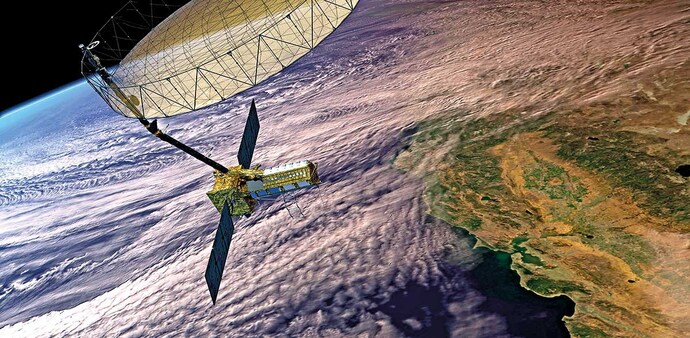
Featuring a 12 m unfurlable mesh reflector mounted on a 9 metre boom — in development by NASA’s Jet Propulsion Laboratory — this is the largest radar antenna ever deployed in space.
5. Revolutionary imaging capabilities
Using SweepSAR technology, NISAR will image a wide swath 240 km across with 5-10 m resolution, scanning nearly all land and ice surfaces every 12 days, or roughly every 6 days with combined ascending & descending passes.
6. Detecting tiny earth movements
It can detect deformations on Earth’s surface of just a few millimeters, making it invaluable for monitoring earthquakes, landslides, and volcanic activity — in day or night, through clouds and vegetation.
7. Monitoring ice and ecosystems
The mission will track melting glaciers, changes in ice sheets and sea ice, and monitor shifts in forests, wetlands, and agricultural biomass, offering insights into climate change and carbon cycles.
8. Open‑access data for science & society
Data from NISAR will be publicly accessible, generally within 1-2 days of observation and within hours for disaster response, supporting research and policymaking globally.
9. Cost & collaboration scale
With a total estimated cost of $1.5 billion — including significant US contribution ($1.118 billion) — it is the most expensive Earth-imaging mission to date and a symbol of deepening Indo‑US space cooperation.
10. Mission lifetime & science scope
Designed for a baseline mission of 3 years, with consumables lasting up to 5 years, NISAR aims to boost understanding of Earth's ecosystems, surface deformation, and cryospheric systems, with a strong emphasis on disaster preparedness and climate science.
Why NISAR Matters
This mission sets a new benchmark in Earth observation. Dual-frequency SAR enables rich, consistent data regardless of weather or daylight. It will transform how scientists and decision-makers monitor climate trends, infrastructure vulnerability, agricultural health, and risks from natural hazards. The global, open-access nature of its data democratizes access, enabling local communities and researchers worldwide to benefit.
Set to launch on July 30, the NASA-ISRO Synthetic Aperture Radar (NISAR) mission marks a historic collaboration between the United States and India in space science. Touted as the world’s most advanced Earth-observing satellite, here's a look at the top 10 key facts you should know about this game-changing Indo-US space mission.
1. A Historic first joint satellite mission
NISAR, short for NASA‑ISRO Synthetic Aperture Radar, is the first-ever Earth-observing satellite co-developed in equal partnership by NASA and the Indian Space Research Organisation (ISRO).
2. Launch betails
Scheduled to launch on July 30, 2025 at 17:40 IST, from Satish Dhawan Space Centre, Sriharikota, aboard ISRO’s GSLV‑F16 rocket. The satellite weighs 2,392 kg and will be placed into a sun-synchronous orbit at ~743–747 km altitude.
3. Dual‑frequency radar system
It carries both L‑band (24 cm wavelength) radar by NASA and S‑band (≈9 cm wavelength) radar by ISRO, enabling dual-frequency imaging for more comprehensive Earth surface data.
4. World’s largest deployable radar antenna
Featuring a 12 m unfurlable mesh reflector mounted on a 9 metre boom — in development by NASA’s Jet Propulsion Laboratory — this is the largest radar antenna ever deployed in space.
5. Revolutionary imaging capabilities
Using SweepSAR technology, NISAR will image a wide swath 240 km across with 5-10 m resolution, scanning nearly all land and ice surfaces every 12 days, or roughly every 6 days with combined ascending & descending passes.
6. Detecting tiny earth movements
It can detect deformations on Earth’s surface of just a few millimeters, making it invaluable for monitoring earthquakes, landslides, and volcanic activity — in day or night, through clouds and vegetation.
7. Monitoring ice and ecosystems
The mission will track melting glaciers, changes in ice sheets and sea ice, and monitor shifts in forests, wetlands, and agricultural biomass, offering insights into climate change and carbon cycles.
8. Open‑access data for science & society
Data from NISAR will be publicly accessible, generally within 1-2 days of observation and within hours for disaster response, supporting research and policymaking globally.
9. Cost & collaboration scale
With a total estimated cost of $1.5 billion — including significant US contribution ($1.118 billion) — it is the most expensive Earth-imaging mission to date and a symbol of deepening Indo‑US space cooperation.
10. Mission lifetime & science scope
Designed for a baseline mission of 3 years, with consumables lasting up to 5 years, NISAR aims to boost understanding of Earth's ecosystems, surface deformation, and cryospheric systems, with a strong emphasis on disaster preparedness and climate science.
Why NISAR Matters
This mission sets a new benchmark in Earth observation. Dual-frequency SAR enables rich, consistent data regardless of weather or daylight. It will transform how scientists and decision-makers monitor climate trends, infrastructure vulnerability, agricultural health, and risks from natural hazards. The global, open-access nature of its data democratizes access, enabling local communities and researchers worldwide to benefit.