
BT AI Summit 2025: Not the western way, India’s frugal AI model could redefine global innovation, say experts
As adoption deepens, India is charting its own path — one defined not by expensive infrastructure or massive data centers, but by frugal innovation, affordable computing, and sustainable AI solutions built for scale and inclusion. This homegrown approach aims to make advanced technology accessible to every citizen while ensuring energy efficiency and long-term resilience.
- Oct 29, 2025,
- Updated Oct 29, 2025 4:48 PM IST
Artificial Intelligence (AI) is transforming the global landscape — redefining industries, economies, and everyday life. In India, it is emerging as a force multiplier, reshaping agriculture, healthcare, education, and financial services while driving inclusion in rural and semi-urban areas. But as the pace of AI innovation accelerates worldwide, India’s challenge lies not in imitation, but in innovation — crafting a model that suits its unique infrastructure, resource, and societal realities.
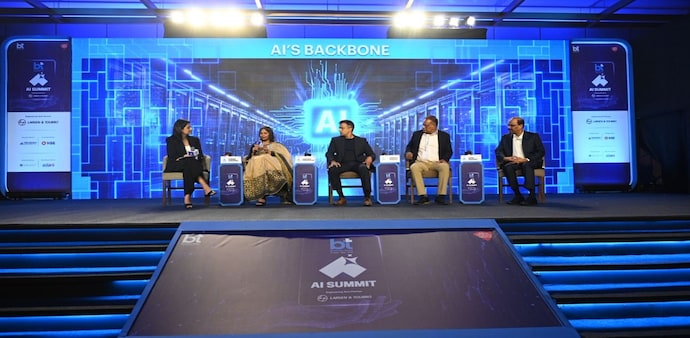
Speaking at the Business Today AI Summit 2025, Himani Agrawal, COO of Microsoft India and South Asia, said the explosive growth of AI has been driven by the “compounding curve” of three critical forces — compute power, advanced models, and software optimization. “Infrastructure is not just the backbone of AI; it’s the multiplier that enables scale,” she noted. “But infrastructure alone is not enough — it must be matched by skills. Skilling and infrastructure are two sides of the same coin, and both are essential to diffuse AI across society.”
This emphasis on AI talent development is particularly crucial as India moves toward integrating AI in governance, small business operations, and public services. Programs promoting AI literacy and cloud-enabled digital access are helping bridge the skills gap while ensuring that technology benefits reach beyond large enterprises to local innovators and startups.
However, replicating Western models of massive data centers and compute-heavy infrastructure may not be feasible in India, cautioned Santhosh Viswanathan, Vice President & Managing Director, India Region, Intel Corporation. “In the last six months, over $600 billion has been invested in data centers in the US, while India spent a fraction of that. But more importantly, we lack the same level of natural resources — like water and energy — to sustain such models,” he said.
Instead, India’s AI journey must focus on frugal innovation — developing efficient, resource-light architectures that balance sustainability with scalability. “We need to rethink infrastructure to fit our context,” he said, pointing toward decentralized, cloud-hybrid, and energy-efficient computing as the future path.
As AI becomes central to productivity and competitiveness, India’s strength lies in building its own model — one that is inclusive, sustainable, and uniquely Indian. By combining local ingenuity with global collaboration, the country is well-positioned to lead a new chapter in responsible, resource-smart AI evolution.
Adding to this, Ramesh Padala, Managing Director and Partner at Boston Consulting Group (BCG), highlighted the scale of India’s challenge and opportunity. “India produces 20% of the world’s data but currently holds the capacity to store only 2%,” he explained. “Expanding data center infrastructure will be extremely expensive—not just financially but in terms of power consumption. Running such compute facilities would require seven to eight times the electricity that powers Mumbai.”
Padala emphasised the need for localised AI innovation. “The key will be to develop specialized language and domain models -- LLMs built in India for India. We must innovate with the same jugaad mindset that gave us UPI, a world-class system that processes more transactions than US credit cards and remains free to use. That’s the spirit we need for AI -- reducing compute costs, cutting energy use, and designing technology that scales efficiently.”
Srini Maddali, Senior Vice President (Engineering & Hardware Lead) at Qualcomm India, said India’s semiconductor sector is poised for a major leap forward. “India already excels in design and intellectual property, but there’s huge untapped potential across the rest of the semiconductor value chain — from wafer development to assembly and testing,” he said.
Maddali cautioned that semiconductor manufacturing is a highly unforgiving process, requiring consistency and precision. “You must get manufacturing right every single day — if yields fall, customers are lost,” he explained. He advised India to focus initially on mature technology nodes, where more than 75% of chips globally are still produced. “It’s practical, cost-effective, and allows us to learn from existing players before jumping into advanced nodes that change every 18 months and demand massive capital,” he said.
Together, these industry leaders outline a unified vision: India’s AI and semiconductor growth story must be built on frugality, sustainability, and skill. By combining local innovation, efficient hardware, and adaptive learning models, India can craft an AI ecosystem that is globally competitive yet uniquely its own — one that empowers millions without straining the planet.
Artificial Intelligence (AI) is transforming the global landscape — redefining industries, economies, and everyday life. In India, it is emerging as a force multiplier, reshaping agriculture, healthcare, education, and financial services while driving inclusion in rural and semi-urban areas. But as the pace of AI innovation accelerates worldwide, India’s challenge lies not in imitation, but in innovation — crafting a model that suits its unique infrastructure, resource, and societal realities.
Speaking at the Business Today AI Summit 2025, Himani Agrawal, COO of Microsoft India and South Asia, said the explosive growth of AI has been driven by the “compounding curve” of three critical forces — compute power, advanced models, and software optimization. “Infrastructure is not just the backbone of AI; it’s the multiplier that enables scale,” she noted. “But infrastructure alone is not enough — it must be matched by skills. Skilling and infrastructure are two sides of the same coin, and both are essential to diffuse AI across society.”
This emphasis on AI talent development is particularly crucial as India moves toward integrating AI in governance, small business operations, and public services. Programs promoting AI literacy and cloud-enabled digital access are helping bridge the skills gap while ensuring that technology benefits reach beyond large enterprises to local innovators and startups.
However, replicating Western models of massive data centers and compute-heavy infrastructure may not be feasible in India, cautioned Santhosh Viswanathan, Vice President & Managing Director, India Region, Intel Corporation. “In the last six months, over $600 billion has been invested in data centers in the US, while India spent a fraction of that. But more importantly, we lack the same level of natural resources — like water and energy — to sustain such models,” he said.
Instead, India’s AI journey must focus on frugal innovation — developing efficient, resource-light architectures that balance sustainability with scalability. “We need to rethink infrastructure to fit our context,” he said, pointing toward decentralized, cloud-hybrid, and energy-efficient computing as the future path.
As AI becomes central to productivity and competitiveness, India’s strength lies in building its own model — one that is inclusive, sustainable, and uniquely Indian. By combining local ingenuity with global collaboration, the country is well-positioned to lead a new chapter in responsible, resource-smart AI evolution.
Adding to this, Ramesh Padala, Managing Director and Partner at Boston Consulting Group (BCG), highlighted the scale of India’s challenge and opportunity. “India produces 20% of the world’s data but currently holds the capacity to store only 2%,” he explained. “Expanding data center infrastructure will be extremely expensive—not just financially but in terms of power consumption. Running such compute facilities would require seven to eight times the electricity that powers Mumbai.”
Padala emphasised the need for localised AI innovation. “The key will be to develop specialized language and domain models -- LLMs built in India for India. We must innovate with the same jugaad mindset that gave us UPI, a world-class system that processes more transactions than US credit cards and remains free to use. That’s the spirit we need for AI -- reducing compute costs, cutting energy use, and designing technology that scales efficiently.”
Srini Maddali, Senior Vice President (Engineering & Hardware Lead) at Qualcomm India, said India’s semiconductor sector is poised for a major leap forward. “India already excels in design and intellectual property, but there’s huge untapped potential across the rest of the semiconductor value chain — from wafer development to assembly and testing,” he said.
Maddali cautioned that semiconductor manufacturing is a highly unforgiving process, requiring consistency and precision. “You must get manufacturing right every single day — if yields fall, customers are lost,” he explained. He advised India to focus initially on mature technology nodes, where more than 75% of chips globally are still produced. “It’s practical, cost-effective, and allows us to learn from existing players before jumping into advanced nodes that change every 18 months and demand massive capital,” he said.
Together, these industry leaders outline a unified vision: India’s AI and semiconductor growth story must be built on frugality, sustainability, and skill. By combining local innovation, efficient hardware, and adaptive learning models, India can craft an AI ecosystem that is globally competitive yet uniquely its own — one that empowers millions without straining the planet.