
Enormous optimism in India vs anxiety in Western countries: ex-UK PM Rishi Sunak at India AI Impact Summit
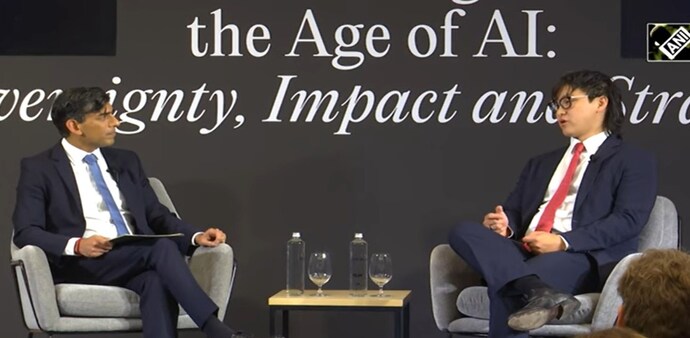
In a fireside chat with Meta’s Chief AI Officer Alexandr Wang, Sunak said New Delhi’s growing role reflects its strategic importance in the global AI landscape, describing India as “a country with huge digital ambitions and capacity”.
- Feb 18, 2026,
- Updated Feb 18, 2026 6:55 PM IST
Former British Prime Minister Rishi Sunak on Wednesday said India demonstrates “enormous optimism and trust” toward artificial intelligence (AI), in sharp contrast to Western countries, where anxiety continues to dominate public sentiment. Speaking at the India AI Impact Summit 2026 in New Delhi, Sunak said the divergence in attitudes reflects deeper differences in how societies perceive technological change and risk.
In a fireside chat with Meta’s Chief AI Officer Alexandr Wang, Sunak observed, “Across the world, we’re seeing different attitudes towards AI. In countries like India, there’s enormous optimism and trust, and in Western countries, we’re seeing that anxiety is still the dominant feeling towards AI.” He cautioned that addressing this imbalance would require deliberate policy intervention alongside technological progress. “I think closing that confidence gap is as much a policy task as it is a technical one,” he said.
Sunak traced the evolution of global AI diplomacy, noting that recent summits have moved from the UK to Paris, South Korea, and now India. He said New Delhi’s growing role reflects its strategic importance in the global AI landscape, describing India as “a country with huge digital ambitions and capacity”. According to Sunak, India’s scale, digital infrastructure, and willingness to embrace new technologies place it at the centre of the next phase of AI-led transformation.
He also highlighted the sheer magnitude of capital being deployed into AI development, arguing that it marks an unprecedented moment in technological history. “This year, the large AI companies are going to spend 20 times more on developing this technology than the US did for the Manhattan Project,” Sunak said, adding that such massive private-sector mobilisation would inevitably demand new models of governance and oversight.
An inflexion point
Meta’s Chief AI Officer Alexandr Wang described the current moment as historic, calling 2026 “an inflexion point” for technology. “I think we are sitting here right now at such an incredibly exciting moment for technology. I think we are at the beginning of a true acceleration,” he said. Wang outlined three distinct phases in AI’s recent evolution. From 2018 to 2024, AI development was dominated by what he termed “the era of pre-training”, driven by a predictable exponential relationship between compute investment and performance gains.
Toward the end of 2024, Wang said a second phase took shape. “This was the era of reinforcement learning… this is when we saw the models begin to learn to reason,” he noted. According to Wang, the industry has now entered a fundamentally new stage. “At the end of 2025… we’ve really begun an entirely new paradigm… the era of recursive self-improvement,” he said, explaining that AI systems are increasingly contributing to the development of future models themselves.
“From the outside, what you see is maybe an acceleration of the overall development velocity… internally, what we see is just dramatic speed-ups,” Wang said, adding that the productivity of individual researchers has “grown dramatically” and is expected to rise further.
Wang also pointed to India as a standout example in the global AI ecosystem, calling it “a very positive case study”. He highlighted the country’s growing startup momentum, saying, “I was at a dinner with a number of Indian founders and venture capitalists last night, and the statistic was that there are more consumer AI startups in India than in the United States.” Citing India’s deep talent pool and expanding entrepreneurial networks, Wang said, “There really are some of these shining examples of incredible development of these ecosystems.”
Former British Prime Minister Rishi Sunak on Wednesday said India demonstrates “enormous optimism and trust” toward artificial intelligence (AI), in sharp contrast to Western countries, where anxiety continues to dominate public sentiment. Speaking at the India AI Impact Summit 2026 in New Delhi, Sunak said the divergence in attitudes reflects deeper differences in how societies perceive technological change and risk.
In a fireside chat with Meta’s Chief AI Officer Alexandr Wang, Sunak observed, “Across the world, we’re seeing different attitudes towards AI. In countries like India, there’s enormous optimism and trust, and in Western countries, we’re seeing that anxiety is still the dominant feeling towards AI.” He cautioned that addressing this imbalance would require deliberate policy intervention alongside technological progress. “I think closing that confidence gap is as much a policy task as it is a technical one,” he said.
Sunak traced the evolution of global AI diplomacy, noting that recent summits have moved from the UK to Paris, South Korea, and now India. He said New Delhi’s growing role reflects its strategic importance in the global AI landscape, describing India as “a country with huge digital ambitions and capacity”. According to Sunak, India’s scale, digital infrastructure, and willingness to embrace new technologies place it at the centre of the next phase of AI-led transformation.
He also highlighted the sheer magnitude of capital being deployed into AI development, arguing that it marks an unprecedented moment in technological history. “This year, the large AI companies are going to spend 20 times more on developing this technology than the US did for the Manhattan Project,” Sunak said, adding that such massive private-sector mobilisation would inevitably demand new models of governance and oversight.
An inflexion point
Meta’s Chief AI Officer Alexandr Wang described the current moment as historic, calling 2026 “an inflexion point” for technology. “I think we are sitting here right now at such an incredibly exciting moment for technology. I think we are at the beginning of a true acceleration,” he said. Wang outlined three distinct phases in AI’s recent evolution. From 2018 to 2024, AI development was dominated by what he termed “the era of pre-training”, driven by a predictable exponential relationship between compute investment and performance gains.
Toward the end of 2024, Wang said a second phase took shape. “This was the era of reinforcement learning… this is when we saw the models begin to learn to reason,” he noted. According to Wang, the industry has now entered a fundamentally new stage. “At the end of 2025… we’ve really begun an entirely new paradigm… the era of recursive self-improvement,” he said, explaining that AI systems are increasingly contributing to the development of future models themselves.
“From the outside, what you see is maybe an acceleration of the overall development velocity… internally, what we see is just dramatic speed-ups,” Wang said, adding that the productivity of individual researchers has “grown dramatically” and is expected to rise further.
Wang also pointed to India as a standout example in the global AI ecosystem, calling it “a very positive case study”. He highlighted the country’s growing startup momentum, saying, “I was at a dinner with a number of Indian founders and venture capitalists last night, and the statistic was that there are more consumer AI startups in India than in the United States.” Citing India’s deep talent pool and expanding entrepreneurial networks, Wang said, “There really are some of these shining examples of incredible development of these ecosystems.”