
India AI Impact Summit 2026: ePlane to build the digital twin of India’s first electric air taxi with NVIDIA
The company is the first electric aviation OEM in the region to leverage NVIDIA Omniverse for multi-physics digital twin modeling
- Feb 19, 2026,
- Updated Feb 19, 2026 12:37 PM IST
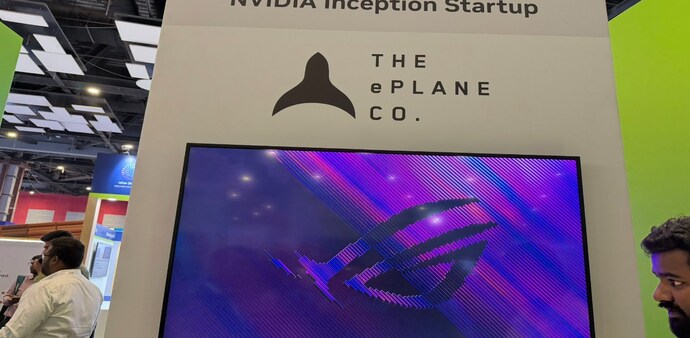
The ePlane Company and NVIDIA on Thursday announced that they are building the digital twin of India’s first electric air taxi using NVIDIA Omniverse libraries. Announced at the India AI Impact Summit 2026, ePlane, developer of electric Vertical Takeoff and Landing (eVTOL) aircraft, will create a high-fidelity “Digital Twin” of its e200x, setting a new benchmark for aerospace simulation.
Additionally, it will use the NVIDIA IGX platform as the onboard computing platform to host a variety of critical applications.
The ePlane Company is using physics-accurate digital reality, enabling its engineers to simulate complex aerodynamic interactions, sensor responses, and flight scenarios with a level of precision that traditional physics engines cannot match.
Modern aviation, particularly Urban Air Mobility, presents new challenges, including the need for pilots to maintain enhanced situational awareness. The NVIDIA IGX platform provides a safe computing solution to integrate multiple sensors— such as cameras and radars—to deploy advanced algorithms for data fusion, decision making and visualisation.
This collaboration tackles a critical challenge in deep-tech aviation: validation. Physical testing of edge cases—including extreme weather, sensor failures, or collision scenarios—is costly and risky.
The e200x Digital Twin enables teams to fly millions of kilometers virtually, training its algorithms on complex real-world scenarios before the aircraft even takes flight. ePlane also plans to use NVIDIA Cosmos world foundation models and NVIDIA Nemotron family of open models with open weights, training data, and recipes for future development.
“We are not just building an aircraft; we are building an ecosystem. Collaborating with NVIDIA allows us to blur the line between the digital and the physical. By validating our flight operations suite in NVIDIA Omniverse, we are effectively pushing the limits of the aircraft thousands of times in simulation so that we never have to in reality. This level of rigor is what defines sovereign aerospace capability,” said Prof. Satya Chakravarthy, Founder & CTO, The ePlane Company.
The collaboration also opens a new frontier for the Indian aviation sector. The computational intensity of these simulations requires high-performance computing (HPC) infrastructure, utilizing top-tier GPUs to render physics in real-time. This high-fidelity digital twin can also serve as a predictive analytics engine, mirroring the configuration of the actual aircraft components to predict maintenance needs long before a failure occurs.
Incubated at IIT Madras, the ePlane Company is building India's first compact flying electric taxi, the e200x. With a mission to alleviate urban congestion, the company holds the country’s first Design Organisation Approval (DOA) for a private electric aircraft and has recently operationalized a 60,000 sq. ft. manufacturing facility in Chennai.
The ePlane Company and NVIDIA on Thursday announced that they are building the digital twin of India’s first electric air taxi using NVIDIA Omniverse libraries. Announced at the India AI Impact Summit 2026, ePlane, developer of electric Vertical Takeoff and Landing (eVTOL) aircraft, will create a high-fidelity “Digital Twin” of its e200x, setting a new benchmark for aerospace simulation.
Additionally, it will use the NVIDIA IGX platform as the onboard computing platform to host a variety of critical applications.
The ePlane Company is using physics-accurate digital reality, enabling its engineers to simulate complex aerodynamic interactions, sensor responses, and flight scenarios with a level of precision that traditional physics engines cannot match.
Modern aviation, particularly Urban Air Mobility, presents new challenges, including the need for pilots to maintain enhanced situational awareness. The NVIDIA IGX platform provides a safe computing solution to integrate multiple sensors— such as cameras and radars—to deploy advanced algorithms for data fusion, decision making and visualisation.
This collaboration tackles a critical challenge in deep-tech aviation: validation. Physical testing of edge cases—including extreme weather, sensor failures, or collision scenarios—is costly and risky.
The e200x Digital Twin enables teams to fly millions of kilometers virtually, training its algorithms on complex real-world scenarios before the aircraft even takes flight. ePlane also plans to use NVIDIA Cosmos world foundation models and NVIDIA Nemotron family of open models with open weights, training data, and recipes for future development.
“We are not just building an aircraft; we are building an ecosystem. Collaborating with NVIDIA allows us to blur the line between the digital and the physical. By validating our flight operations suite in NVIDIA Omniverse, we are effectively pushing the limits of the aircraft thousands of times in simulation so that we never have to in reality. This level of rigor is what defines sovereign aerospace capability,” said Prof. Satya Chakravarthy, Founder & CTO, The ePlane Company.
The collaboration also opens a new frontier for the Indian aviation sector. The computational intensity of these simulations requires high-performance computing (HPC) infrastructure, utilizing top-tier GPUs to render physics in real-time. This high-fidelity digital twin can also serve as a predictive analytics engine, mirroring the configuration of the actual aircraft components to predict maintenance needs long before a failure occurs.
Incubated at IIT Madras, the ePlane Company is building India's first compact flying electric taxi, the e200x. With a mission to alleviate urban congestion, the company holds the country’s first Design Organisation Approval (DOA) for a private electric aircraft and has recently operationalized a 60,000 sq. ft. manufacturing facility in Chennai.