
The next green revolution: WEF unveils 7 deep-tech innovations to revolutionise agriculture
According to the Food and Agriculture Organization (FAO), global food production must increase by 70% by 2050 to sustain the planet’s rising population.
- Nov 7, 2025,
- Updated Nov 7, 2025 2:16 PM IST
As the world races to meet an impending food security crisis, a new report from the World Economic Forum (WEF) spotlights how deep-tech innovations could fundamentally reshape the future of farming.
Titled “Shaping the Deep-Tech Revolution in Agriculture”, the report — developed in collaboration with global industry and academic experts — highlights seven frontier technologies that promise to revolutionize how crops are grown, monitored, and protected: generative artificial intelligence (AI), computer vision, robotics, edge Internet of Things (IoT), satellite-enabled remote sensing, CRISPR gene editing, and nanotechnology.
Together, these emerging domains are expected to usher in a new era of precision agriculture, sustainability, and resilience across the food value chain.
A growing challenge
According to the Food and Agriculture Organization (FAO), global food production must increase by 70% by 2050 to sustain the planet’s rising population. Yet, the challenges are mounting: one-third of the world’s soil is degraded, 71% of aquifers are depleting, and the average age of farmers is approaching 60.
Against this backdrop, the WEF report calls for urgent innovation and integration of deep-tech solutions to build a more productive and sustainable agricultural system.
Technologies powering the future of farming
- Generative AI (GenAI): Large language models are helping farmers make smarter, data-driven decisions — from predicting pest outbreaks to optimizing planting schedules—tailored to local conditions.
- Computer vision: Real-time visual monitoring enables early detection of crop diseases and efficient sorting of produce, increasingly accessible via mobile cameras.
- Edge IoT: On-farm data processing supports automation in irrigation, fertilization, and pest management, especially vital in low-connectivity areas.
- Satellite-enabled remote sensing: Satellites deliver vital insights on soil health, crop status, and weather patterns, aiding precision agriculture and logistics planning.
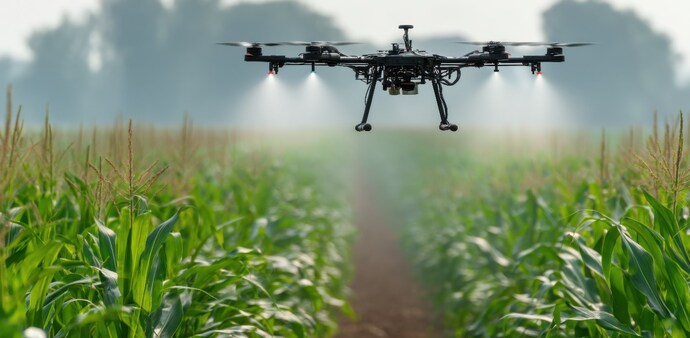
- Robotics and drones: Autonomous machinery is reshaping labor-intensive tasks like planting and harvesting, improving efficiency and lowering operational costs.
- CRISPR gene editing: Precision gene editing is accelerating the creation of climate-resilient, pest-resistant, and nutrient-rich crops.
- Nanotechnology: Nanomaterials enable targeted delivery of fertilizers and pesticides, minimizing waste and ecological damage.
Breakthrough use cases
The convergence of these technologies is already giving rise to revolutionary agricultural applications, such as:
- Swarm robotics: Fleets of small, task-specific robots collaborating to perform repetitive tasks like weeding and harvesting.
- Agentic AI systems: Autonomous AI agents that oversee crop management and supply chains.
- Precision irrigation: Integrated IoT, AI, and satellite systems that fine-tune water and nutrient delivery to boost yields while conserving resources.
Building the deep-tech ecosystem
To unlock the full potential of these innovations, the report emphasizes strengthening four foundational pillars:
- Policy and regulations: Clear frameworks around data privacy, genetic modification, and sustainable practices.
- Finance and investment: Patient capital and new funding models to support research and scaling.
- Human capital: Cross-disciplinary training to bridge agronomy and advanced technology.
- Data and digital infrastructure: Reliable connectivity and high-quality datasets to support smart farming applications.
The WEF concludes that the transformation of agriculture through deep tech will depend on collaboration among governments, private enterprises, researchers, and farmers. Only through coordinated action, the report notes, can these technologies be scaled globally to address food insecurity, climate stress, and resource depletion.
As the report puts it, “The future of agriculture depends on our ability to shape the deep-tech revolution — not just to feed the world, but to sustain it.”
As the world races to meet an impending food security crisis, a new report from the World Economic Forum (WEF) spotlights how deep-tech innovations could fundamentally reshape the future of farming.
Titled “Shaping the Deep-Tech Revolution in Agriculture”, the report — developed in collaboration with global industry and academic experts — highlights seven frontier technologies that promise to revolutionize how crops are grown, monitored, and protected: generative artificial intelligence (AI), computer vision, robotics, edge Internet of Things (IoT), satellite-enabled remote sensing, CRISPR gene editing, and nanotechnology.
Together, these emerging domains are expected to usher in a new era of precision agriculture, sustainability, and resilience across the food value chain.
A growing challenge
According to the Food and Agriculture Organization (FAO), global food production must increase by 70% by 2050 to sustain the planet’s rising population. Yet, the challenges are mounting: one-third of the world’s soil is degraded, 71% of aquifers are depleting, and the average age of farmers is approaching 60.
Against this backdrop, the WEF report calls for urgent innovation and integration of deep-tech solutions to build a more productive and sustainable agricultural system.
Technologies powering the future of farming
- Generative AI (GenAI): Large language models are helping farmers make smarter, data-driven decisions — from predicting pest outbreaks to optimizing planting schedules—tailored to local conditions.
- Computer vision: Real-time visual monitoring enables early detection of crop diseases and efficient sorting of produce, increasingly accessible via mobile cameras.
- Edge IoT: On-farm data processing supports automation in irrigation, fertilization, and pest management, especially vital in low-connectivity areas.
- Satellite-enabled remote sensing: Satellites deliver vital insights on soil health, crop status, and weather patterns, aiding precision agriculture and logistics planning.
- Robotics and drones: Autonomous machinery is reshaping labor-intensive tasks like planting and harvesting, improving efficiency and lowering operational costs.
- CRISPR gene editing: Precision gene editing is accelerating the creation of climate-resilient, pest-resistant, and nutrient-rich crops.
- Nanotechnology: Nanomaterials enable targeted delivery of fertilizers and pesticides, minimizing waste and ecological damage.
Breakthrough use cases
The convergence of these technologies is already giving rise to revolutionary agricultural applications, such as:
- Swarm robotics: Fleets of small, task-specific robots collaborating to perform repetitive tasks like weeding and harvesting.
- Agentic AI systems: Autonomous AI agents that oversee crop management and supply chains.
- Precision irrigation: Integrated IoT, AI, and satellite systems that fine-tune water and nutrient delivery to boost yields while conserving resources.
Building the deep-tech ecosystem
To unlock the full potential of these innovations, the report emphasizes strengthening four foundational pillars:
- Policy and regulations: Clear frameworks around data privacy, genetic modification, and sustainable practices.
- Finance and investment: Patient capital and new funding models to support research and scaling.
- Human capital: Cross-disciplinary training to bridge agronomy and advanced technology.
- Data and digital infrastructure: Reliable connectivity and high-quality datasets to support smart farming applications.
The WEF concludes that the transformation of agriculture through deep tech will depend on collaboration among governments, private enterprises, researchers, and farmers. Only through coordinated action, the report notes, can these technologies be scaled globally to address food insecurity, climate stress, and resource depletion.
As the report puts it, “The future of agriculture depends on our ability to shape the deep-tech revolution — not just to feed the world, but to sustain it.”