
Google wants to build AI data centres in space: What Project Suncatcher's satellite test means
Google is set to launch a prototype satellite next week as part of Project Suncatcher to test AI computing in space.
- Sep 25, 2026,
- Updated Sep 25, 2026 11:44 AM IST
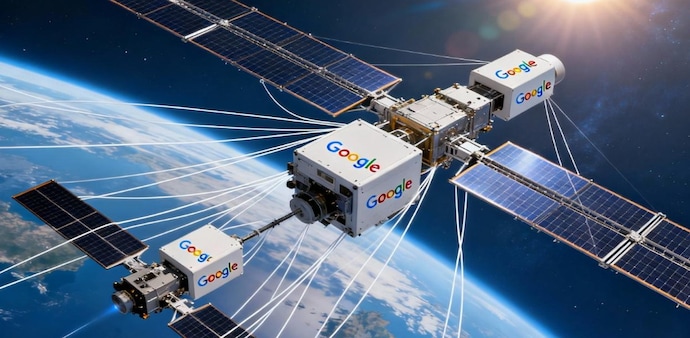
Google is exploring the idea of building AI computing infrastructure in space, powered by solar satellites equipped with AI chips. The tech giant is conducting first orbital tests by sending a prototype satellite next week as part of Project Suncatcher. The goal of the project is to examine whether future data centres could operate in orbit, eventually helping meet the growing energy and computing demands of AI.
Here’s everything you need to know about Google’s Project Suncatcher and Google’s plan for building an AI data centre in space.
Google’s prototype satellite testing
As mentioned above, Google will be sending a prototype satellite to test whether its AI hardware can function in the harsh conditions of space, involving launch forces, radiation, and extreme temperatures. The experiment is said to answer two research questions: Can AI computing infrastructure be deployed in space and eventually scaled into a network of satellites?
Alongside Google, companies like SpaceX and Starcloud are exploring similar possibilities of deploying data centres in low Earth orbit. Google’s satellite launch will be powered by its in-house Tensor Processing Units (TPUs), and will be placed into low Earth orbit.
Must read: Now, Google Gemini becomes latest AI model to break out & hack real companies
While the TPU passed internal testing, Google says that the biggest challenge would be cooling orbital data centers. In the company blog post, Google highlighted that TPUs generate a large amount of heat in a small area, which may result in chip overheating. “In space, there’s no airflow. In a vacuum, you can only diffuse heat via radiators, which requires a totally different approach to cooling electronics.”
The company is testing different cooling methods, and it's considering a combination of heat pipes and radiators to remove heat generated by the AI chips. Google has also tested the cooling technology inside a thermal vacuum chamber, which simulates the vacuum and thermal conditions of space. Now, Google will be conducting a TPU cooling system test in space. Google expects to learn from the space test and make improvements to the cooling system based on the results.
For Unparalleled coverage of India's Businesses and Economy – Subscribe to Business Today Magazine
Google is exploring the idea of building AI computing infrastructure in space, powered by solar satellites equipped with AI chips. The tech giant is conducting first orbital tests by sending a prototype satellite next week as part of Project Suncatcher. The goal of the project is to examine whether future data centres could operate in orbit, eventually helping meet the growing energy and computing demands of AI.
Here’s everything you need to know about Google’s Project Suncatcher and Google’s plan for building an AI data centre in space.
Google’s prototype satellite testing
As mentioned above, Google will be sending a prototype satellite to test whether its AI hardware can function in the harsh conditions of space, involving launch forces, radiation, and extreme temperatures. The experiment is said to answer two research questions: Can AI computing infrastructure be deployed in space and eventually scaled into a network of satellites?
Alongside Google, companies like SpaceX and Starcloud are exploring similar possibilities of deploying data centres in low Earth orbit. Google’s satellite launch will be powered by its in-house Tensor Processing Units (TPUs), and will be placed into low Earth orbit.
Must read: Now, Google Gemini becomes latest AI model to break out & hack real companies
While the TPU passed internal testing, Google says that the biggest challenge would be cooling orbital data centers. In the company blog post, Google highlighted that TPUs generate a large amount of heat in a small area, which may result in chip overheating. “In space, there’s no airflow. In a vacuum, you can only diffuse heat via radiators, which requires a totally different approach to cooling electronics.”
The company is testing different cooling methods, and it's considering a combination of heat pipes and radiators to remove heat generated by the AI chips. Google has also tested the cooling technology inside a thermal vacuum chamber, which simulates the vacuum and thermal conditions of space. Now, Google will be conducting a TPU cooling system test in space. Google expects to learn from the space test and make improvements to the cooling system based on the results.
For Unparalleled coverage of India's Businesses and Economy – Subscribe to Business Today Magazine