
Why Sarvam CEO believes India is set to hijack the global AI race on a budget
Speaking at the Global Fintech Fest, Kumar drew parallels between AI and India's digital payments journey. However, he acknowledged that adoption remains in flux, operating largely in silos.
- Sep 10, 2026,
- Updated Sep 10, 2026 8:24 AM IST
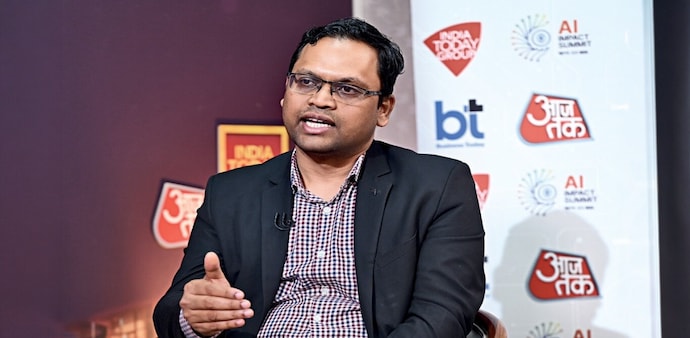
India may not have built the most capable or sophisticated artificial intelligence models yet, but it will build AI at scale in the coming years with a distinct cost advantage, according to Pratyush Kumar, co-founder and CEO of homegrown startup Sarvam.
"I am very comfortable believing that India will not only do it at scale, but also at the cost structure that works for a billion people. That is the opportunity India offers to the global effort in AI," Kumar said, highlighting finance and fintech as the primary drivers of innovation.
Banking and financial services firms have already begun deploying AI across various use cases, ranging from customer support chatbots to loan underwriting, cybersecurity, and fraud prevention.
Speaking at the Global Fintech Fest, Kumar drew parallels between AI and India's digital payments journey. In 2016, India was not among the top ten globally in digital payments, but it now accounts for over 60% of world transactions — a trajectory he expects AI to mirror.
"It is year four for of the Chat GPT launch. But in some sense it's year one for India building it's own AI. We had the (AI) Impact Summit in Delhi this year. We have now our own models, we have GPUs coming to India, we have talent getting skilled up in India, and I believe in the next 10 years, India will absolutely lead in AI, for adoption and building of it, " Kumar said.
He emphasised that just as India manufactures cars and steel, it must produce intelligence at scale through what he termed "token factories." Running on a large cluster of GPUs, Sarvam has served models at prices equal to or lower than global standards. To sustain this, India must build infrastructure capable of both serving models and hosting a stack for custom training.
Over the past year, Sarvam has logged 325 million minutes of voice AI natively, handles nearly 400 million API calls daily, and has digitized millions of documents.
"We have been working with organisations of quite some importance, whether it is on the public sector institutions like NPCI or SEBI or with private sector banks," Kumar added.
However, he acknowledged that adoption remains in flux, operating largely in silos. "There is some kind of apprehension and risk in making all these choices, whether it is deployment of voice, deployment of documents, there are a range of challenges," Kumar said.
To solve this, he urged the industry to adopt an "ecosystem view" to deploy AI swiftly, safely, and securely within regulated sectors, ensuring technology reaches tier 3, 4, and 5 regions where financial inclusion matters most.
For Unparalleled coverage of India's Businesses and Economy – Subscribe to Business Today Magazine
India may not have built the most capable or sophisticated artificial intelligence models yet, but it will build AI at scale in the coming years with a distinct cost advantage, according to Pratyush Kumar, co-founder and CEO of homegrown startup Sarvam.
"I am very comfortable believing that India will not only do it at scale, but also at the cost structure that works for a billion people. That is the opportunity India offers to the global effort in AI," Kumar said, highlighting finance and fintech as the primary drivers of innovation.
Banking and financial services firms have already begun deploying AI across various use cases, ranging from customer support chatbots to loan underwriting, cybersecurity, and fraud prevention.
Speaking at the Global Fintech Fest, Kumar drew parallels between AI and India's digital payments journey. In 2016, India was not among the top ten globally in digital payments, but it now accounts for over 60% of world transactions — a trajectory he expects AI to mirror.
"It is year four for of the Chat GPT launch. But in some sense it's year one for India building it's own AI. We had the (AI) Impact Summit in Delhi this year. We have now our own models, we have GPUs coming to India, we have talent getting skilled up in India, and I believe in the next 10 years, India will absolutely lead in AI, for adoption and building of it, " Kumar said.
He emphasised that just as India manufactures cars and steel, it must produce intelligence at scale through what he termed "token factories." Running on a large cluster of GPUs, Sarvam has served models at prices equal to or lower than global standards. To sustain this, India must build infrastructure capable of both serving models and hosting a stack for custom training.
Over the past year, Sarvam has logged 325 million minutes of voice AI natively, handles nearly 400 million API calls daily, and has digitized millions of documents.
"We have been working with organisations of quite some importance, whether it is on the public sector institutions like NPCI or SEBI or with private sector banks," Kumar added.
However, he acknowledged that adoption remains in flux, operating largely in silos. "There is some kind of apprehension and risk in making all these choices, whether it is deployment of voice, deployment of documents, there are a range of challenges," Kumar said.
To solve this, he urged the industry to adopt an "ecosystem view" to deploy AI swiftly, safely, and securely within regulated sectors, ensuring technology reaches tier 3, 4, and 5 regions where financial inclusion matters most.
For Unparalleled coverage of India's Businesses and Economy – Subscribe to Business Today Magazine