
Bengaluru startup's rocket engine marks a first: Can it become India's answer to SpaceX's Raptor?
Bengaluru startup's rocket engine marks a first: Can it become India's answer to SpaceX's Raptor?
The announcement has drawn comparisons with SpaceX's Raptor, the engine powering Starship, because Raptor remains the only Full-Flow Staged Combustion engine to have flown in space.
Subhankar Paul
- Aug 8, 2026,
- Updated Aug 8, 2026 6:00 AM IST
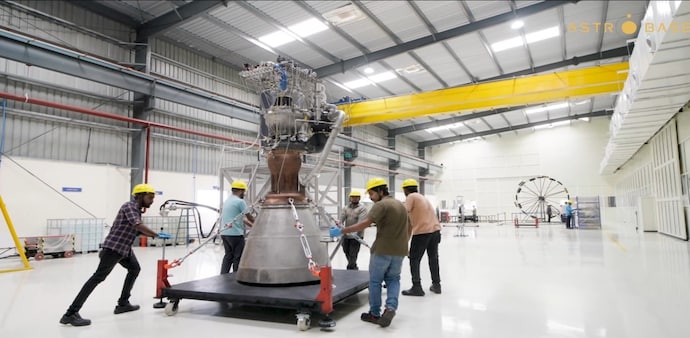
India's private space industry has taken a significant technological leap with the unveiling of the country's first indigenous Full-Flow Staged Combustion (FFSC) rocket engine. Developed by Bengaluru-based startup Astrobase Space Technologies, the 800-kilonewton (kN) "Everest" engine belongs to one of the rarest and most advanced classes of rocket propulsion ever attempted.
Advertisement
The announcement has drawn comparisons with SpaceX's Raptor, the engine powering Starship, because Raptor remains the only Full-Flow Staged Combustion engine to have flown in space. While India's engine is still awaiting full-scale hot-fire qualification, its development marks an important milestone for the country's ambitions in reusable launch vehicles and commercial spaceflight.
What exactly is a Full-Flow Staged Combustion engine?
A rocket engine needs turbopumps to force fuel and oxidiser into the combustion chamber at extremely high pressures.
Most engines use one of two common approaches:
- Gas-generator cycle: Burns a small amount of propellant to power the pumps, then discards that exhaust, sacrificing some efficiency.
- Staged combustion cycle: Routes one propellant through a preburner before sending it into the main combustion chamber, improving efficiency.
A Full-Flow Staged Combustion (FFSC) engine goes one step further.
Advertisement
Instead of using only one preburner, it employs two separate preburners:
- A fuel-rich preburner
- An oxidiser-rich preburner
Every kilogram of fuel and oxidiser first powers the turbopumps before entering the main combustion chamber. No propellant used to drive the pumps is wasted. That makes FFSC the most efficient chemical rocket engine architecture currently known.
Why is FFSC considered the "holy grail" of rocket engines?
Engineers often describe FFSC as the most difficult rocket engine architecture because it combines exceptional performance with extraordinary engineering complexity.
Key advantages include:
- Higher specific impulse (fuel efficiency)
- Extremely high chamber pressures
- Greater thrust from a compact engine
- Lower thermal stress on turbomachinery
- Better durability for repeated flights
- Improved reliability for reusable rockets
The challenge lies in materials science and precision engineering. Handling hot, oxygen-rich gases at very high pressures requires advanced alloys, sophisticated manufacturing techniques and highly precise control systems. Even small design flaws can destroy an engine during ignition.
Advertisement
Although Everest belongs to the same propulsion family as Raptor, it is not a direct competitor.
SpaceX's engine has undergone years of development, hundreds of hot-fire tests and multiple flight campaigns. Everest is currently at a much earlier stage, with the integrated engine moving toward full-scale qualification testing after earlier sub-scale demonstrations and turbopump trials.
Why this matters for India
Reusable rockets are the future: Launch providers worldwide are shifting toward reusable launch vehicles because they dramatically reduce launch costs. If India wants to compete with companies like SpaceX, Blue Origin and emerging Chinese launch providers, reusable propulsion technology will be essential.
It strengthens India's private space ecosystem: Until recently, advanced rocket engine development was largely confined to government space agencies. An Indian startup attempting one of the world's most complex propulsion technologies reflects the rapid growth of India's commercial space sector following regulatory reforms and support from IN-SPACe.
It complements ISRO's own roadmap: The development is separate from ISRO's ongoing semi-cryogenic engine programme, which uses a different propulsion cycle and fuel combination. ISRO has been advancing its semi-cryogenic propulsion programme for future upgrades to the LVM3 launch vehicle, while the FFSC engine represents a parallel leap by the private sector into reusable launch technology.
Advertisement
It reduces dependence on foreign technology: Developing indigenous high-performance propulsion gives India greater technological independence in launch services, satellite deployment and future deep-space missions. It also builds domestic expertise in advanced metallurgy, turbomachinery, precision manufacturing and high-performance control systems.
Is India now in the same league as SpaceX?
Not yet — but the gap has narrowed in one important area. SpaceX remains years ahead in operational maturity, having successfully flown FFSC engines on Starship. Astrobase must still demonstrate full-scale hot fires, repeated test campaigns and eventually successful launches before proving the technology.
However, reaching the stage of designing and integrating an indigenous FFSC engine is itself a significant engineering achievement. Only a handful of organisations worldwide have pursued this architecture because of its immense complexity.
For Unparalleled coverage of India's Businesses and Economy – Subscribe to Business Today Magazine
India's private space industry has taken a significant technological leap with the unveiling of the country's first indigenous Full-Flow Staged Combustion (FFSC) rocket engine. Developed by Bengaluru-based startup Astrobase Space Technologies, the 800-kilonewton (kN) "Everest" engine belongs to one of the rarest and most advanced classes of rocket propulsion ever attempted.
Advertisement
The announcement has drawn comparisons with SpaceX's Raptor, the engine powering Starship, because Raptor remains the only Full-Flow Staged Combustion engine to have flown in space. While India's engine is still awaiting full-scale hot-fire qualification, its development marks an important milestone for the country's ambitions in reusable launch vehicles and commercial spaceflight.
What exactly is a Full-Flow Staged Combustion engine?
A rocket engine needs turbopumps to force fuel and oxidiser into the combustion chamber at extremely high pressures.
Most engines use one of two common approaches:
- Gas-generator cycle: Burns a small amount of propellant to power the pumps, then discards that exhaust, sacrificing some efficiency.
- Staged combustion cycle: Routes one propellant through a preburner before sending it into the main combustion chamber, improving efficiency.
A Full-Flow Staged Combustion (FFSC) engine goes one step further.
Advertisement
Instead of using only one preburner, it employs two separate preburners:
- A fuel-rich preburner
- An oxidiser-rich preburner
Every kilogram of fuel and oxidiser first powers the turbopumps before entering the main combustion chamber. No propellant used to drive the pumps is wasted. That makes FFSC the most efficient chemical rocket engine architecture currently known.
Why is FFSC considered the "holy grail" of rocket engines?
Engineers often describe FFSC as the most difficult rocket engine architecture because it combines exceptional performance with extraordinary engineering complexity.
Key advantages include:
- Higher specific impulse (fuel efficiency)
- Extremely high chamber pressures
- Greater thrust from a compact engine
- Lower thermal stress on turbomachinery
- Better durability for repeated flights
- Improved reliability for reusable rockets
The challenge lies in materials science and precision engineering. Handling hot, oxygen-rich gases at very high pressures requires advanced alloys, sophisticated manufacturing techniques and highly precise control systems. Even small design flaws can destroy an engine during ignition.
Advertisement
Although Everest belongs to the same propulsion family as Raptor, it is not a direct competitor.
SpaceX's engine has undergone years of development, hundreds of hot-fire tests and multiple flight campaigns. Everest is currently at a much earlier stage, with the integrated engine moving toward full-scale qualification testing after earlier sub-scale demonstrations and turbopump trials.
Why this matters for India
Reusable rockets are the future: Launch providers worldwide are shifting toward reusable launch vehicles because they dramatically reduce launch costs. If India wants to compete with companies like SpaceX, Blue Origin and emerging Chinese launch providers, reusable propulsion technology will be essential.
It strengthens India's private space ecosystem: Until recently, advanced rocket engine development was largely confined to government space agencies. An Indian startup attempting one of the world's most complex propulsion technologies reflects the rapid growth of India's commercial space sector following regulatory reforms and support from IN-SPACe.
It complements ISRO's own roadmap: The development is separate from ISRO's ongoing semi-cryogenic engine programme, which uses a different propulsion cycle and fuel combination. ISRO has been advancing its semi-cryogenic propulsion programme for future upgrades to the LVM3 launch vehicle, while the FFSC engine represents a parallel leap by the private sector into reusable launch technology.
Advertisement
It reduces dependence on foreign technology: Developing indigenous high-performance propulsion gives India greater technological independence in launch services, satellite deployment and future deep-space missions. It also builds domestic expertise in advanced metallurgy, turbomachinery, precision manufacturing and high-performance control systems.
Is India now in the same league as SpaceX?
Not yet — but the gap has narrowed in one important area. SpaceX remains years ahead in operational maturity, having successfully flown FFSC engines on Starship. Astrobase must still demonstrate full-scale hot fires, repeated test campaigns and eventually successful launches before proving the technology.
However, reaching the stage of designing and integrating an indigenous FFSC engine is itself a significant engineering achievement. Only a handful of organisations worldwide have pursued this architecture because of its immense complexity.
For Unparalleled coverage of India's Businesses and Economy – Subscribe to Business Today Magazine
Read more!