
China’s new AI economy: People are licensing their faces and earning up to ₹15 lakh
Platforms such as ActID and New Claw allow users to register their faces after identity verification. Producers can then browse digital catalogues and search for faces based on age, gender and appearance, with categories including “girl-next-door”, “rugged” and “supermodel”.
- Sep 20, 2026,
- Updated Sep 20, 2026 10:54 AM IST
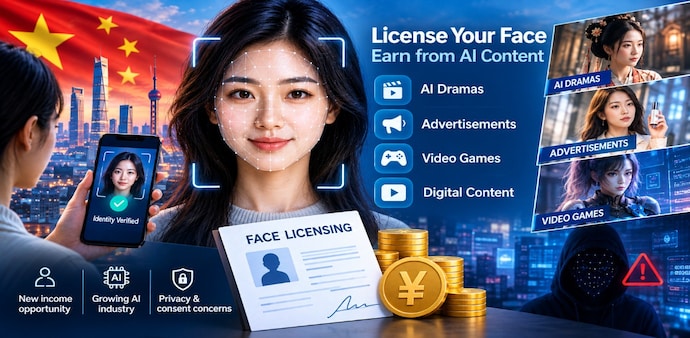
China’s artificial intelligence boom has created an unusual new income opportunity: people are licensing their facial likenesses for use in AI-generated dramas, advertisements, video games and digital content.
Fees on emerging face-licensing platforms reportedly range from 50 yuan (around ₹700) to 99,999 yuan, or approximately ₹14 lakh, reported by South China Morning Post. However, payouts depend on factors such as the permitted use, duration of the licence and the number of productions featuring a person’s face.
How the face-licensing market works
Platforms such as ActID and New Claw allow users to register their faces after identity verification. Producers can then browse digital catalogues and search for faces based on age, gender and appearance, with categories including “girl-next-door”, “rugged” and “supermodel”.
ALSO READ: AI agents are coming for every day tasks: What Goldman Sachs sees for the next AI growth wave
Users can also specify whether their faces may be used in television commercials, short-form dramas, video games or other content. In some cases, they can set their own prices and decide how many productions can use their likeness.
ActID said it had registered around 800 users since its launch in March, including professional extras, influencers and people without acting experience. About 300 users had agreed to license their images, while two AI drama productions had reportedly licensed around 10 faces through the platform.
The platform said fees for these projects ranged from 99 yuan to 500 yuan — approximately ₹1,400 to ₹7,000 — per episode, with ActID retaining a 10% commission.
People in China can now earn from their appearance without participating in every production. Shenzhen-based Yuanxiang Xinsheng, launched in May, and Chengdu-based Xinzhua, launched in April, allow creators to license faces for AI-generated dramas, advertisements and games. Xinzhua has around 370 digital actor profiles, with fees ranging from 500 yuan (approximately ₹7,000) to 6,000 yuan (around ₹85,000). Users can search for faces by gender, age, style and genre.
Demand rises as AI content expands
China’s fast-growing microdrama industry is driving demand for real faces. More than 95% of the 128,000 microdramas released in the country during the first three months of 2026 reportedly used AI during production.
Long Lyu, operations lead at New Claw, said the technology had already disrupted the entertainment business. “Whether actors and models choose to license their faces on our platform or not, AI has already disrupted the industry,” Lyu said. “Selling the rights to their photos gives them a way to earn while continuing their careers offline.”
One bank employee reportedly earned nearly 2,500 yuan—around ₹35,000—after an advertising company acquired his portrait seven times within three days, according to the National Business Daily.
DO CHECKOUT: A factory run by robots? Xpeng takes humanoid production to a new level
Consent and privacy concerns
The trend has also raised concerns over biometric data, consent and long-term control. Many lawyers warn that contracts may not clearly explain how a face can be modified or reused after it enters an AI marketplace.
Yile Deng, a Beijing-based lawyer handling AI-related portrait-rights cases, said the unclear scope of authorisation remained a major problem. She warned that users may not know who will ultimately use their likeness or for what purpose.
China has already seen several disputes involving unauthorised AI face swaps. ByteDance’s AI drama platform reportedly removed more than 85,000 videos involving unauthorised reproductions of people’s faces and voices since the beginning of 2026.
For Unparalleled coverage of India's Businesses and Economy – Subscribe to Business Today Magazine
China’s artificial intelligence boom has created an unusual new income opportunity: people are licensing their facial likenesses for use in AI-generated dramas, advertisements, video games and digital content.
Fees on emerging face-licensing platforms reportedly range from 50 yuan (around ₹700) to 99,999 yuan, or approximately ₹14 lakh, reported by South China Morning Post. However, payouts depend on factors such as the permitted use, duration of the licence and the number of productions featuring a person’s face.
How the face-licensing market works
Platforms such as ActID and New Claw allow users to register their faces after identity verification. Producers can then browse digital catalogues and search for faces based on age, gender and appearance, with categories including “girl-next-door”, “rugged” and “supermodel”.
ALSO READ: AI agents are coming for every day tasks: What Goldman Sachs sees for the next AI growth wave
Users can also specify whether their faces may be used in television commercials, short-form dramas, video games or other content. In some cases, they can set their own prices and decide how many productions can use their likeness.
ActID said it had registered around 800 users since its launch in March, including professional extras, influencers and people without acting experience. About 300 users had agreed to license their images, while two AI drama productions had reportedly licensed around 10 faces through the platform.
The platform said fees for these projects ranged from 99 yuan to 500 yuan — approximately ₹1,400 to ₹7,000 — per episode, with ActID retaining a 10% commission.
People in China can now earn from their appearance without participating in every production. Shenzhen-based Yuanxiang Xinsheng, launched in May, and Chengdu-based Xinzhua, launched in April, allow creators to license faces for AI-generated dramas, advertisements and games. Xinzhua has around 370 digital actor profiles, with fees ranging from 500 yuan (approximately ₹7,000) to 6,000 yuan (around ₹85,000). Users can search for faces by gender, age, style and genre.
Demand rises as AI content expands
China’s fast-growing microdrama industry is driving demand for real faces. More than 95% of the 128,000 microdramas released in the country during the first three months of 2026 reportedly used AI during production.
Long Lyu, operations lead at New Claw, said the technology had already disrupted the entertainment business. “Whether actors and models choose to license their faces on our platform or not, AI has already disrupted the industry,” Lyu said. “Selling the rights to their photos gives them a way to earn while continuing their careers offline.”
One bank employee reportedly earned nearly 2,500 yuan—around ₹35,000—after an advertising company acquired his portrait seven times within three days, according to the National Business Daily.
DO CHECKOUT: A factory run by robots? Xpeng takes humanoid production to a new level
Consent and privacy concerns
The trend has also raised concerns over biometric data, consent and long-term control. Many lawyers warn that contracts may not clearly explain how a face can be modified or reused after it enters an AI marketplace.
Yile Deng, a Beijing-based lawyer handling AI-related portrait-rights cases, said the unclear scope of authorisation remained a major problem. She warned that users may not know who will ultimately use their likeness or for what purpose.
China has already seen several disputes involving unauthorised AI face swaps. ByteDance’s AI drama platform reportedly removed more than 85,000 videos involving unauthorised reproductions of people’s faces and voices since the beginning of 2026.
For Unparalleled coverage of India's Businesses and Economy – Subscribe to Business Today Magazine