
Budget 2026: What is customs duty, how does it work? Industry's wishlist for Sitharaman
Recent pre-budget talks highlight customs duty reforms as a game-changer because India's current complex structure, with over eight slabs (0-40%+), thousands of exemptions, and inverted duties
- Jan 23, 2026,
- Updated Feb 1, 2026 11:41 AM IST
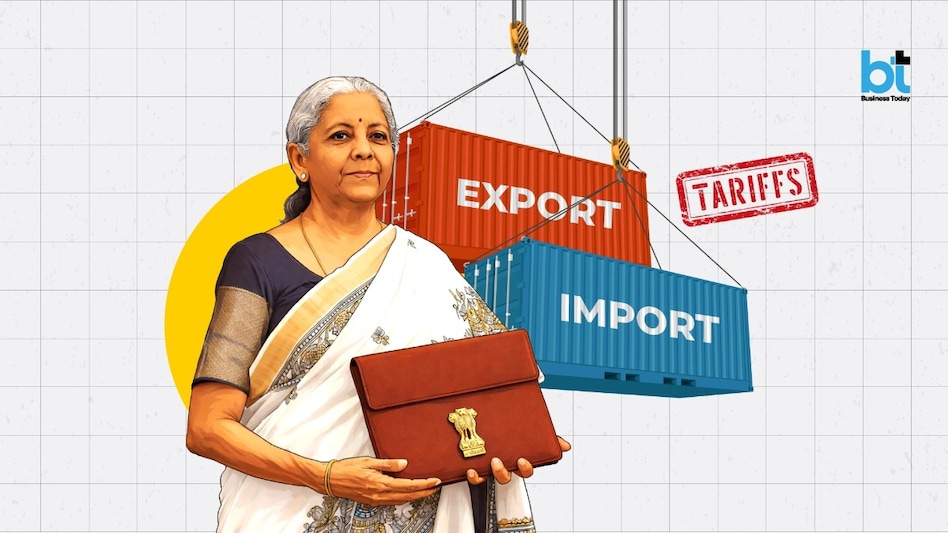
Budget 2026 | Union Finance Minister Nirmala Sitharaman’s presented her ninth consecutive Budget in the Parliament on February 1 2026. The Finance Minister emphasised that the government has consistently chosen reform over rhetoric and addressed global uncertainty.
Recent pre-budget talks highlight customs duty reforms as a game-changer because India's current complex structure, with over eight slabs (0-40%+), thousands of exemptions, and inverted duties, locks up ₹24,000 crore in disputes, delays clearances by weeks, and erodes SME competitiveness in exports amid global tariffs, while simplification could unlock working capital, cut litigation by 70%, speed AI-driven approvals to hours, and boost manufacturing value addition under PLI schemes
What is customs duty, how does it work?
Customs duty is a tax on imported and some exported goods, protecting local industries from cheap foreign competition, generating over ₹2 lakh crore yearly revenue, and regulating trade under the Customs Act, 1962. Levied at ports and airports, it comprises Basic Customs Duty (BCD, typically 0-40% based on item value), plus Social Welfare Surcharge (10% of BCD), Agriculture Infrastructure Cess (AIDC on select goods), and IGST (up to 28%). Assessable value includes FOB cost, freight, and insurance; for example, a ₹1 lakh gadget at 20% BCD adds ₹20,000 duty before other levies.
Industry expectations on customs duty
Ahead of Budget 2026, industry demands GST-style simplification as the current eight slabs (0%, 5%, 10%, 15%, 20%, 25%, 30%, 40%+) create complexity with specific rates, mixed duties, and disputes worth ₹24,000 crore, hurting SMEs.
Think tanks like GTRI have sought consolidation into 4-5 transparent slabs based on total duty (BCD + cesses), a single tariff schedule, and a zero-base audit of rules.
"India needs to simplify its customs duty structure by cutting the actual number of duty slabs, instead of only tweaking the basic customs duty (BCD) rates".
Budget 2026 | Union Finance Minister Nirmala Sitharaman’s presented her ninth consecutive Budget in the Parliament on February 1 2026. The Finance Minister emphasised that the government has consistently chosen reform over rhetoric and addressed global uncertainty.
Recent pre-budget talks highlight customs duty reforms as a game-changer because India's current complex structure, with over eight slabs (0-40%+), thousands of exemptions, and inverted duties, locks up ₹24,000 crore in disputes, delays clearances by weeks, and erodes SME competitiveness in exports amid global tariffs, while simplification could unlock working capital, cut litigation by 70%, speed AI-driven approvals to hours, and boost manufacturing value addition under PLI schemes
What is customs duty, how does it work?
Customs duty is a tax on imported and some exported goods, protecting local industries from cheap foreign competition, generating over ₹2 lakh crore yearly revenue, and regulating trade under the Customs Act, 1962. Levied at ports and airports, it comprises Basic Customs Duty (BCD, typically 0-40% based on item value), plus Social Welfare Surcharge (10% of BCD), Agriculture Infrastructure Cess (AIDC on select goods), and IGST (up to 28%). Assessable value includes FOB cost, freight, and insurance; for example, a ₹1 lakh gadget at 20% BCD adds ₹20,000 duty before other levies.
Industry expectations on customs duty
Ahead of Budget 2026, industry demands GST-style simplification as the current eight slabs (0%, 5%, 10%, 15%, 20%, 25%, 30%, 40%+) create complexity with specific rates, mixed duties, and disputes worth ₹24,000 crore, hurting SMEs.
Think tanks like GTRI have sought consolidation into 4-5 transparent slabs based on total duty (BCD + cesses), a single tariff schedule, and a zero-base audit of rules.
"India needs to simplify its customs duty structure by cutting the actual number of duty slabs, instead of only tweaking the basic customs duty (BCD) rates".