
Union Budget 2026: Manufacturing, infrastructure, textile dominate FM Sitharaman’s ninth budget
Budget 2026: FM Sitharaman’s Union Budget 2026 took off with the announcements for manufacturing in the seven frontier sectors.
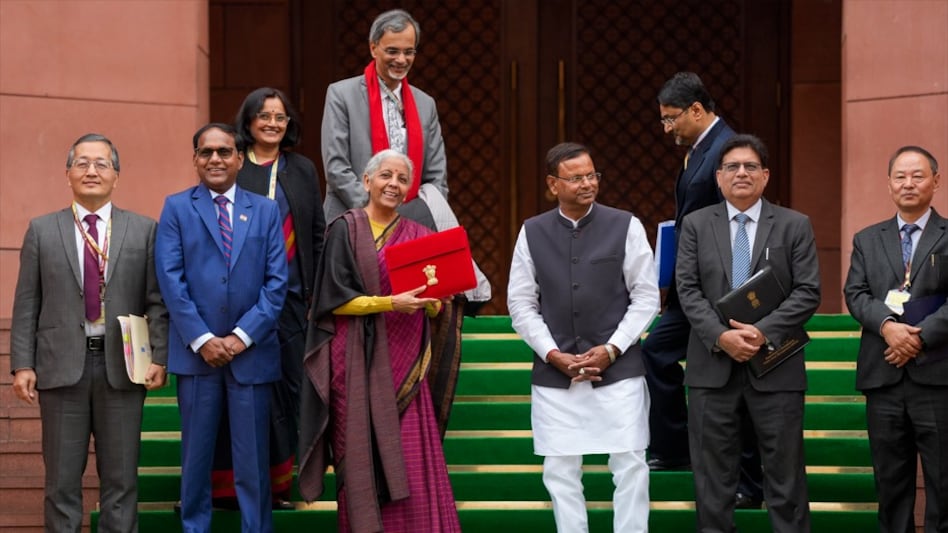
- Feb 1, 2026,
- Updated Feb 1, 2026 2:08 PM IST
Union Budget 2026: Finance Minister Nirmala Sitharaman’s ninth budget was driven by ‘yuva-shakti’, encompassing a boost to economic growth, aspirations and equal access. She said it was the three ‘kartavyas’ that drove the formation of this budget – a nod to the fact that this was the first Union Budget prepared at the Kartavya Bhawan.
She detailed the three kartavyas – to accelerate and sustain economic growth, to fulfill the aspirations of the people, and to ensure equal access to every citizen – that inspired the many of the proposals.
FM Sitharaman’s Union Budget 2026 took off with the announcements for manufacturing in the seven frontier sectors. She proposed the Biopharma SHAKTI with an outlay of Rs 10,000 crore over the next five years to build an ecosystem for domestic production of biologics and biosimilars, and establishing three new National Institutes of Pharmaceutical Education and Research (NIPERs).
The minister announced the second phase of the India Semiconductor Mission, increasing the outlay of the Electronics Components Manufacturing Scheme to Rs 40,000 crore, supporting the mineral-rich states of Odisha, Kerala, Andhra Pradesh and Tamil Nadu to establish dedicated rare earth corridors, and establishing three dedicated chemical parks.
To enhance capital goods capability, the finance minister announced the establishment of high-tech tool rooms at two locations to “design, test, and manufacture high-precision components at scale and at lower cost” and a scheme for container manufacturing with a budgetary allocation of Rs 10,000 crore across five years.
Textile was under the focus as FM Sitharaman announced an integrated programme with five sub-parts including the National Fibre Scheme, the Textile Expansion and Employment Scheme, the National Handloom and Handicraft programme, the Tex-Eco Initiative, and Samarth 2.0. With the proposal to set up Mega Textile parks and launching the Mahatma Gandhi Gram Swaraj initiative, and a dedicated initiative for sports goods to promote manufacturing, research and innovation for equipment design and material sciences, the textile sector received FM Sitharaman’s unwavering focus.
For what FM Sitharaman announced on Income-Tax, follow:
NRI taxes: Budget 2026 proposes simplification of TDS process for inland property sales
Union Budget 2026: New Income Tax Act to come into force from April 1, says FM Sitharaman
Reviving 200 legacy industrial clusters, creating ‘champion’ SMEs, introducing Rs 10,000 crore SME Growth Fund, and topping up the Self-Reliant India Fund for MSMEs with Rs 2,000 crore.
More than Rs 7 lakh crore has been made available to MSMEs with TReDS, and facilitation of professional institutions such as ICAI, ICSI, ICMAI to design short-term, modular courses and practical tools to develop a cadre of ‘corporate mitras’, said FM Sitharaman.
Sitharaman announced that public capex has increased manifold to Rs 12.2 lakh crore.
She also announced the establishment of Dedicated Freight Corridors, 20 new National Waterways (NW) over next five years, a ship repair ecosystem, a Coastal Cargo Promotion Scheme, and a Seaplane VGF Scheme.
Further amplification of cities by mapping city economic regions, establishment of seven High-Speed Rail corridors between cities, setting up of a High Level Committee on Banking, restructuring of the Power Finance Corporation and Rural Electrification Corporation, and a comprehensive review of the Foreign Exchange Management (Non-debt Instruments) Rules were also announced.
Sitharaman announced that individual Persons Resident Outside India (PROI) will be permitted to invest in equity instruments of listed Indian companies through the Portfolio Investment Scheme. She added that 100,000 Allied Health Professionals (AHPs) will be added, and five Regional Medical Hubs will be established.
Five university townships and a girls’ hostel in every district were also announced. A National Institute of Hospitality, a pilot scheme for upskilling 10,000 guides in 20 locations, and a National Destination Digital Knowledge Grid were also announced.
FM Sitharaman announced the Khelo India Mission to transform the sports sector over the next decade, as well as increase farmer incomes, setting up of Self-Help Entrepreneur (SHE) Marts, Divyangjan Kaushal Yojana and Divyang Sahara Yojana. Setting up NIMHANS 2 as well as Buddhist sites in the Northeast were announced too.
Union Budget 2026: Finance Minister Nirmala Sitharaman’s ninth budget was driven by ‘yuva-shakti’, encompassing a boost to economic growth, aspirations and equal access. She said it was the three ‘kartavyas’ that drove the formation of this budget – a nod to the fact that this was the first Union Budget prepared at the Kartavya Bhawan.
She detailed the three kartavyas – to accelerate and sustain economic growth, to fulfill the aspirations of the people, and to ensure equal access to every citizen – that inspired the many of the proposals.
FM Sitharaman’s Union Budget 2026 took off with the announcements for manufacturing in the seven frontier sectors. She proposed the Biopharma SHAKTI with an outlay of Rs 10,000 crore over the next five years to build an ecosystem for domestic production of biologics and biosimilars, and establishing three new National Institutes of Pharmaceutical Education and Research (NIPERs).
The minister announced the second phase of the India Semiconductor Mission, increasing the outlay of the Electronics Components Manufacturing Scheme to Rs 40,000 crore, supporting the mineral-rich states of Odisha, Kerala, Andhra Pradesh and Tamil Nadu to establish dedicated rare earth corridors, and establishing three dedicated chemical parks.
To enhance capital goods capability, the finance minister announced the establishment of high-tech tool rooms at two locations to “design, test, and manufacture high-precision components at scale and at lower cost” and a scheme for container manufacturing with a budgetary allocation of Rs 10,000 crore across five years.
Textile was under the focus as FM Sitharaman announced an integrated programme with five sub-parts including the National Fibre Scheme, the Textile Expansion and Employment Scheme, the National Handloom and Handicraft programme, the Tex-Eco Initiative, and Samarth 2.0. With the proposal to set up Mega Textile parks and launching the Mahatma Gandhi Gram Swaraj initiative, and a dedicated initiative for sports goods to promote manufacturing, research and innovation for equipment design and material sciences, the textile sector received FM Sitharaman’s unwavering focus.
For what FM Sitharaman announced on Income-Tax, follow:
NRI taxes: Budget 2026 proposes simplification of TDS process for inland property sales
Union Budget 2026: New Income Tax Act to come into force from April 1, says FM Sitharaman
Reviving 200 legacy industrial clusters, creating ‘champion’ SMEs, introducing Rs 10,000 crore SME Growth Fund, and topping up the Self-Reliant India Fund for MSMEs with Rs 2,000 crore.
More than Rs 7 lakh crore has been made available to MSMEs with TReDS, and facilitation of professional institutions such as ICAI, ICSI, ICMAI to design short-term, modular courses and practical tools to develop a cadre of ‘corporate mitras’, said FM Sitharaman.
Sitharaman announced that public capex has increased manifold to Rs 12.2 lakh crore.
She also announced the establishment of Dedicated Freight Corridors, 20 new National Waterways (NW) over next five years, a ship repair ecosystem, a Coastal Cargo Promotion Scheme, and a Seaplane VGF Scheme.
Further amplification of cities by mapping city economic regions, establishment of seven High-Speed Rail corridors between cities, setting up of a High Level Committee on Banking, restructuring of the Power Finance Corporation and Rural Electrification Corporation, and a comprehensive review of the Foreign Exchange Management (Non-debt Instruments) Rules were also announced.
Sitharaman announced that individual Persons Resident Outside India (PROI) will be permitted to invest in equity instruments of listed Indian companies through the Portfolio Investment Scheme. She added that 100,000 Allied Health Professionals (AHPs) will be added, and five Regional Medical Hubs will be established.
Five university townships and a girls’ hostel in every district were also announced. A National Institute of Hospitality, a pilot scheme for upskilling 10,000 guides in 20 locations, and a National Destination Digital Knowledge Grid were also announced.
FM Sitharaman announced the Khelo India Mission to transform the sports sector over the next decade, as well as increase farmer incomes, setting up of Self-Help Entrepreneur (SHE) Marts, Divyangjan Kaushal Yojana and Divyang Sahara Yojana. Setting up NIMHANS 2 as well as Buddhist sites in the Northeast were announced too.