
Ashneer Grover slams Union Budget 2026 as ‘bilkul time waste’, reaction goes viral
Union Budget 2026: The criticism came amid sharp volatility on Dalal Street after Finance Minister Nirmala Sitharaman proposed an increase in the Securities Transaction Tax (STT) on derivatives, a move aimed at curbing excessive speculation in the futures and options (F&O) segment.
- Feb 1, 2026,
- Updated Feb 1, 2026 6:12 PM IST
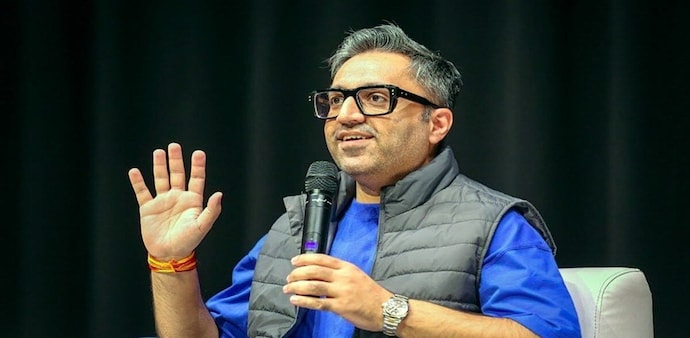
The Union Budget 2026 has drawn sharp reactions former BharatPe co-founder Ashneer Grover, who called it a complete waste of time.
Taking to X (formerly Twitter), Grover described the Budget as “Bilkul time waste,” invoking a line from his popular Shark Tank India rebuke. “This budget reminded of my rebuke on Shark Tank to one of the pitchers: ‘Bilkul time waste kiya aapne – apna bhi aur humara bhi!’” he wrote, reflecting broader frustration among sections of market participants.
The criticism came amid sharp volatility on Dalal Street after Finance Minister Nirmala Sitharaman proposed an increase in the Securities Transaction Tax (STT) on derivatives, a move aimed at curbing excessive speculation in the futures and options (F&O) segment.
Follow live coverage on Union Budget here
Equity benchmarks reversed early gains and plunged deep into the red. The Sensex crashed as much as 2,370.36 points, or 2.88%, during intraday trade to slip below the 80,000 mark at 79,899.42. It later pared losses but still ended the session down 1,546.84 points, or 1.88%, at 80,722.94.
The Nifty also witnessed heavy selling pressure, tumbling 495.20 points, or 1.96%, to close at 24,825.45. At its lowest point during the day, the index plunged nearly 749 points, or 2.95%, to 24,571.75.
Despite the market reaction, Sitharaman defended the broader intent of her ninth straight Budget, stating it was guided by three “Kartavyas” or responsibilities — accelerating and sustaining economic growth by enhancing competitiveness, fulfilling the aspirations of citizens, and ensuring that every family, community and region has access to resources and opportunities for participation.
Unveiling a ₹53.5 lakh crore Budget, the Finance Minister announced a slew of measures to boost manufacturing, a tax holiday for global data centres, and targeted incentives for agriculture and tourism, positioning the Budget as a long-term blueprint to sustain growth amid rising global risks.
The government also raised its capital expenditure outlay to ₹12.2 lakh crore from ₹11.2 lakh crore last year, reinforcing its focus on infrastructure-led growth at a time of global economic uncertainty.
While there were no changes to income tax slabs, Sitharaman announced that the New Tax Act would come into force from April 1, 2026. The Budget presentation was also historic, marking the first time India’s Union Budget was presented on a Sunday.
Even as the government highlighted its vision of “Sabka Vikas” through sustained public investment and structural reforms, reactions like Grover’s underscore the growing divide between long-term policy objectives and short-term market sentiment in a Budget that continues to spark debate across India’s economic landscape.
The Union Budget 2026 has drawn sharp reactions former BharatPe co-founder Ashneer Grover, who called it a complete waste of time.
Taking to X (formerly Twitter), Grover described the Budget as “Bilkul time waste,” invoking a line from his popular Shark Tank India rebuke. “This budget reminded of my rebuke on Shark Tank to one of the pitchers: ‘Bilkul time waste kiya aapne – apna bhi aur humara bhi!’” he wrote, reflecting broader frustration among sections of market participants.
The criticism came amid sharp volatility on Dalal Street after Finance Minister Nirmala Sitharaman proposed an increase in the Securities Transaction Tax (STT) on derivatives, a move aimed at curbing excessive speculation in the futures and options (F&O) segment.
Follow live coverage on Union Budget here
Equity benchmarks reversed early gains and plunged deep into the red. The Sensex crashed as much as 2,370.36 points, or 2.88%, during intraday trade to slip below the 80,000 mark at 79,899.42. It later pared losses but still ended the session down 1,546.84 points, or 1.88%, at 80,722.94.
The Nifty also witnessed heavy selling pressure, tumbling 495.20 points, or 1.96%, to close at 24,825.45. At its lowest point during the day, the index plunged nearly 749 points, or 2.95%, to 24,571.75.
Despite the market reaction, Sitharaman defended the broader intent of her ninth straight Budget, stating it was guided by three “Kartavyas” or responsibilities — accelerating and sustaining economic growth by enhancing competitiveness, fulfilling the aspirations of citizens, and ensuring that every family, community and region has access to resources and opportunities for participation.
Unveiling a ₹53.5 lakh crore Budget, the Finance Minister announced a slew of measures to boost manufacturing, a tax holiday for global data centres, and targeted incentives for agriculture and tourism, positioning the Budget as a long-term blueprint to sustain growth amid rising global risks.
The government also raised its capital expenditure outlay to ₹12.2 lakh crore from ₹11.2 lakh crore last year, reinforcing its focus on infrastructure-led growth at a time of global economic uncertainty.
While there were no changes to income tax slabs, Sitharaman announced that the New Tax Act would come into force from April 1, 2026. The Budget presentation was also historic, marking the first time India’s Union Budget was presented on a Sunday.
Even as the government highlighted its vision of “Sabka Vikas” through sustained public investment and structural reforms, reactions like Grover’s underscore the growing divide between long-term policy objectives and short-term market sentiment in a Budget that continues to spark debate across India’s economic landscape.