
'Chennai-Bengaluru in 1:13 hours, Varanasi-Siliguri in 2:55': Ashwini Vaishnaw maps high-speed rail plan
Union Budget 2026: Finance Minister Nirmala Sitharaman, while presenting the Budget 2026 on Sunday, announced that the government will develop seven high-speed rail corridors
- Feb 2, 2026,
- Updated Feb 2, 2026 6:46 PM IST
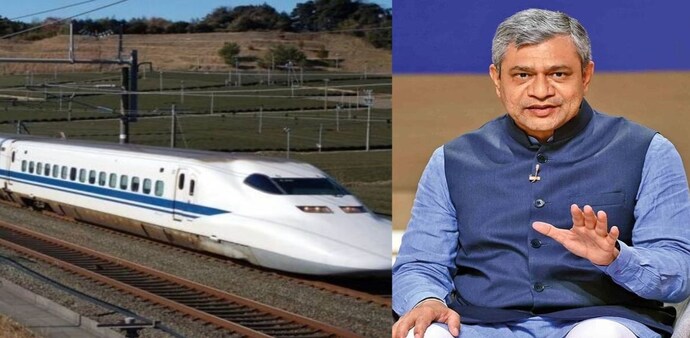
Budget 2026 | Union Minister Ashwini Vaishnaw on Sunday detailed how the seven new high-speed rail corridors announced in Budget 2026 could dramatically cut travel time between major cities — including Chennai to Bengaluru in just 1 hour and 13 minutes and Varanasi to Siliguri in 2 hours and 55 minutes.
Finance Minister Nirmala Sitharaman, while presenting the Budget 2026 on Sunday, announced that the government will develop seven high-speed rail corridors between cities, namely i) Mumbai-Pune, ii) Pune-Hyderabad, iii) Hyderabad-Bengaluru, iv) Hyderabad-Chennai, v) Chennai-Bengaluru, vi) Delhi-Varanasi, vii) Varanasi-Siliguri.
"Today, the seven new high-speed corridors have been announced...this triangle will be a big boost for the economy of five south Indian states - Karnataka, Telangana, Andhra, Tamil Nadu, Kerala, and the Union Territory of Puducherry," Vaishnaw said while speaking to Business Today Group Editor Siddharth Zarabi.
He outlined the proposed travel times across the southern high-speed network. "Chennai-Bengaluru will become a journey of just 1 hour and 13 minutes. Bengaluru-Hyderabad will be a journey of 2 hours. Chennai-Hyderabad will be a journey of 2 hours 55 minutes," he said.
Vaishnaw said western India will also see big gains once the new corridors become operational. "Then Mumbai-Pune will be a journey of just 48 minutes, less than 1 hour. Pune-Hyderabad will be a journey of 1 hour and 55 minutes only," he said.
The railway minister described the connectivity as a shift that goes beyond transport, linking it directly to daily life and economic output. "This kind of connectivity will bring an immense change in the lives of people. These are large cities, large economies. When they get connected, the multiplier is huge," Vaishnaw said.
He also explained how the northern corridors could reshape movement along a key stretch anchored by Delhi, Varanasi, Patna, and Siliguri. "Then comes the north Indian corridor from Delhi to Varanasi and then Varanasi to Siliguri via Patna. Delhi to Varanasi will be just 3 hours and 50 minutes. Varanasi-Siliguri will be just 2 hours and 55 minutes," he said.
Vaishnaw said the impact would be felt across healthcare, education, tourism, and economic activity. "Whether it is for you are moving for healthcare for education for economic work for leisure tourism this becomes a major economic multiplier," he said.
The minister said the rollout would mean a large expansion of high-speed rail construction over the coming years. "This is about 4,000 km of high-speed rail to be constructed in the coming years," he said.
He also argued that the biggest advantage India now has is experience from the first corridor (which is the Ahmedabad-Mumbai corridor), with teams having absorbed key technologies and improved construction methods.
"The good thing is that in the first corridor, the learning curve has been climbed. The learning curve is now behind us. We understand the technology very well. The construction technology, the track technology, the rolling stock, the train technology, the signaling technology, all those things have been absorbed by our teams,” Vaishnaw said.
He added that India’s project execution has already fed into innovation — including practices that Japan itself may adopt. "We have made many innovations in construction technology. Some of the innovations the Japanese want to take back to their country when they do the next corridor out there in Japan," he said.
On Monday, during a press conference, Vaishnaw revealed that the high-speed railway will have a speed of 350 km per hour. He also informed that the bullet train that will go to Siliguri will, in the future, also connect Guwahati.
Budget 2026 | Union Minister Ashwini Vaishnaw on Sunday detailed how the seven new high-speed rail corridors announced in Budget 2026 could dramatically cut travel time between major cities — including Chennai to Bengaluru in just 1 hour and 13 minutes and Varanasi to Siliguri in 2 hours and 55 minutes.
Finance Minister Nirmala Sitharaman, while presenting the Budget 2026 on Sunday, announced that the government will develop seven high-speed rail corridors between cities, namely i) Mumbai-Pune, ii) Pune-Hyderabad, iii) Hyderabad-Bengaluru, iv) Hyderabad-Chennai, v) Chennai-Bengaluru, vi) Delhi-Varanasi, vii) Varanasi-Siliguri.
"Today, the seven new high-speed corridors have been announced...this triangle will be a big boost for the economy of five south Indian states - Karnataka, Telangana, Andhra, Tamil Nadu, Kerala, and the Union Territory of Puducherry," Vaishnaw said while speaking to Business Today Group Editor Siddharth Zarabi.
He outlined the proposed travel times across the southern high-speed network. "Chennai-Bengaluru will become a journey of just 1 hour and 13 minutes. Bengaluru-Hyderabad will be a journey of 2 hours. Chennai-Hyderabad will be a journey of 2 hours 55 minutes," he said.
Vaishnaw said western India will also see big gains once the new corridors become operational. "Then Mumbai-Pune will be a journey of just 48 minutes, less than 1 hour. Pune-Hyderabad will be a journey of 1 hour and 55 minutes only," he said.
The railway minister described the connectivity as a shift that goes beyond transport, linking it directly to daily life and economic output. "This kind of connectivity will bring an immense change in the lives of people. These are large cities, large economies. When they get connected, the multiplier is huge," Vaishnaw said.
He also explained how the northern corridors could reshape movement along a key stretch anchored by Delhi, Varanasi, Patna, and Siliguri. "Then comes the north Indian corridor from Delhi to Varanasi and then Varanasi to Siliguri via Patna. Delhi to Varanasi will be just 3 hours and 50 minutes. Varanasi-Siliguri will be just 2 hours and 55 minutes," he said.
Vaishnaw said the impact would be felt across healthcare, education, tourism, and economic activity. "Whether it is for you are moving for healthcare for education for economic work for leisure tourism this becomes a major economic multiplier," he said.
The minister said the rollout would mean a large expansion of high-speed rail construction over the coming years. "This is about 4,000 km of high-speed rail to be constructed in the coming years," he said.
He also argued that the biggest advantage India now has is experience from the first corridor (which is the Ahmedabad-Mumbai corridor), with teams having absorbed key technologies and improved construction methods.
"The good thing is that in the first corridor, the learning curve has been climbed. The learning curve is now behind us. We understand the technology very well. The construction technology, the track technology, the rolling stock, the train technology, the signaling technology, all those things have been absorbed by our teams,” Vaishnaw said.
He added that India’s project execution has already fed into innovation — including practices that Japan itself may adopt. "We have made many innovations in construction technology. Some of the innovations the Japanese want to take back to their country when they do the next corridor out there in Japan," he said.
On Monday, during a press conference, Vaishnaw revealed that the high-speed railway will have a speed of 350 km per hour. He also informed that the bullet train that will go to Siliguri will, in the future, also connect Guwahati.