
Budget 2026: India to set up and upgrade 4 telescope locations to boost astronomy and astrophysics
Union Budget 2026: The Union Budget 2026 has announced the setting up and upgradation of four telescopes and astronomy facilities to promote research in astrophysics and astronomy in India.
- Feb 1, 2026,
- Updated Feb 1, 2026 12:27 PM IST
Union Budget 2026: Finance Minister Nirmala Sitharaman, during her Union Budget 2026 speech, has announced the setting up and upgradation of 4 major telescopes in India, to promote astrophysics and astronomy, via immersive experiences.
The four facilities identified under the Budget announcement include the National Large Solar Telescope (NLST), the National Large Optical Infrared Telescope (NLOT), the Himalayan Chandra Telescope, and the COSMOS 2 Planetarium. All of which aim to cement India’s position as a global leader in space research.
One of the flagship projects is the National Large Solar Telescope (NLST), which will be dedicated to keeping a close eye on the Sun. By capturing high-resolution images of solar activity and magnetic fields, this facility will help scientists predict "space weather" events. These solar storms are more than just a scientific curiosity; they have the potential to disrupt the satellites, communication networks, and power grids we rely on every day. Once finished, it will be one of the most advanced solar observatories on the planet.
The National Large Optical Infrared Telescope (NLOT) will be set up to provide a window into the distant past. This telescope will specialise in spotting faint objects that are millions of light-years away, such as newborn stars, distant galaxies, and planets orbiting other suns. By using infrared technology, it can "see" through cosmic dust clouds, allowing researchers to study how the universe evolved and how planetary systems are formed.
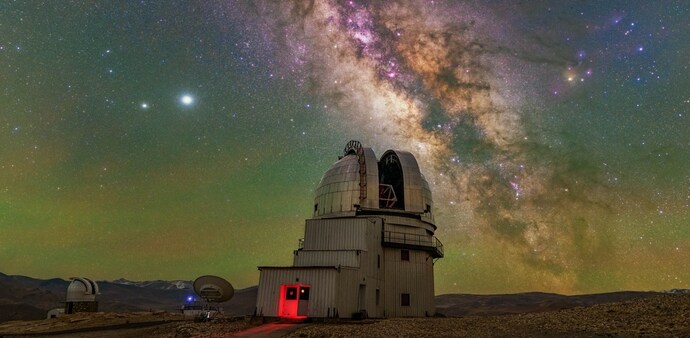
The government is also modernising existing infrastructure by upgrading the Himalayan Chandra Telescope in Ladakh. Situated at one of the highest points in the world, this observatory already benefits from incredibly clear, thin air, which is perfect for stargazing.
Finally, the new COSMOS 2 Planetarium will bring the wonders of space down to Earth for the general public. Designed as a modern education hub, it will focus on inspiring students and curious minds through interactive displays and celestial shows. Together, these four projects represent a major commitment to scientific discovery, ensuring that India not only studies the stars but also inspires the next generation of scientists to reach for them.
Union Budget 2026: Finance Minister Nirmala Sitharaman, during her Union Budget 2026 speech, has announced the setting up and upgradation of 4 major telescopes in India, to promote astrophysics and astronomy, via immersive experiences.
The four facilities identified under the Budget announcement include the National Large Solar Telescope (NLST), the National Large Optical Infrared Telescope (NLOT), the Himalayan Chandra Telescope, and the COSMOS 2 Planetarium. All of which aim to cement India’s position as a global leader in space research.
One of the flagship projects is the National Large Solar Telescope (NLST), which will be dedicated to keeping a close eye on the Sun. By capturing high-resolution images of solar activity and magnetic fields, this facility will help scientists predict "space weather" events. These solar storms are more than just a scientific curiosity; they have the potential to disrupt the satellites, communication networks, and power grids we rely on every day. Once finished, it will be one of the most advanced solar observatories on the planet.
The National Large Optical Infrared Telescope (NLOT) will be set up to provide a window into the distant past. This telescope will specialise in spotting faint objects that are millions of light-years away, such as newborn stars, distant galaxies, and planets orbiting other suns. By using infrared technology, it can "see" through cosmic dust clouds, allowing researchers to study how the universe evolved and how planetary systems are formed.
The government is also modernising existing infrastructure by upgrading the Himalayan Chandra Telescope in Ladakh. Situated at one of the highest points in the world, this observatory already benefits from incredibly clear, thin air, which is perfect for stargazing.
Finally, the new COSMOS 2 Planetarium will bring the wonders of space down to Earth for the general public. Designed as a modern education hub, it will focus on inspiring students and curious minds through interactive displays and celestial shows. Together, these four projects represent a major commitment to scientific discovery, ensuring that India not only studies the stars but also inspires the next generation of scientists to reach for them.