
Budget 2026: Who presented India’s first Union Budget after Independence and when
Union Budget 2026: India became independent in August 1947, but its first Budget was presented even before the Constitution came into force on January 26, 1950
- Jan 26, 2026,
- Updated Feb 1, 2026 12:01 PM IST
Budget 2026 | Union Finance Minister Nirmala Sitharaman’s presented her ninth consecutive Budget in the Parliament on February 1 2026. The Finance Minister emphasised that the government has consistently chosen reform over rhetoric and addressed global uncertainty.
Delivered at a time when the nation was still finding its footing, the first Budget played a crucial role in ensuring financial continuity during an extraordinary political and economic transition.
India became independent in August 1947, but its first Budget was presented even before the Constitution came into force on January 26, 1950. During this interim period, the country was governed under transitional constitutional arrangements, while its core institutions were still being established.
When was India’s first Union Budget presented after Independence?
India’s first Union Budget after Independence was presented on November 26, 1947, barely three months after the end of British rule. Unlike the annual Budgets presented today, this was a short-term or interim budget, covering the period from August 15, 1947, to March 31, 1948. Its limited timeframe reflected the government’s immediate priority of stabilising public finances during the transition.
Who presented the first Budget of independent India?
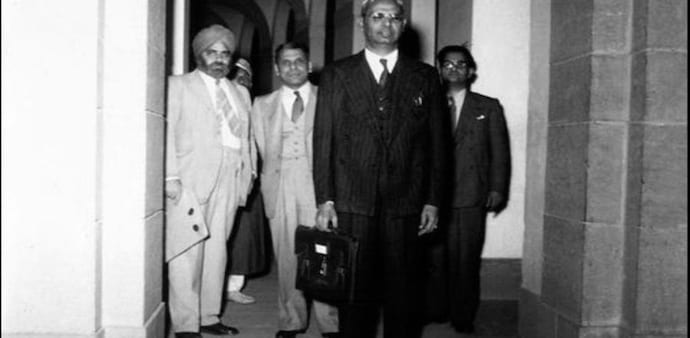
The first Budget of independent India was presented by R. K. Shanmukham Chetty, the country’s first Finance Minister. An economist and constitutional expert, Chetty faced the daunting task of managing an economy disrupted by Partition, large-scale refugee rehabilitation, food shortages and severely constrained foreign exchange reserves.
Why was the first Union Budget introduced?
The primary objective of the first post-Independence Budget was stability, not reform. The government aimed to:
- Manage the economic fallout of Partition
- Ensure continuity in revenue collection and public expenditure
- Fund essential services, including administration and defence
- Lay the foundation for long-term economic planning
Rather than introducing sweeping policy changes or new taxes, the Budget focused on prudence and administrative continuity.
Lesser-known facts about India’s first Budget
- It was an interim Budget, not a full-year financial statement
- No major new taxes were introduced
- R. K. Shanmukham Chetty resigned soon after, reportedly due to differences within the Cabinet
- The first full Union Budget of independent India was presented in 1948 by John Mathai
- Early Budgets paved the way for planned economic development, leading to the First Five-Year Plan in 1951
Budget 2026 | Union Finance Minister Nirmala Sitharaman’s presented her ninth consecutive Budget in the Parliament on February 1 2026. The Finance Minister emphasised that the government has consistently chosen reform over rhetoric and addressed global uncertainty.
Delivered at a time when the nation was still finding its footing, the first Budget played a crucial role in ensuring financial continuity during an extraordinary political and economic transition.
India became independent in August 1947, but its first Budget was presented even before the Constitution came into force on January 26, 1950. During this interim period, the country was governed under transitional constitutional arrangements, while its core institutions were still being established.
When was India’s first Union Budget presented after Independence?
India’s first Union Budget after Independence was presented on November 26, 1947, barely three months after the end of British rule. Unlike the annual Budgets presented today, this was a short-term or interim budget, covering the period from August 15, 1947, to March 31, 1948. Its limited timeframe reflected the government’s immediate priority of stabilising public finances during the transition.
Who presented the first Budget of independent India?
The first Budget of independent India was presented by R. K. Shanmukham Chetty, the country’s first Finance Minister. An economist and constitutional expert, Chetty faced the daunting task of managing an economy disrupted by Partition, large-scale refugee rehabilitation, food shortages and severely constrained foreign exchange reserves.
Why was the first Union Budget introduced?
The primary objective of the first post-Independence Budget was stability, not reform. The government aimed to:
- Manage the economic fallout of Partition
- Ensure continuity in revenue collection and public expenditure
- Fund essential services, including administration and defence
- Lay the foundation for long-term economic planning
Rather than introducing sweeping policy changes or new taxes, the Budget focused on prudence and administrative continuity.
Lesser-known facts about India’s first Budget
- It was an interim Budget, not a full-year financial statement
- No major new taxes were introduced
- R. K. Shanmukham Chetty resigned soon after, reportedly due to differences within the Cabinet
- The first full Union Budget of independent India was presented in 1948 by John Mathai
- Early Budgets paved the way for planned economic development, leading to the First Five-Year Plan in 1951