
‘We want to work together’: Jayadev Galla says private sectors facing headwinds from both India, China govts
WEF 2025: Amara Raja Group Chairman Jayadev Galla said that there have been headwinds from the Indian and the Chinese governments, and that both sides have held back the private sector.
- Jan 22, 2025,
- Updated Jan 22, 2025 4:33 PM IST
Jayadev Galla, co-founder and Chairman of the Amara Raja Group, said that India is going to move forward in the electric vehicle (EV) space despite a slowdown in the West but a lot of it depends on how independent the country can be of Chinese products. Galla said that there have been headwinds from the Indian and the Chinese governments, and that both sides have held back the private sector.
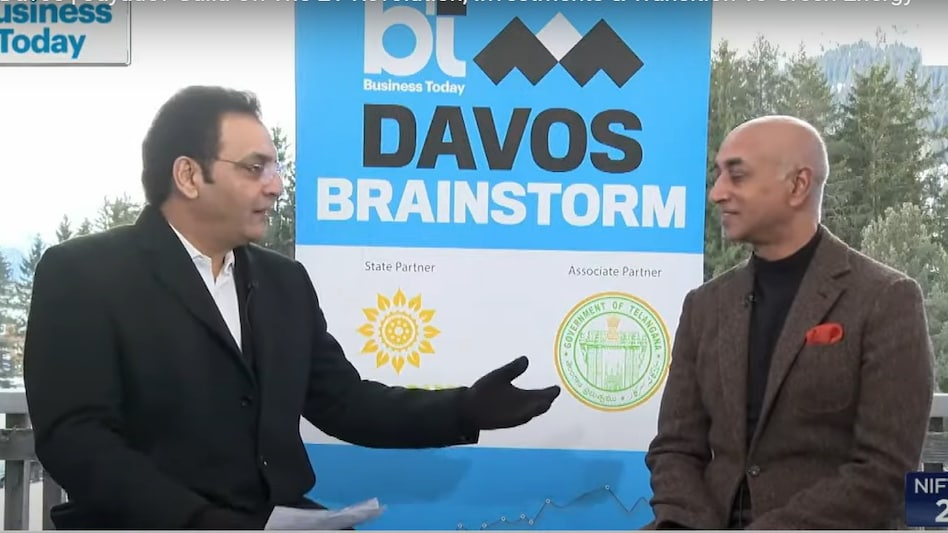
Speaking with Business Today TV at the World Economic Forum 2025, Galla said, “There's headwinds from both the governments, you know, like we are not able to get visas for Chinese technicians, we are not able to get visas even for Chinese CEOs to come and visit India. And on the other hand, China's putting pressure on Chinese companies to not work with India, and to maintain their monopoly on these sectors for as long as possible. So, despite the private sector wanting to work together on both sides, the governments are kind of holding us back right now.”
Galla said that in the West, the EV market has become a rich man’s game. It is only luxury vehicles that are rolling out their electric vehicle versions, he said, adding that people are spending far more than they would for the petrol versions. There are not too many options there, said Galla.
“So that's also one of the reasons why the segment hasn't really taken off, and so is the case with Europe. But if you look at China it's in the light mobility space – small vehicles, two-wheelers, three-wheelers, last mile delivery services, last mile connectivity services – these are the sectors that really have taken off. I think we're going to see that happening in India too because these are the places where market dynamics have already caught up, the economics have already caught up with the demand,” he said.
Galla said that in the two- and three-wheeler segment even without incentives, it is a fairly even swap between ICE and EV. “In the long run you actually end up saving money with EV if you use it more. The more you use it, the more the savings are. So, I think India will continue to move forward, despite the slowdown in the West. The only thing is how independent we are going to be of China in terms of accessing parts, raw materials, technologies and so on and so forth,” he said.
The Amara Raja founder said India will inevitably move forward in the EV space but it is all a question of how long it will take the country to indigenise the critical components. He said that as India indigenises the critical components, the cost of EVs would come down. Galla emphasised that the Indian market will continue to grow in the light mobility sector. The indigenising of the critical components, especially the battery that amounts to almost 40 per cent of the passenger car, would bring down EV costs substantially, Galla explained.
Jayadev Galla, co-founder and Chairman of the Amara Raja Group, said that India is going to move forward in the electric vehicle (EV) space despite a slowdown in the West but a lot of it depends on how independent the country can be of Chinese products. Galla said that there have been headwinds from the Indian and the Chinese governments, and that both sides have held back the private sector.
Speaking with Business Today TV at the World Economic Forum 2025, Galla said, “There's headwinds from both the governments, you know, like we are not able to get visas for Chinese technicians, we are not able to get visas even for Chinese CEOs to come and visit India. And on the other hand, China's putting pressure on Chinese companies to not work with India, and to maintain their monopoly on these sectors for as long as possible. So, despite the private sector wanting to work together on both sides, the governments are kind of holding us back right now.”
Galla said that in the West, the EV market has become a rich man’s game. It is only luxury vehicles that are rolling out their electric vehicle versions, he said, adding that people are spending far more than they would for the petrol versions. There are not too many options there, said Galla.
“So that's also one of the reasons why the segment hasn't really taken off, and so is the case with Europe. But if you look at China it's in the light mobility space – small vehicles, two-wheelers, three-wheelers, last mile delivery services, last mile connectivity services – these are the sectors that really have taken off. I think we're going to see that happening in India too because these are the places where market dynamics have already caught up, the economics have already caught up with the demand,” he said.
Galla said that in the two- and three-wheeler segment even without incentives, it is a fairly even swap between ICE and EV. “In the long run you actually end up saving money with EV if you use it more. The more you use it, the more the savings are. So, I think India will continue to move forward, despite the slowdown in the West. The only thing is how independent we are going to be of China in terms of accessing parts, raw materials, technologies and so on and so forth,” he said.
The Amara Raja founder said India will inevitably move forward in the EV space but it is all a question of how long it will take the country to indigenise the critical components. He said that as India indigenises the critical components, the cost of EVs would come down. Galla emphasised that the Indian market will continue to grow in the light mobility sector. The indigenising of the critical components, especially the battery that amounts to almost 40 per cent of the passenger car, would bring down EV costs substantially, Galla explained.