
Davos 2026: AI skills must become the new pathway to jobs and mobility, says Satya Nadella
Drawing parallels with the early days of personal computing, Nadella said the adoption curve for AI mirrors the period when workers had to learn software such as Excel and Word to stay employable.
- Jan 20, 2026,
- Updated Jan 20, 2026 5:41 PM IST
Microsoft Corp. Chairman and Chief Executive Officer Satya Nadella said artificial intelligence is emerging as a primary engine of economic mobility, urging governments and businesses to focus on large-scale skills training and a fundamental redesign of how work gets done.
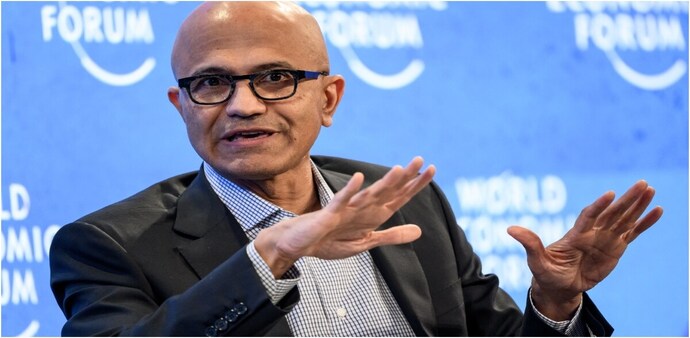
Speaking at the World Economic Forum in Davos in a conversation with BlackRock Inc. Chairman and CEO Laurence Fink, Nadella said AI is not merely a technical trend but a platform shift that will reshape productivity, professional growth and organisational structures across industries.
“People need to say, Oh, I picked up this AI skill, and now I'm a better provider of some product or service in the real economy,” Nadella said.
Drawing parallels with the early days of personal computing, Nadella said the adoption curve for AI mirrors the period when workers had to learn software such as Excel and Word to stay employable. The next phase of economic growth, he said, will depend on how widely people are trained to use AI tools in everyday work.
He added that the scale of AI adoption will be determined not just by technology, but by how effectively governments and companies work together to ensure access and training.
“The private sector and the public sector to ensure the diffusion happens,” Nadella said, adding that the central question is “how broadly are people skilled in using this?”
Beyond skills, Nadella said AI will force a complete rethink of how organisations operate, reversing traditional information flows and making existing work structures obsolete.
“AI is a complete inversion of how information is flowing in an organisation. Once you have that, you have to redesign the work structure because the current structure does not make sense. So the mindset we as leaders should have is that we have to change the workflow with the technology,” he said.
Nadella’s comments come as companies globally race to deploy AI across operations, from software development and customer support to finance, manufacturing and healthcare, while governments push national AI strategies focused on workforce readiness.
Microsoft has emerged as one of the biggest corporate backers of AI infrastructure and deployment through its partnership with OpenAI and large-scale investments in data centres, cloud computing and enterprise AI platforms.
At Davos, Nadella positioned AI as the next major economic transformation — one that will reward those who adapt early, rethink how work is structured and invest in broad-based skills training.
Microsoft Corp. Chairman and Chief Executive Officer Satya Nadella said artificial intelligence is emerging as a primary engine of economic mobility, urging governments and businesses to focus on large-scale skills training and a fundamental redesign of how work gets done.
Speaking at the World Economic Forum in Davos in a conversation with BlackRock Inc. Chairman and CEO Laurence Fink, Nadella said AI is not merely a technical trend but a platform shift that will reshape productivity, professional growth and organisational structures across industries.
“People need to say, Oh, I picked up this AI skill, and now I'm a better provider of some product or service in the real economy,” Nadella said.
Drawing parallels with the early days of personal computing, Nadella said the adoption curve for AI mirrors the period when workers had to learn software such as Excel and Word to stay employable. The next phase of economic growth, he said, will depend on how widely people are trained to use AI tools in everyday work.
He added that the scale of AI adoption will be determined not just by technology, but by how effectively governments and companies work together to ensure access and training.
“The private sector and the public sector to ensure the diffusion happens,” Nadella said, adding that the central question is “how broadly are people skilled in using this?”
Beyond skills, Nadella said AI will force a complete rethink of how organisations operate, reversing traditional information flows and making existing work structures obsolete.
“AI is a complete inversion of how information is flowing in an organisation. Once you have that, you have to redesign the work structure because the current structure does not make sense. So the mindset we as leaders should have is that we have to change the workflow with the technology,” he said.
Nadella’s comments come as companies globally race to deploy AI across operations, from software development and customer support to finance, manufacturing and healthcare, while governments push national AI strategies focused on workforce readiness.
Microsoft has emerged as one of the biggest corporate backers of AI infrastructure and deployment through its partnership with OpenAI and large-scale investments in data centres, cloud computing and enterprise AI platforms.
At Davos, Nadella positioned AI as the next major economic transformation — one that will reward those who adapt early, rethink how work is structured and invest in broad-based skills training.