
Davos 2026: 'An unsettled world,' Walter Russell Mead warns on Trump-era diplomacy over next 12 months
Mead’s assessment came as global leaders in Davos weighed the impact of US President Donald Trump’s latest diplomatic moves, including outreach on Gaza and renewed engagement on Ukraine
- Jan 23, 2026,
- Updated Jan 23, 2026 10:07 AM IST
The world is entering a prolonged phase of instability, driven by overlapping geopolitical conflicts and rapid technological disruption, and expectations of smooth diplomacy may no longer be realistic, according to Walter Russell Mead.
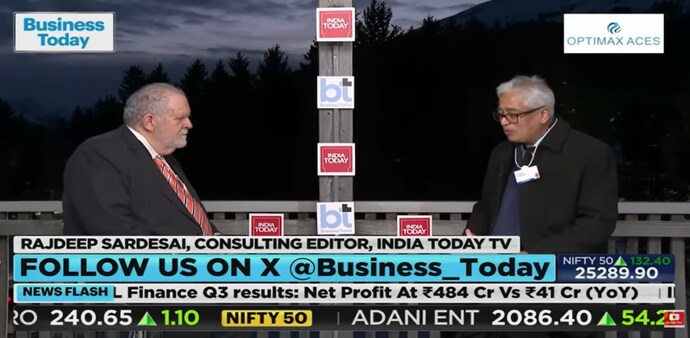
Speaking to Rajdeep Sardesai, Consulting Editor, India Today TV, during an exclusive conversation at the World Economic Forum’s BT Davos Brainstorm, the American academic and Wall Street Journal columnist said uncertainty is likely to define global affairs well beyond 2026.
“Well, I would say we’re certainly going to see an unsettled world. I’m quite confident about that."
"Over the next 12 months?" asked Sardesai.
"Absolutely. And I suspect for longer than that,” Mead replied.
He pointed to a convergence of pressures reshaping the global order. “When you think about we see the rise of China, we see Russia involved in this war in Ukraine, but we add to that the information revolution, the tech revolution, AI that is challenging people in their daily lives all over the world,” he said. “Will we all have jobs in three years? A lot of people don’t know the answer to that.”
“In those conditions,” Mead added, “to expect somehow that world conditions are going to be smooth and easy and diplomacy will always work, I think that’s unrealistic.”
Trump’s imprint, shifting signals
Mead’s assessment came as global leaders in Davos weighed the impact of US President Donald Trump’s latest diplomatic moves, including outreach on Gaza and renewed engagement on Ukraine. While Trump has left Davos, his imprint on the discussions remained unmistakable.
Asked whether Trump should be seen as a man of peace, Mead struck a cautious note. “That’s a very good question and I’m not sure that he knows the answer,” he said, noting that while attention has focused on Greenland and Ukraine, “the American aircraft carrier group has been sailing toward Iran this whole time.”
As debates swirl over whether Trump’s diplomacy is transactional rather than values-driven, Mead argued that such an interpretation is not without precedent. Drawing a parallel with former US Secretary of State Henry Kissinger, he said, “When you talk to him, he talked about the need for ultimately order and stability. He had a kind of a tragic view of life that sometimes you can’t have everything.”
“In that sense,” Mead said, “I think Donald Trump actually does feel that he’s doing the right thing at some level.”
A negotiator, not an orator
Mead described Trump less as a conventional communicator and more as a reaction-driven negotiator. “President Trump is a negotiator more than an orator,” he said. “He doesn’t use communication to convey information. Sometimes what he does is he says something and then looks at the reaction that comes out of it, and then from the reaction he can judge what his bargaining partner is really thinking.”
That approach, Mead suggested, feeds into the unpredictability now shaping global diplomacy. “We can be quite confident that we don’t know what tomorrow brings,” he said. “It was Greenland today. Who knows which part of the world it’ll be tomorrow?”
Limits of peace in Gaza and Ukraine
On the prospects of lasting peace in Gaza, Mead was blunt about the structural hole. “The one thing that the rest of the world is insisting that Hamas do is disarm. But the one thing Hamas absolutely does not want to do is disarm,” he said. “We’re engaged in this very complicated dance trying to orchestrate pressure.”
“The Israelis were trying to do it by an unrelenting campaign against Hamas,” he added. “Can the same end be accomplished without the violence? In a way, Hamas has the answer to that. You and I do not.”
Ukraine, he argued, presents a similarly hard problem. “That’s really the test of the Trumpian view of diplomacy. Can he get a ceasefire between Ukraine and Russia?” Mead said. “Honestly, I don’t think either the Russians or the Ukrainians are yet at a point where they are willing to make peace.”
Instead, he suggested, political leaders may focus on reframing unresolved conflicts. “Sometimes what a diplomat or even more a political leader will do is just try to find a pretty box to put this very unpleasant object in,” he said. “So we may be talking about the Trump peace plan for Ukraine rather than the war in Ukraine.”
A divided America, an anxious world
Mead also reflected on how Americans are responding to Trump’s second term. “He seems to have about 40% approval ratings in the polls and about 56% disapproval,” he said, adding that while dissatisfaction is evident, “it is not the end of the world either.”
He noted the paradox Trump now faces. “Trump is always the guy who says things are a mess, and I’m on your side,” Mead said. “But now anything that is a mess, who’s the president?”
As for whether domestic pushback could reshape US politics in the coming months, Mead remained cautious. “What happens in the American midterms? I cannot tell you. We are still much too far away,” he said.
Looking ahead, Mead suggested that global anxiety may persist as geopolitical rivalry collides with technological upheaval. “We are in a world in which only trust and hope in God is going to be able to keep us sane,” he said.
The world is entering a prolonged phase of instability, driven by overlapping geopolitical conflicts and rapid technological disruption, and expectations of smooth diplomacy may no longer be realistic, according to Walter Russell Mead.
Speaking to Rajdeep Sardesai, Consulting Editor, India Today TV, during an exclusive conversation at the World Economic Forum’s BT Davos Brainstorm, the American academic and Wall Street Journal columnist said uncertainty is likely to define global affairs well beyond 2026.
“Well, I would say we’re certainly going to see an unsettled world. I’m quite confident about that."
"Over the next 12 months?" asked Sardesai.
"Absolutely. And I suspect for longer than that,” Mead replied.
He pointed to a convergence of pressures reshaping the global order. “When you think about we see the rise of China, we see Russia involved in this war in Ukraine, but we add to that the information revolution, the tech revolution, AI that is challenging people in their daily lives all over the world,” he said. “Will we all have jobs in three years? A lot of people don’t know the answer to that.”
“In those conditions,” Mead added, “to expect somehow that world conditions are going to be smooth and easy and diplomacy will always work, I think that’s unrealistic.”
Trump’s imprint, shifting signals
Mead’s assessment came as global leaders in Davos weighed the impact of US President Donald Trump’s latest diplomatic moves, including outreach on Gaza and renewed engagement on Ukraine. While Trump has left Davos, his imprint on the discussions remained unmistakable.
Asked whether Trump should be seen as a man of peace, Mead struck a cautious note. “That’s a very good question and I’m not sure that he knows the answer,” he said, noting that while attention has focused on Greenland and Ukraine, “the American aircraft carrier group has been sailing toward Iran this whole time.”
As debates swirl over whether Trump’s diplomacy is transactional rather than values-driven, Mead argued that such an interpretation is not without precedent. Drawing a parallel with former US Secretary of State Henry Kissinger, he said, “When you talk to him, he talked about the need for ultimately order and stability. He had a kind of a tragic view of life that sometimes you can’t have everything.”
“In that sense,” Mead said, “I think Donald Trump actually does feel that he’s doing the right thing at some level.”
A negotiator, not an orator
Mead described Trump less as a conventional communicator and more as a reaction-driven negotiator. “President Trump is a negotiator more than an orator,” he said. “He doesn’t use communication to convey information. Sometimes what he does is he says something and then looks at the reaction that comes out of it, and then from the reaction he can judge what his bargaining partner is really thinking.”
That approach, Mead suggested, feeds into the unpredictability now shaping global diplomacy. “We can be quite confident that we don’t know what tomorrow brings,” he said. “It was Greenland today. Who knows which part of the world it’ll be tomorrow?”
Limits of peace in Gaza and Ukraine
On the prospects of lasting peace in Gaza, Mead was blunt about the structural hole. “The one thing that the rest of the world is insisting that Hamas do is disarm. But the one thing Hamas absolutely does not want to do is disarm,” he said. “We’re engaged in this very complicated dance trying to orchestrate pressure.”
“The Israelis were trying to do it by an unrelenting campaign against Hamas,” he added. “Can the same end be accomplished without the violence? In a way, Hamas has the answer to that. You and I do not.”
Ukraine, he argued, presents a similarly hard problem. “That’s really the test of the Trumpian view of diplomacy. Can he get a ceasefire between Ukraine and Russia?” Mead said. “Honestly, I don’t think either the Russians or the Ukrainians are yet at a point where they are willing to make peace.”
Instead, he suggested, political leaders may focus on reframing unresolved conflicts. “Sometimes what a diplomat or even more a political leader will do is just try to find a pretty box to put this very unpleasant object in,” he said. “So we may be talking about the Trump peace plan for Ukraine rather than the war in Ukraine.”
A divided America, an anxious world
Mead also reflected on how Americans are responding to Trump’s second term. “He seems to have about 40% approval ratings in the polls and about 56% disapproval,” he said, adding that while dissatisfaction is evident, “it is not the end of the world either.”
He noted the paradox Trump now faces. “Trump is always the guy who says things are a mess, and I’m on your side,” Mead said. “But now anything that is a mess, who’s the president?”
As for whether domestic pushback could reshape US politics in the coming months, Mead remained cautious. “What happens in the American midterms? I cannot tell you. We are still much too far away,” he said.
Looking ahead, Mead suggested that global anxiety may persist as geopolitical rivalry collides with technological upheaval. “We are in a world in which only trust and hope in God is going to be able to keep us sane,” he said.