
Davos 2026: India has a unique advantage in applying AI, explains Google’s James Manyika
WEF Davos 2026: Google’s James Manyika talks about how India is transitioning from an AI adopter to an AI innovation and research hub.
- Jan 22, 2026,
- Updated Jan 22, 2026 12:09 PM IST
At the World Economic Forum (WEF) 2026 in Davos, James Manyika, Senior Vice President at Google Alphabet, talked about how India is transitioning into a premier hub for high-impact AI research. From scaling life-saving diabetic screenings to deploying monsoon models to about 38 million farmers, these initiatives showcase India's ability to effectively apply AI and solve pressing challenges, he said.
AI is bridging healthcare gap in India
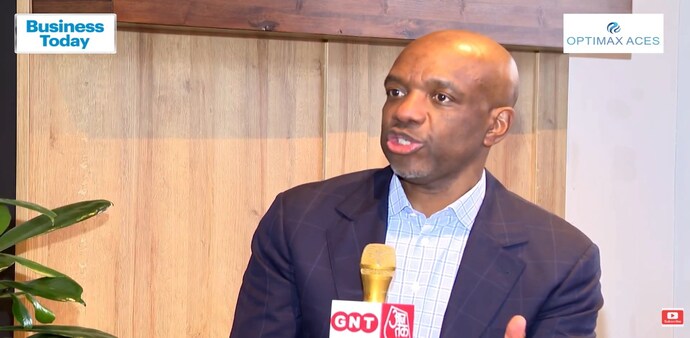
In a conversation with Business Today, James Manyika at Davos, highlighted how India is strategically applying AI in healthcare, agriculture, and education.
“We've already so far in India actually done retinal scans of diabetic retinopathy of something like over 600,000 patients,” said Manyika. He added, “We're (Google) working with partners in India to see if we can get to where we can diagnose millions of people using this technology.”
It highlights that AI can significantly bridge healthcare access gaps, especially in the Global South. In addition, AI-based diagnostics can also address diseases like tuberculosis, where nearly 40% of cases globally go undiagnosed, as per Manyika.
AI for Agriculture & Climate
Manyika told Business Today that AI-based monsoon prediction could help over 38 million farmers in India.
“We worked last year with the Indian Ministry of Agriculture, where we and farmers because we just developed these breakthrough ways to predict monsoons, and we actually use our latest model neural GCM to predict monsoons… and we actually showed that we could actually get monsoon warnings to 38 million farmers in India. That was just the first trial.
That kind of work will have a strong ground-level impact because climate change is impacting the monsoon cycle of how it pans out,” he said.
The discussion also explored Google’s $15 billion investment in India last year that spans across sectors, including infrastructure, data centres, research, training, and innovation.
Manyika said, “I also think that the ability to invest and actually innovate and drive some of the research and innovation is also exciting.”
“So that actual research can also… happen in India for the benefit of India and in fact quite frankly the world,” he added.
Watch the full video:
At the World Economic Forum (WEF) 2026 in Davos, James Manyika, Senior Vice President at Google Alphabet, talked about how India is transitioning into a premier hub for high-impact AI research. From scaling life-saving diabetic screenings to deploying monsoon models to about 38 million farmers, these initiatives showcase India's ability to effectively apply AI and solve pressing challenges, he said.
AI is bridging healthcare gap in India
In a conversation with Business Today, James Manyika at Davos, highlighted how India is strategically applying AI in healthcare, agriculture, and education.
“We've already so far in India actually done retinal scans of diabetic retinopathy of something like over 600,000 patients,” said Manyika. He added, “We're (Google) working with partners in India to see if we can get to where we can diagnose millions of people using this technology.”
It highlights that AI can significantly bridge healthcare access gaps, especially in the Global South. In addition, AI-based diagnostics can also address diseases like tuberculosis, where nearly 40% of cases globally go undiagnosed, as per Manyika.
AI for Agriculture & Climate
Manyika told Business Today that AI-based monsoon prediction could help over 38 million farmers in India.
“We worked last year with the Indian Ministry of Agriculture, where we and farmers because we just developed these breakthrough ways to predict monsoons, and we actually use our latest model neural GCM to predict monsoons… and we actually showed that we could actually get monsoon warnings to 38 million farmers in India. That was just the first trial.
That kind of work will have a strong ground-level impact because climate change is impacting the monsoon cycle of how it pans out,” he said.
The discussion also explored Google’s $15 billion investment in India last year that spans across sectors, including infrastructure, data centres, research, training, and innovation.
Manyika said, “I also think that the ability to invest and actually innovate and drive some of the research and innovation is also exciting.”
“So that actual research can also… happen in India for the benefit of India and in fact quite frankly the world,” he added.
Watch the full video: