
Davos 2026: 'PLI scheme failing because of L-1 mentality,' says Amara Raja co-founder Jayadev Galla
WEF Davos 2026: Galla said that the incentives under PLI scheme are handed out like candy on the basis of quotations and nothing else.
- Jan 22, 2026,
- Updated Jan 22, 2026 10:07 AM IST
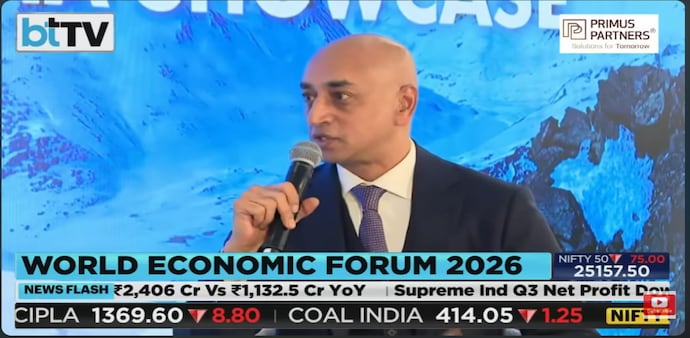
Amara Raja Group co-founder and chairman Jayadev Galla flagged growing issues with the traditional L-1 procurement strategy, or the lowest bidder strategy that governs the country's production-linked incentive (PLI) scheme at the India Showcase in Davos 2026. With this strategy often leading to the lowest possible quality, Galla said that these incentives are handed out like candy on the basis of quotations and nothing else.
"Wherever you see failures in the government's PLI scheme is also because of the same L-1 mentality. Evaluating who should be given these incentives, just based on quotations and nothing else, and nobody is able to deliver on those commitments made in the PLI scheme," he said.
The Amara Raja co-founder also stated that most of the money is unspent and unrealised, and the incentives are not being given because the companies are unable to meet the unrealistic numbers they initially quoted.
Sounding a warning note, he said: "I think it is high time. We need to move to a different system, and the qualitative bidding needs to come in more. Looking at capabilities, looking at life cycle costs and benefits of any particular contract."
Hitachi India MD Dr Bharat Kaushal also weighed in said that the "needle has turned" in capital goods as well as sectors like power and rail. In sectors such as infra, power, and rail, a more balanced approach is emerging as price typically accounts for 50-60 per cent of the evaluation, whereas the remaining weight is given to technical specifications.
The transition is visible in the capital goods sector, where there is a growing willingness to pay for value and better quality as the Indian economy's consumption power goes up.
Furthermore, Jayadev Galla said that India needs to transition from "small r" reforms to "big R" reforms.
He added that for Prime Minister Narendra Modi's Surya Ghar Yojana to become a success, it is crucial to allow for gross metering and Time of Day (ToD) tariffs and enable consumers to not only buy but also sell power through digital marketplaces and algorithms.
Watch the full video here
Amara Raja Group co-founder and chairman Jayadev Galla flagged growing issues with the traditional L-1 procurement strategy, or the lowest bidder strategy that governs the country's production-linked incentive (PLI) scheme at the India Showcase in Davos 2026. With this strategy often leading to the lowest possible quality, Galla said that these incentives are handed out like candy on the basis of quotations and nothing else.
"Wherever you see failures in the government's PLI scheme is also because of the same L-1 mentality. Evaluating who should be given these incentives, just based on quotations and nothing else, and nobody is able to deliver on those commitments made in the PLI scheme," he said.
The Amara Raja co-founder also stated that most of the money is unspent and unrealised, and the incentives are not being given because the companies are unable to meet the unrealistic numbers they initially quoted.
Sounding a warning note, he said: "I think it is high time. We need to move to a different system, and the qualitative bidding needs to come in more. Looking at capabilities, looking at life cycle costs and benefits of any particular contract."
Hitachi India MD Dr Bharat Kaushal also weighed in said that the "needle has turned" in capital goods as well as sectors like power and rail. In sectors such as infra, power, and rail, a more balanced approach is emerging as price typically accounts for 50-60 per cent of the evaluation, whereas the remaining weight is given to technical specifications.
The transition is visible in the capital goods sector, where there is a growing willingness to pay for value and better quality as the Indian economy's consumption power goes up.
Furthermore, Jayadev Galla said that India needs to transition from "small r" reforms to "big R" reforms.
He added that for Prime Minister Narendra Modi's Surya Ghar Yojana to become a success, it is crucial to allow for gross metering and Time of Day (ToD) tariffs and enable consumers to not only buy but also sell power through digital marketplaces and algorithms.
Watch the full video here