
'It's a new world order...': Dipali Goenka of Welspun Living on AI, tariffs, global supply chains
Dipali Goenka, CEO and Managing Director of Welspun Living said artificial intelligence has become a critical enabler in managing complexity across Welspun’s global operations, which span more than 60 countries, including the US, Europe, the UK and Japan.
- Jan 20, 2026,
- Updated Jan 20, 2026 7:52 PM IST
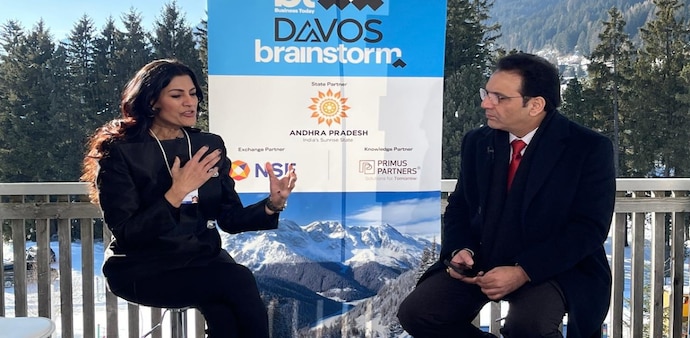
Davos 2026: Dipali Goenka, CEO and Managing Director of Welspun Living, on Tuesday said the impact of tariffs and artificial intelligence on global businesses is far deeper than previously anticipated, as supply chains today are no longer linear or predictable but increasingly global, dynamic and agile.
Speaking on the evolving nature of global trade, Goenka said the world is operating in what she described as a “BANI” environment, brittle, anxious, non-linear and incomprehensible -- where uncertainty and disruption are no longer episodic but constant. “Businesses and supply chains are not linear the way they were once projected to be. Today, they are working globally, dynamically and with far greater agility,” she said.
Drawing from Welspun Living’s experience in textiles, Goenka highlighted how deep domain expertise, technology and partnerships have enabled the company to redesign its supply chain. “We have in-depth knowledge of the entire textile value chain—from innovation and technology to sourcing and execution. That allows us to build ancillary vendor partnerships across the globe and supply from anywhere in the world,” she said, adding that supply chain agility and strong collaboration with global retailers are reshaping how businesses operate.
On productivity gains, Goenka said artificial intelligence has become a critical enabler in managing complexity across Welspun’s global operations, which span more than 60 countries, including the US, Europe, the UK and Japan. “AI helps us forecast demand, understand consumer behaviour and trigger supply chain responses more accurately,” she said.
She cited the use of AI-powered automation in manufacturing as a key example. Welspun employs over 20,000 people across its factories, and AI tools such as automated towel-counting systems have reduced human fatigue while improving efficiency. “We produce nearly a million towels. When AI handles tasks like counting, efficiency improves and value loss comes down by nearly 20%,” she said.
Goenka added that even amid tariff pressures, deeper AI integration could reduce inventory levels by about 20% and deliver at least a 10% improvement in workforce productivity. Addressing concerns around job losses, she said AI-driven productivity gains have helped economies remain resilient. Citing the US as an example, she noted that despite higher import duties, economic strength has been supported by the AI boom rather than undermined by it.
Davos 2026: Dipali Goenka, CEO and Managing Director of Welspun Living, on Tuesday said the impact of tariffs and artificial intelligence on global businesses is far deeper than previously anticipated, as supply chains today are no longer linear or predictable but increasingly global, dynamic and agile.
Speaking on the evolving nature of global trade, Goenka said the world is operating in what she described as a “BANI” environment, brittle, anxious, non-linear and incomprehensible -- where uncertainty and disruption are no longer episodic but constant. “Businesses and supply chains are not linear the way they were once projected to be. Today, they are working globally, dynamically and with far greater agility,” she said.
Drawing from Welspun Living’s experience in textiles, Goenka highlighted how deep domain expertise, technology and partnerships have enabled the company to redesign its supply chain. “We have in-depth knowledge of the entire textile value chain—from innovation and technology to sourcing and execution. That allows us to build ancillary vendor partnerships across the globe and supply from anywhere in the world,” she said, adding that supply chain agility and strong collaboration with global retailers are reshaping how businesses operate.
On productivity gains, Goenka said artificial intelligence has become a critical enabler in managing complexity across Welspun’s global operations, which span more than 60 countries, including the US, Europe, the UK and Japan. “AI helps us forecast demand, understand consumer behaviour and trigger supply chain responses more accurately,” she said.
She cited the use of AI-powered automation in manufacturing as a key example. Welspun employs over 20,000 people across its factories, and AI tools such as automated towel-counting systems have reduced human fatigue while improving efficiency. “We produce nearly a million towels. When AI handles tasks like counting, efficiency improves and value loss comes down by nearly 20%,” she said.
Goenka added that even amid tariff pressures, deeper AI integration could reduce inventory levels by about 20% and deliver at least a 10% improvement in workforce productivity. Addressing concerns around job losses, she said AI-driven productivity gains have helped economies remain resilient. Citing the US as an example, she noted that despite higher import duties, economic strength has been supported by the AI boom rather than undermined by it.