
Davos 2026 | 'Don't think US will take military action': FT's Gideon Rachman on Trump's Greenland push
WEF Davos 2026: The US is going to ramp up the pressure on Europe in ways that lead to an intensifying kind of confrontation, says Gideon Rachman, Chief Foreign Affairs Commentator at the Financial Times
- Jan 19, 2026,
- Updated Jan 19, 2026 4:48 PM IST
Tensions between the United States and Europe over Greenland are no longer a hypothetical future risk, according to senior foreign affairs commentators speaking at the World Economic Forum in Davos. What began as a provocative claim by US President Donald Trump has, they argue, already evolved into a live geopolitical confrontation — one likely to be fought not with troops, but through tariffs, arms supplies and the future of NATO itself.
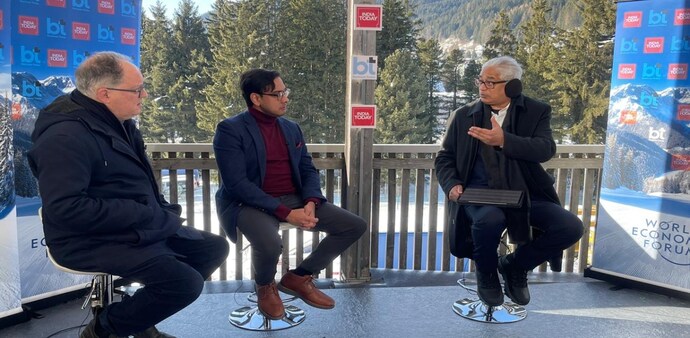
Speaking at BT Davos 2026, Gideon Rachman, Chief Foreign Affairs Commentator at the Financial Times, said the standoff between the United States and Europe over Greenland is no longer theoretical. "I think we're already in a conflict. The question is how it develops from here," he said during a conversation with Rajdeep Sardesai, Consulting Editor, India Today TV, on the sidelines of the World Economic Forum (WEF).
Rachman cautioned that while outright military action was unlikely, pressure would intensify rapidly through economic and security levers. "I don't think the Americans are going to do military action as a first resort. They may not do it at all because I think that would be so drastic. I think people around Trump would try to restrain him," he said. But restraint, he added, would not mean de-escalation.
Instead, Rachman predicted a tariff-driven spiral. "But I do think that they are going to ramp up the pressure on Europe in ways that lead to an intensifying kind of confrontation. They will do these tariffs probably unless the Supreme Court comes to our rescue and says the tariffs are illegal. Europe will hit back with tariffs. I'm pretty sure about that."
According to Rachman, Trump's worldview does not separate trade from security. "And then Trump has this tendency to link security and economics," he said, laying out a scenario in which economic retaliation spills into the Ukraine war. "He will then cut off arms sales to Ukraine. Actually, it's the Europeans who buy the arms from America and hand them over to Ukraine."
That sequence, the noted commentator warned, could hollow out the transatlantic alliance. "Then the question is really can NATO survive all of this. It may survive as a sort of nameplate on a door but I'm not sure it's really functional."
Asked whether Europe would actually push back or accept American coercion, Rachman was clear. "No, I think they will push back. Maybe that's me as a European," he said, noting that Britain — despite leaving the EU — has aligned itself firmly with the continent. "And of course Britain is no longer a member of the EU, but interestingly is signing all the letters with the Europeans. They've absolutely sided with Europe on this one."
He added that domestic politics in the UK have converged around opposition to Trump's posture. "The UK political leaders are united on this. The Conservatives and Labour saying this is unacceptable from Trump. So, oddly Trump is pushing Britain back towards Europe."
At the same time, Rachman acknowledged European hesitation. "I wouldn't completely rule out Europe folding. I think they're desperately searching for some sort of compromise but I don't think Trump is in a compromising mood, and if there's no compromise to be had, Europe will have to push back."
To decode what is driving this impulse, Ishaan Tharoor, Global Affairs Columnist at the Washington Post, offered his diagnosis. "It's quite fascinating," Tharoor said. "If you look at the national security strategy that came out from the White House just a few months ago there's barely a word about Greenland in there. There's no official policy in this administration anchored around security strategy in the Arctic with Greenland but this is very much the personal conviction of President Trump."
According to Tharoor, Trump's fixation does not flow from institutional planning. "President Trump has got in his head that this is something the US must have and absolutely when you talk about the Donroe Doctrine it is this kind of 21st century manifest destiny of the United States that he seems to feel that he's capable of exerting."
He pointed to comments from Trump's inner circle to underline the logic at play. "He believes - as his advisor Stephen Miller said on TV - that the iron law of the world is 'might makes right' and they can do what they want in the Western Hemisphere."
Tharoor described the approach as reactive rather than strategic. "It's a set of impulses less than a strategy at this point," he said, linking it to domestic political conflict. "It also flows out of a kind of culture war within the United States. He still sees himself at war with the Left at home and he extends that to a broader war with a kind of global liberal establishment.
Even then, Tharoor admitted, the obsession with Greenland remains difficult to explain fully. "If you're looking for a strategy, that's basically it. But even then, it doesn't fully explain what's happening with Greenland and why it matters so much to Trump."
Tensions between the United States and Europe over Greenland are no longer a hypothetical future risk, according to senior foreign affairs commentators speaking at the World Economic Forum in Davos. What began as a provocative claim by US President Donald Trump has, they argue, already evolved into a live geopolitical confrontation — one likely to be fought not with troops, but through tariffs, arms supplies and the future of NATO itself.
Speaking at BT Davos 2026, Gideon Rachman, Chief Foreign Affairs Commentator at the Financial Times, said the standoff between the United States and Europe over Greenland is no longer theoretical. "I think we're already in a conflict. The question is how it develops from here," he said during a conversation with Rajdeep Sardesai, Consulting Editor, India Today TV, on the sidelines of the World Economic Forum (WEF).
Rachman cautioned that while outright military action was unlikely, pressure would intensify rapidly through economic and security levers. "I don't think the Americans are going to do military action as a first resort. They may not do it at all because I think that would be so drastic. I think people around Trump would try to restrain him," he said. But restraint, he added, would not mean de-escalation.
Instead, Rachman predicted a tariff-driven spiral. "But I do think that they are going to ramp up the pressure on Europe in ways that lead to an intensifying kind of confrontation. They will do these tariffs probably unless the Supreme Court comes to our rescue and says the tariffs are illegal. Europe will hit back with tariffs. I'm pretty sure about that."
According to Rachman, Trump's worldview does not separate trade from security. "And then Trump has this tendency to link security and economics," he said, laying out a scenario in which economic retaliation spills into the Ukraine war. "He will then cut off arms sales to Ukraine. Actually, it's the Europeans who buy the arms from America and hand them over to Ukraine."
That sequence, the noted commentator warned, could hollow out the transatlantic alliance. "Then the question is really can NATO survive all of this. It may survive as a sort of nameplate on a door but I'm not sure it's really functional."
Asked whether Europe would actually push back or accept American coercion, Rachman was clear. "No, I think they will push back. Maybe that's me as a European," he said, noting that Britain — despite leaving the EU — has aligned itself firmly with the continent. "And of course Britain is no longer a member of the EU, but interestingly is signing all the letters with the Europeans. They've absolutely sided with Europe on this one."
He added that domestic politics in the UK have converged around opposition to Trump's posture. "The UK political leaders are united on this. The Conservatives and Labour saying this is unacceptable from Trump. So, oddly Trump is pushing Britain back towards Europe."
At the same time, Rachman acknowledged European hesitation. "I wouldn't completely rule out Europe folding. I think they're desperately searching for some sort of compromise but I don't think Trump is in a compromising mood, and if there's no compromise to be had, Europe will have to push back."
To decode what is driving this impulse, Ishaan Tharoor, Global Affairs Columnist at the Washington Post, offered his diagnosis. "It's quite fascinating," Tharoor said. "If you look at the national security strategy that came out from the White House just a few months ago there's barely a word about Greenland in there. There's no official policy in this administration anchored around security strategy in the Arctic with Greenland but this is very much the personal conviction of President Trump."
According to Tharoor, Trump's fixation does not flow from institutional planning. "President Trump has got in his head that this is something the US must have and absolutely when you talk about the Donroe Doctrine it is this kind of 21st century manifest destiny of the United States that he seems to feel that he's capable of exerting."
He pointed to comments from Trump's inner circle to underline the logic at play. "He believes - as his advisor Stephen Miller said on TV - that the iron law of the world is 'might makes right' and they can do what they want in the Western Hemisphere."
Tharoor described the approach as reactive rather than strategic. "It's a set of impulses less than a strategy at this point," he said, linking it to domestic political conflict. "It also flows out of a kind of culture war within the United States. He still sees himself at war with the Left at home and he extends that to a broader war with a kind of global liberal establishment.
Even then, Tharoor admitted, the obsession with Greenland remains difficult to explain fully. "If you're looking for a strategy, that's basically it. But even then, it doesn't fully explain what's happening with Greenland and why it matters so much to Trump."