
Davos 2026: 'India is surplus in solar modules, ready to export,' says Prahlad Joshi
WEF Davos 2024: India remains firmly on track to meet its 500-gigawatt renewable energy target by 2030, says Prahlad Joshi
- Jan 19, 2026,
- Updated Jan 19, 2026 9:41 PM IST
India has moved into a position of surplus in solar manufacturing and is now ready to export modules globally, Union Minister for New and Renewable Energy Prahlad Joshi told Business Today in Davos on Monday. He asserted that the country remains firmly on track to meet its 500-gigawatt renewable energy target by 2030.
Speaking at the World Economic Forum in Davos, Prahlad Joshi said India's renewable capacity had expanded sharply over the past year and that domestic manufacturing strength had reduced dependence on external suppliers, even as global energy priorities shift.
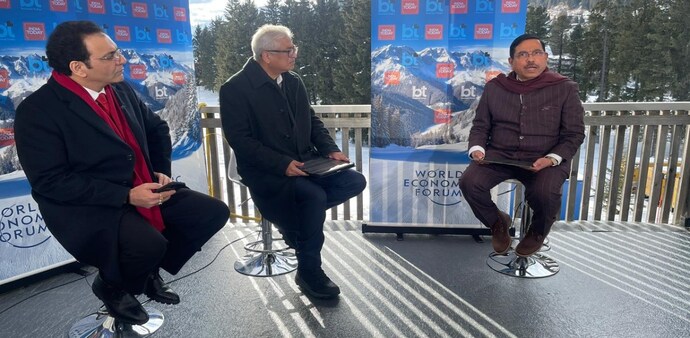
The minister was in conversation with Business Today Group Editor Siddharth Zarabi and India Today Consulting Editor Rajdeep Sardesai on the sidelines of the World Economic Forum (WEF).
Responding to a question on whether India was on track to reach 500 GW of renewable capacity by 2030, Joshi pointed to the pace of recent additions. He said two months ago, the capacity was 251 gigawatt, which had now increased to 267 gigawatts.
The minister said capacity additions over the past year underscored that momentum. "From January, December 31st, we have added 49 gigawatts. We are perfectly on track," he said.
According to Joshi, India's clean energy push is not limited to renewables alone. He referred to the nuclear act, which opens the sector for private players. Joshi said, "In the ease of doing business, we have done a lot of things in that....for small and moderate reactors, we have allowed private parties. By 2030, our target is 15 gigawatt in that also."
Placing India's energy transition in a global context, the minister said the country had balanced growth with emissions responsibility. "Keeping all this in mind, India truly is the leader in renewable energy. We have 17% of the population of the world, and total emission is just 4% per capita," he said.
"In spite of that, we have invested, we have supported the private parties, decentralised renewable energy. We are on track, I am quite sure by 2030, we will achieve 500 gigawatts," he added.
Asked whether global shifts — particularly the US prioritising crude oil — posed risks to India's renewable ambitions, Joshi dismissed such concerns. "I don't think that is a risk for us, according to me," he said.
He said many countries continued to prioritise clean energy, particularly in the Global South. "But especially in the global south, first the requirement is finance. The second thing is technology. Third thing, as we go on adding the capacity, the question of grid stabilisation," he said, pointing to the need for "multilateral bank funding, blended finance."
India has moved into a position of surplus in solar manufacturing and is now ready to export modules globally, Union Minister for New and Renewable Energy Prahlad Joshi told Business Today in Davos on Monday. He asserted that the country remains firmly on track to meet its 500-gigawatt renewable energy target by 2030.
Speaking at the World Economic Forum in Davos, Prahlad Joshi said India's renewable capacity had expanded sharply over the past year and that domestic manufacturing strength had reduced dependence on external suppliers, even as global energy priorities shift.
The minister was in conversation with Business Today Group Editor Siddharth Zarabi and India Today Consulting Editor Rajdeep Sardesai on the sidelines of the World Economic Forum (WEF).
Responding to a question on whether India was on track to reach 500 GW of renewable capacity by 2030, Joshi pointed to the pace of recent additions. He said two months ago, the capacity was 251 gigawatt, which had now increased to 267 gigawatts.
The minister said capacity additions over the past year underscored that momentum. "From January, December 31st, we have added 49 gigawatts. We are perfectly on track," he said.
According to Joshi, India's clean energy push is not limited to renewables alone. He referred to the nuclear act, which opens the sector for private players. Joshi said, "In the ease of doing business, we have done a lot of things in that....for small and moderate reactors, we have allowed private parties. By 2030, our target is 15 gigawatt in that also."
Placing India's energy transition in a global context, the minister said the country had balanced growth with emissions responsibility. "Keeping all this in mind, India truly is the leader in renewable energy. We have 17% of the population of the world, and total emission is just 4% per capita," he said.
"In spite of that, we have invested, we have supported the private parties, decentralised renewable energy. We are on track, I am quite sure by 2030, we will achieve 500 gigawatts," he added.
Asked whether global shifts — particularly the US prioritising crude oil — posed risks to India's renewable ambitions, Joshi dismissed such concerns. "I don't think that is a risk for us, according to me," he said.
He said many countries continued to prioritise clean energy, particularly in the Global South. "But especially in the global south, first the requirement is finance. The second thing is technology. Third thing, as we go on adding the capacity, the question of grid stabilisation," he said, pointing to the need for "multilateral bank funding, blended finance."