
Davos 2026: India-US trade deal likely in 3 months, says USISPF’s Mukesh Aghi
WEF Davos 2026: Aghi also pointed to recent major investment commitments from US companies — including large capital pledges in AI, cloud computing and data infrastructure — as evidence of companies’ confidence in India’s growth story.
- Jan 19, 2026,
- Updated Jan 19, 2026 8:30 PM IST
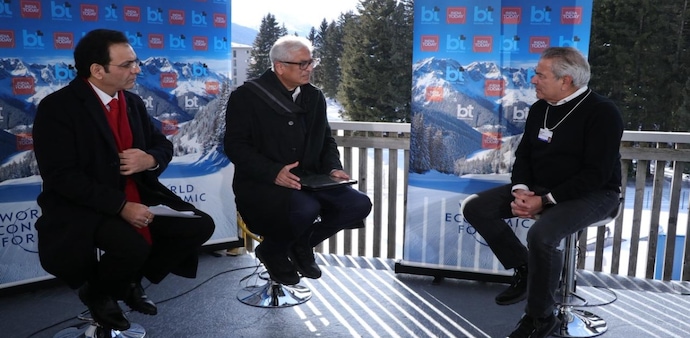
As global uncertainty reshapes economic partnerships, Mukesh Aghi, President & CEO of the US‑India Strategic Partnership Forum (USISPF), in an exclusive interaction with Business Today TV expressed cautious optimism on the prospects of a comprehensive India‑US trade agreement and the broader trajectory of bilateral ties at the World Economic Forum in Davos.
Asked if a long‑awaited trade deal between New Delhi and Washington was closer now in 2026, Aghi said negotiations have progressed through multiple rounds and are nearing finalisation. He expects “some kind of a trade … deal in the next 3 months,” with both sides working through detailed reciprocal terms, including on agriculture — an area that has been more technically complex than past deals with other partners.
On the question of trust — particularly given recent tariff actions and concerns about unpredictability — Aghi acknowledged the dilemma many countries face when negotiating with an administration seen as volatile on trade policy. Still, he urged stakeholders to assess the durability of any agreement on its substance and reciprocal commitments, rather than solely on political rhetoric.
Amid concerns that tariff disputes and political noise might cool commercial interest, Aghi was unequivocal about investment momentum: he said that in conversations with over 100 US and global CEOs, not a single company said it planned to reduce investment in India or shift supply chains away. He highlighted India’s importance not just as a market but as a source of global competitiveness — with over 2,000 global capability centres there, 60% of them American, and significant intellectual property generation.
Aghi also pointed to recent major investment commitments from US companies — including large capital pledges in AI, cloud computing and data infrastructure — as evidence of companies’ confidence in India’s growth story. He noted the ongoing reform agenda in India, while urging further progress at the state level to simplify licensing and ease of doing business.
The forum also touched on people‑to‑people ties — with Aghi describing Indian talent as integral to the US economy. He said challenges around work visas like the H‑1B reflect broader system issues that many countries have grappled with, and emphasised that Indian professionals continue to be welcomed and essential.
On the broader strategic relationship, Aghi described India‑US ties as driven by business, defence cooperation, technology collaboration and deep diaspora linkages, rather than being solely contingent on political leadership in either capital. He urged both nations to ignore political noise and focus on “solid” mutual interests that underpin long‑term partnership.
Watch the full interview here
As global uncertainty reshapes economic partnerships, Mukesh Aghi, President & CEO of the US‑India Strategic Partnership Forum (USISPF), in an exclusive interaction with Business Today TV expressed cautious optimism on the prospects of a comprehensive India‑US trade agreement and the broader trajectory of bilateral ties at the World Economic Forum in Davos.
Asked if a long‑awaited trade deal between New Delhi and Washington was closer now in 2026, Aghi said negotiations have progressed through multiple rounds and are nearing finalisation. He expects “some kind of a trade … deal in the next 3 months,” with both sides working through detailed reciprocal terms, including on agriculture — an area that has been more technically complex than past deals with other partners.
On the question of trust — particularly given recent tariff actions and concerns about unpredictability — Aghi acknowledged the dilemma many countries face when negotiating with an administration seen as volatile on trade policy. Still, he urged stakeholders to assess the durability of any agreement on its substance and reciprocal commitments, rather than solely on political rhetoric.
Amid concerns that tariff disputes and political noise might cool commercial interest, Aghi was unequivocal about investment momentum: he said that in conversations with over 100 US and global CEOs, not a single company said it planned to reduce investment in India or shift supply chains away. He highlighted India’s importance not just as a market but as a source of global competitiveness — with over 2,000 global capability centres there, 60% of them American, and significant intellectual property generation.
Aghi also pointed to recent major investment commitments from US companies — including large capital pledges in AI, cloud computing and data infrastructure — as evidence of companies’ confidence in India’s growth story. He noted the ongoing reform agenda in India, while urging further progress at the state level to simplify licensing and ease of doing business.
The forum also touched on people‑to‑people ties — with Aghi describing Indian talent as integral to the US economy. He said challenges around work visas like the H‑1B reflect broader system issues that many countries have grappled with, and emphasised that Indian professionals continue to be welcomed and essential.
On the broader strategic relationship, Aghi described India‑US ties as driven by business, defence cooperation, technology collaboration and deep diaspora linkages, rather than being solely contingent on political leadership in either capital. He urged both nations to ignore political noise and focus on “solid” mutual interests that underpin long‑term partnership.
Watch the full interview here