
Davos 2026: Telangana targets over ₹2 lakh crore investments under Life Sciences Policy 2026–30
Chief Minister A. Revanth Reddy said the policy outlines Telangana’s plan to expand its role across global healthcare supply chains
- Jan 22, 2026,
- Updated Jan 22, 2026 1:57 PM IST
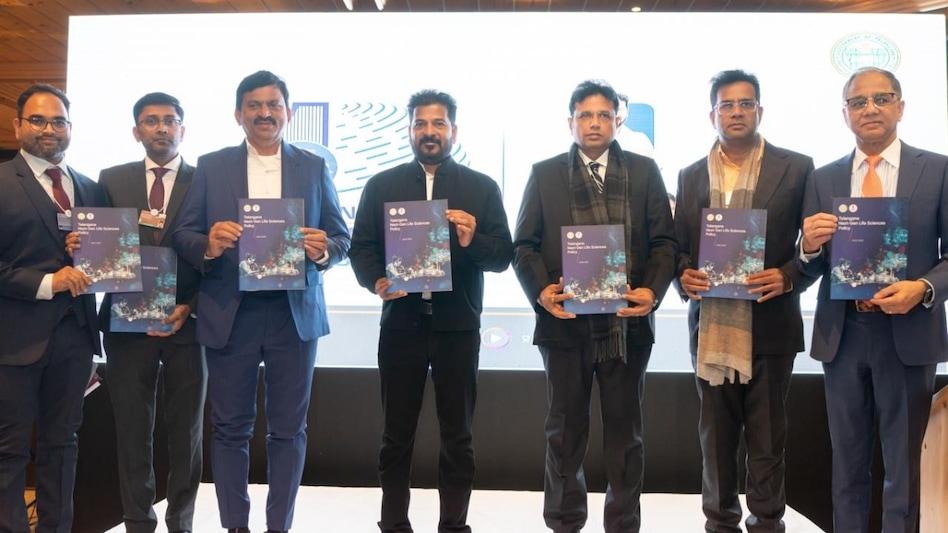
The Telangana government has launched its Next-Gen Life Sciences Policy 2026–30, setting a target of attracting over ₹2 lakh crore in investments and creating about five lakh jobs by 2030, as it looks to move beyond bulk drug manufacturing into higher-value segments such as advanced biologics, clinical research and pharma services.
The policy announced at the World Economic Forum meeting in Davos on Tuesday outlines a five-year framework covering manufacturing, research, scale-up infrastructure and funding support across the healthcare and life sciences value chain.
Chief Minister Revanth Reddy said the policy outlines Telangana’s plan to expand its role across global healthcare supply chains. “We are building one of the world’s most trusted and transformational biosciences ecosystems, driving global health impact from Telangana,” he said.
The state already hosts large pharmaceutical manufacturing clusters and research centres in Hyderabad. Over the past few years, multinational drugmakers such as Amgen, Sanofi, Bristol Myers Squibb and Eli Lilly have expanded their research, digital and global capability centres in the city.
IT and industries minister D. Sridhar Babu said Telangana is seeking to scale up recent investment momentum. “In the last two years alone, we have attracted investments of about ₹73,000 crore. With the launch of the new policy, we are aiming to attract ₹2 lakh crore over the next five years,” he said. He added that the emphasis is on advanced manufacturing platforms, including cell and gene therapies, peptides, precision fermentation, and other next-generation modalities.
A major part of the policy focuses on infrastructure. The government plans to develop a Green Pharma City, designed as a common manufacturing cluster with shared utilities, waste management and energy systems. In addition, 10 Pharma Villages are proposed along the Outer Ring Road to support decentralised manufacturing and supplier networks.
The policy also proposes a new facility called 1Bio, aimed at helping companies scale up biopharma manufacturing from pilot to commercial stages. For startups and growing companies, the state plans to set up a Life Sciences Innovation Fund with an initial corpus of ₹100 crore, with the option to expand it to ₹1,000 crore over time through public–private partnerships.
Special chief secretary Sanjay Kumar said regulatory changes form an important part of the plan. “The policy recognises R&D units as industrial enterprises, allowing them access to incentives available to manufacturing units,” he said. He added that measures are also being put in place to support faster adoption of digital health tools and data-driven healthcare systems.
From an industry perspective, the policy places particular emphasis on pharma services, including contract research and manufacturing. Telangana estimates the sector could grow from around ₹16,600 crore at present to about ₹83,000 crore over the next few years, supported by demand from global drugmakers.
Shakthi M. Nagappan, CEO of Telangana Life Sciences, said the focus is on building a pipeline from startups to commercial-scale companies. “The policy strengthens the ecosystem across research, manufacturing and talent, while supporting early- and growth-stage companies through funding and infrastructure,” he said.
To improve ease of execution, the government said approvals will continue to be routed through the TG-iPASS single-window system, with time-bound clearances and provisions for deemed approvals. Designated life sciences parks will also be permitted round-the-clock operations, subject to safety norms.
The Telangana government has launched its Next-Gen Life Sciences Policy 2026–30, setting a target of attracting over ₹2 lakh crore in investments and creating about five lakh jobs by 2030, as it looks to move beyond bulk drug manufacturing into higher-value segments such as advanced biologics, clinical research and pharma services.
The policy announced at the World Economic Forum meeting in Davos on Tuesday outlines a five-year framework covering manufacturing, research, scale-up infrastructure and funding support across the healthcare and life sciences value chain.
Chief Minister Revanth Reddy said the policy outlines Telangana’s plan to expand its role across global healthcare supply chains. “We are building one of the world’s most trusted and transformational biosciences ecosystems, driving global health impact from Telangana,” he said.
The state already hosts large pharmaceutical manufacturing clusters and research centres in Hyderabad. Over the past few years, multinational drugmakers such as Amgen, Sanofi, Bristol Myers Squibb and Eli Lilly have expanded their research, digital and global capability centres in the city.
IT and industries minister D. Sridhar Babu said Telangana is seeking to scale up recent investment momentum. “In the last two years alone, we have attracted investments of about ₹73,000 crore. With the launch of the new policy, we are aiming to attract ₹2 lakh crore over the next five years,” he said. He added that the emphasis is on advanced manufacturing platforms, including cell and gene therapies, peptides, precision fermentation, and other next-generation modalities.
A major part of the policy focuses on infrastructure. The government plans to develop a Green Pharma City, designed as a common manufacturing cluster with shared utilities, waste management and energy systems. In addition, 10 Pharma Villages are proposed along the Outer Ring Road to support decentralised manufacturing and supplier networks.
The policy also proposes a new facility called 1Bio, aimed at helping companies scale up biopharma manufacturing from pilot to commercial stages. For startups and growing companies, the state plans to set up a Life Sciences Innovation Fund with an initial corpus of ₹100 crore, with the option to expand it to ₹1,000 crore over time through public–private partnerships.
Special chief secretary Sanjay Kumar said regulatory changes form an important part of the plan. “The policy recognises R&D units as industrial enterprises, allowing them access to incentives available to manufacturing units,” he said. He added that measures are also being put in place to support faster adoption of digital health tools and data-driven healthcare systems.
From an industry perspective, the policy places particular emphasis on pharma services, including contract research and manufacturing. Telangana estimates the sector could grow from around ₹16,600 crore at present to about ₹83,000 crore over the next few years, supported by demand from global drugmakers.
Shakthi M. Nagappan, CEO of Telangana Life Sciences, said the focus is on building a pipeline from startups to commercial-scale companies. “The policy strengthens the ecosystem across research, manufacturing and talent, while supporting early- and growth-stage companies through funding and infrastructure,” he said.
To improve ease of execution, the government said approvals will continue to be routed through the TG-iPASS single-window system, with time-bound clearances and provisions for deemed approvals. Designated life sciences parks will also be permitted round-the-clock operations, subject to safety norms.