
'15 years of hard work...': Iranian Composer turns devastation into music, performing amid the ruins of airstrike
The school had around 250 students from toddlers to elderly learners and had become a creative haven.
- Apr 9, 2026,
- Updated Apr 9, 2026 10:41 PM IST
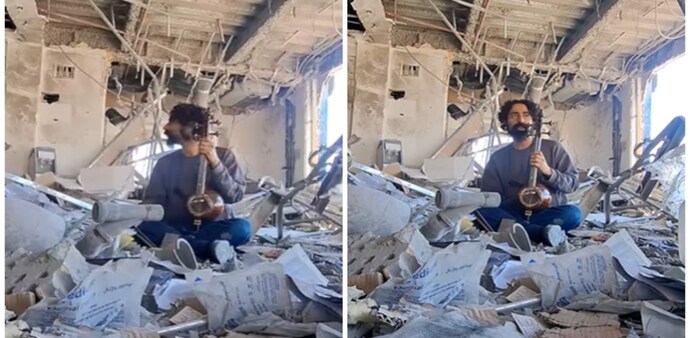
Amid the ruins of his music school, Iranian composer Hamidreza Afarideh picked up his instrument and played, creating a haunting act of resilience after alleged US and Israeli airstrikes reduced his academy to rubble.
What was once a lively space for learning and performing classical Persian music is now a scene of devastation, reflecting the human cost of war beyond the headlines.
According to a report by CNN, the Honiak Music Academy, founded by Afarideh and his wife Sheida Ebadatdoust two years ago, was hit on March 23 when an Israeli airstrike targeted a building on the east side of Tehran. The same building also housed several businesses including a maternity clinic and was located less than two kilometers from a military air base.
The school had around 250 students from toddlers to elderly learners and had become a creative haven. Afarideh and Ebadatdoust had closed it as a precaution after the US and Israel launched joint attacks on Iran.
“All the property and assets that my spouse and I had built over 15 years of hard work were destroyed overnight completely wiped out with nothing left,” Afarideh told CNN.
From music to silence
Before the strike, the academy was filled with the sounds of traditional instruments such as the setar and santur. It employed around two dozen teachers and staff and offered students a warm, family-like environment.
“For many of them, this place was like a second home,” Afarideh said. “It gave them a strong sense of comfort and security.”
The morning of the attack began with the school’s alarm system blaring just after dawn. Initially fearing a break-in, the couple rushed to the building and found a much worse scene with thick smoke and heavy fog that made it nearly impossible to drive toward the institute.
“We saw very heavy smoke and fog in the sky,” he said. “It was so dense that we couldn’t see ahead of us and couldn’t even properly drive toward the institute.”
They had to wait for hours until authorities completed search and rescue operations. When they were finally allowed inside, the destruction was staggering.
“With each floor we climbed, the level of destruction was so severe that the stairs were collapsing as we moved upward,” Afarideh said.
Their studio on the fourth floor was completely destroyed. “There were no musical instruments left,” he said. “None of the equipment we had such as TVs, audio systems, or any of the facilities a professional institute should have remained.”
Strike and aftermath
That day, Tehran experienced multiple airstrikes. Israel’s military said it had carried out wide-scale strikes targeting military infrastructure including weapons manufacturing sites and security headquarters.
The Israel Defense Forces told CNN it had carried out a targeted strike on a Quds Force intelligence headquarters near the specified location. It added that the expected military advantage outweighed the expected collateral damage including to nearby structures.
The United States Central Command said it had no information to provide.
Lives disrupted
Afarideh and Ebadatdoust now face the challenge of rebuilding both their school and the community it supported.
“Now, the students are distraught because that kind of space no longer exists for them,” Afarideh said.
The academy employed about two dozen teachers and administrative staff, many young graduates in their 20s, who now have no income as the war further strains Iran’s economy.
The couple estimates the total loss at around $42,000. In a country where the annual GDP per capita was about $5,120 in 2024 according to the World Bank, the financial blow is significant.
Because the building is badly damaged, they may need to move to a new location. Rising costs and uncertainty make rebuilding difficult.
They are seeking help from music associations and the government’s Ministry of Culture, but assistance may take time.
“Countries like Iran, with thousands of years of culture and art, have a strong identity tied to music,” Afarideh said. “When this identity is meant to be passed on through our students and us to future generations, it must be supported.”
Amid the ruins of his music school, Iranian composer Hamidreza Afarideh picked up his instrument and played, creating a haunting act of resilience after alleged US and Israeli airstrikes reduced his academy to rubble.
What was once a lively space for learning and performing classical Persian music is now a scene of devastation, reflecting the human cost of war beyond the headlines.
According to a report by CNN, the Honiak Music Academy, founded by Afarideh and his wife Sheida Ebadatdoust two years ago, was hit on March 23 when an Israeli airstrike targeted a building on the east side of Tehran. The same building also housed several businesses including a maternity clinic and was located less than two kilometers from a military air base.
The school had around 250 students from toddlers to elderly learners and had become a creative haven. Afarideh and Ebadatdoust had closed it as a precaution after the US and Israel launched joint attacks on Iran.
“All the property and assets that my spouse and I had built over 15 years of hard work were destroyed overnight completely wiped out with nothing left,” Afarideh told CNN.
From music to silence
Before the strike, the academy was filled with the sounds of traditional instruments such as the setar and santur. It employed around two dozen teachers and staff and offered students a warm, family-like environment.
“For many of them, this place was like a second home,” Afarideh said. “It gave them a strong sense of comfort and security.”
The morning of the attack began with the school’s alarm system blaring just after dawn. Initially fearing a break-in, the couple rushed to the building and found a much worse scene with thick smoke and heavy fog that made it nearly impossible to drive toward the institute.
“We saw very heavy smoke and fog in the sky,” he said. “It was so dense that we couldn’t see ahead of us and couldn’t even properly drive toward the institute.”
They had to wait for hours until authorities completed search and rescue operations. When they were finally allowed inside, the destruction was staggering.
“With each floor we climbed, the level of destruction was so severe that the stairs were collapsing as we moved upward,” Afarideh said.
Their studio on the fourth floor was completely destroyed. “There were no musical instruments left,” he said. “None of the equipment we had such as TVs, audio systems, or any of the facilities a professional institute should have remained.”
Strike and aftermath
That day, Tehran experienced multiple airstrikes. Israel’s military said it had carried out wide-scale strikes targeting military infrastructure including weapons manufacturing sites and security headquarters.
The Israel Defense Forces told CNN it had carried out a targeted strike on a Quds Force intelligence headquarters near the specified location. It added that the expected military advantage outweighed the expected collateral damage including to nearby structures.
The United States Central Command said it had no information to provide.
Lives disrupted
Afarideh and Ebadatdoust now face the challenge of rebuilding both their school and the community it supported.
“Now, the students are distraught because that kind of space no longer exists for them,” Afarideh said.
The academy employed about two dozen teachers and administrative staff, many young graduates in their 20s, who now have no income as the war further strains Iran’s economy.
The couple estimates the total loss at around $42,000. In a country where the annual GDP per capita was about $5,120 in 2024 according to the World Bank, the financial blow is significant.
Because the building is badly damaged, they may need to move to a new location. Rising costs and uncertainty make rebuilding difficult.
They are seeking help from music associations and the government’s Ministry of Culture, but assistance may take time.
“Countries like Iran, with thousands of years of culture and art, have a strong identity tied to music,” Afarideh said. “When this identity is meant to be passed on through our students and us to future generations, it must be supported.”