
Afghanistan earthquake death toll climbs to over 1,400; 3,124 injured
The earthquake, rated at magnitude 6, occurred around midnight on Monday at a depth of 10 km, impacting primarily the eastern provinces of Kunar and Nangarhar.
- Sep 2, 2025,
- Updated Sep 2, 2025 5:07 PM IST
The death toll from Afghanistan's most severe earthquake in recent years climbed to over 1,400 on Tuesday, with thousands more injured, according to local authorities. The earthquake struck the country's mountainous eastern region, severely complicating rescue efforts in isolated villages.
According to Reuters that quoted Zabihullah Mujahid, spokesperson for the Taliban administration, at least 1,411 fatalities and 3,124 injuries have been recorded, with over 5,400 homes destroyed across the affected regions. The Afghan Red Crescent Society has warned that more individuals may remain trapped under debris, while the UN coordinator in Afghanistan indicated that the death toll could increase further.
The earthquake, rated at magnitude 6, occurred around midnight on Monday at a depth of 10 km, impacting primarily the eastern provinces of Kunar and Nangarhar. Ehsanullah Ehsan, head of disaster management in Kunar, stated that rescue operations had been conducted in four heavily impacted villages, with efforts now shifting to more remote areas. "We cannot accurately predict how many bodies might still be trapped under the rubble," he said. "Our effort is to complete these operations as soon as possible and to begin distributing aid to the affected families."
The WHO reported that the earthquake affected over 12,000 people, noting significant challenges in aid delivery due to damaged roads, aftershocks, and remote locations. "Damaged roads, ongoing aftershocks, and remote locations of many villages severely impede the delivery of aid," the organisation said. It highlighted the overwhelming of local health systems and dependence on external assistance: "The pre-earthquake fragility of the health system means local capacity is overwhelmed, creating total dependence on external actors."
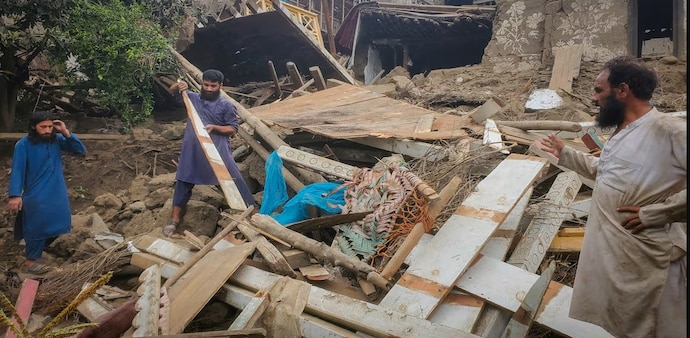
Rescue operations face significant obstacles due to the mountainous terrain and inclement weather, particularly in areas near the Pakistani border where mud-and-brick homes have been flattened. Access for vehicles along narrow mountain roads is a major challenge, although machinery is being brought in to clear debris and facilitate further rescue efforts.
International assistance has been slow to arrive in the aftermath of the tragedy, with Britain allocating £1 million to support UN and Red Cross emergency efforts, while India has sent 1,000 tents and is delivering 15 tonnes of food supplies. Other countries, including China, the UAE, the EU, Pakistan, and Iran, have pledged aid but have yet to deliver.
The earthquake's impact comes amid already strained resources in the conflict-ridden country, exacerbated by cuts in foreign aid. Reductions in funding from the United States and other international donors, due to crises elsewhere and concerns over the Taliban's policies, have further hampered relief efforts.
The death toll from Afghanistan's most severe earthquake in recent years climbed to over 1,400 on Tuesday, with thousands more injured, according to local authorities. The earthquake struck the country's mountainous eastern region, severely complicating rescue efforts in isolated villages.
According to Reuters that quoted Zabihullah Mujahid, spokesperson for the Taliban administration, at least 1,411 fatalities and 3,124 injuries have been recorded, with over 5,400 homes destroyed across the affected regions. The Afghan Red Crescent Society has warned that more individuals may remain trapped under debris, while the UN coordinator in Afghanistan indicated that the death toll could increase further.
The earthquake, rated at magnitude 6, occurred around midnight on Monday at a depth of 10 km, impacting primarily the eastern provinces of Kunar and Nangarhar. Ehsanullah Ehsan, head of disaster management in Kunar, stated that rescue operations had been conducted in four heavily impacted villages, with efforts now shifting to more remote areas. "We cannot accurately predict how many bodies might still be trapped under the rubble," he said. "Our effort is to complete these operations as soon as possible and to begin distributing aid to the affected families."
The WHO reported that the earthquake affected over 12,000 people, noting significant challenges in aid delivery due to damaged roads, aftershocks, and remote locations. "Damaged roads, ongoing aftershocks, and remote locations of many villages severely impede the delivery of aid," the organisation said. It highlighted the overwhelming of local health systems and dependence on external assistance: "The pre-earthquake fragility of the health system means local capacity is overwhelmed, creating total dependence on external actors."
Rescue operations face significant obstacles due to the mountainous terrain and inclement weather, particularly in areas near the Pakistani border where mud-and-brick homes have been flattened. Access for vehicles along narrow mountain roads is a major challenge, although machinery is being brought in to clear debris and facilitate further rescue efforts.
International assistance has been slow to arrive in the aftermath of the tragedy, with Britain allocating £1 million to support UN and Red Cross emergency efforts, while India has sent 1,000 tents and is delivering 15 tonnes of food supplies. Other countries, including China, the UAE, the EU, Pakistan, and Iran, have pledged aid but have yet to deliver.
The earthquake's impact comes amid already strained resources in the conflict-ridden country, exacerbated by cuts in foreign aid. Reductions in funding from the United States and other international donors, due to crises elsewhere and concerns over the Taliban's policies, have further hampered relief efforts.