
'An Indian and a Pakistani': JD Vance jokes about his inner circle at US-Iran peace summit
Addressing the media at the Lake Lucerne Summit, Vance paused to highlight two central figures in his life, pointing directly to his cross-border connections as Pakistan Prime Minister Shehbaz Sharif looked on.
- Jun 21, 2026,
- Updated Jun 21, 2026 9:30 PM IST
Amid high-stakes diplomatic maneuvering in Switzerland to stabilize relations with Iran, US Vice President JD Vance injected a moment of levity into the proceedings by leaning on his personal life and a newfound geopolitical partnership.
Addressing the media at the Lake Lucerne Summit, Vance paused to highlight two central figures in his life, pointing directly to his cross-border connections as Pakistan Prime Minister Shehbaz Sharif looked on.
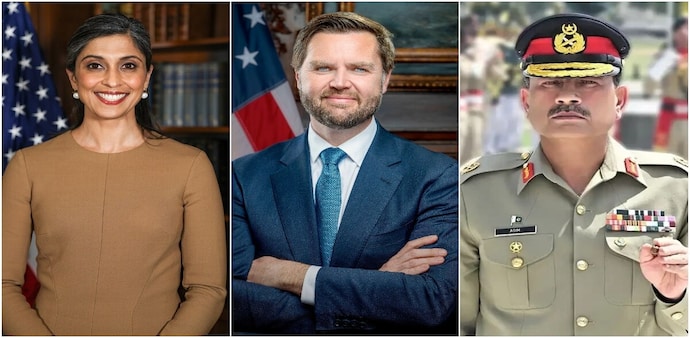
“Since Field Marshal Asim Munir welcomed us with the Prime Minister in Islamabad, I have joked that I have two very, very important people in my life,” Vance said. “An Indian and a Pakistani. The Indian is my wife, and the Pakistani is Field Marshal Munir.”
The lighthearted remark underscores an intense period of diplomatic engagement between Washington and Islamabad, which has been serving as a key mediator alongside Qatar in the US-Iran talks. Vance revealed just how closely he has been working with Pakistan’s military chief during the recent regional friction.
“I've probably talked to Field Marshal Munir more than I've talked to anybody else over the last three months,” Vance added. “He is of course a great military leader but I think he's shown himself to be a great diplomat.”
Vance also extended warm praise to Prime Minister Sharif, describing him as a “dear friend of the president's, dear friend of mine,” and credited Sharif’s “very careful and skilled negotiations” for progressing the peace talks to their current stage.
The camaraderie, however, followed earlier notes of friction during the summit. Vance previously offered a blunt critique regarding the transparency of the draft agreements, noting that differing democratic standards between the nations had complicated the public release of the text.
“I think part of the misalignment here is that in the Pakistani and Qatari systems, they don't quite have the First Amendment and freedom of the press,” Vance remarked during discussions about releasing the interim text. “And so there isn't this expectation that the text is going to be out there for the American people to actually interrogate and look at and analyze and understand for themselves.”
Despite those systemic differences and recent logistical delays — including the cancellation of a formal signing ceremony after the agreement was instead processed electronically — the summit successfully focused on reinforcing a fragile, provisional two-week ceasefire.
Amid high-stakes diplomatic maneuvering in Switzerland to stabilize relations with Iran, US Vice President JD Vance injected a moment of levity into the proceedings by leaning on his personal life and a newfound geopolitical partnership.
Addressing the media at the Lake Lucerne Summit, Vance paused to highlight two central figures in his life, pointing directly to his cross-border connections as Pakistan Prime Minister Shehbaz Sharif looked on.
“Since Field Marshal Asim Munir welcomed us with the Prime Minister in Islamabad, I have joked that I have two very, very important people in my life,” Vance said. “An Indian and a Pakistani. The Indian is my wife, and the Pakistani is Field Marshal Munir.”
The lighthearted remark underscores an intense period of diplomatic engagement between Washington and Islamabad, which has been serving as a key mediator alongside Qatar in the US-Iran talks. Vance revealed just how closely he has been working with Pakistan’s military chief during the recent regional friction.
“I've probably talked to Field Marshal Munir more than I've talked to anybody else over the last three months,” Vance added. “He is of course a great military leader but I think he's shown himself to be a great diplomat.”
Vance also extended warm praise to Prime Minister Sharif, describing him as a “dear friend of the president's, dear friend of mine,” and credited Sharif’s “very careful and skilled negotiations” for progressing the peace talks to their current stage.
The camaraderie, however, followed earlier notes of friction during the summit. Vance previously offered a blunt critique regarding the transparency of the draft agreements, noting that differing democratic standards between the nations had complicated the public release of the text.
“I think part of the misalignment here is that in the Pakistani and Qatari systems, they don't quite have the First Amendment and freedom of the press,” Vance remarked during discussions about releasing the interim text. “And so there isn't this expectation that the text is going to be out there for the American people to actually interrogate and look at and analyze and understand for themselves.”
Despite those systemic differences and recent logistical delays — including the cancellation of a formal signing ceremony after the agreement was instead processed electronically — the summit successfully focused on reinforcing a fragile, provisional two-week ceasefire.