
US escalates pressure on China: Pentagon names Alibaba, Baidu, BYD as military-linked firms
With the update, the Pentagon has now declared that three of China's leading artificial intelligence companies — Alibaba, Baidu and Tencent — are aiding the country's armed forces
- Jun 9, 2026,
- Updated Jun 9, 2026 2:35 PM IST
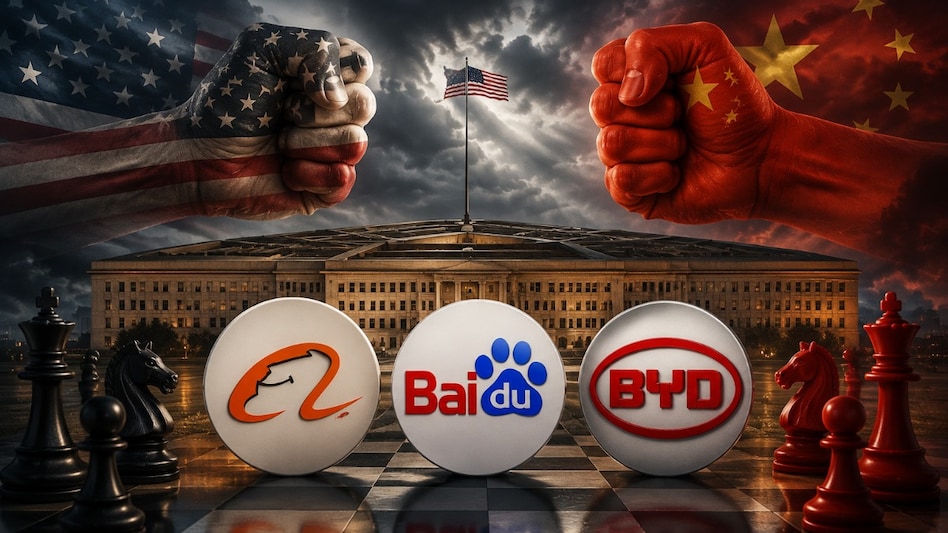
The Pentagon has accused some of China's biggest companies, including Alibaba, Baidu and electric vehicle giant BYD, of supporting the Chinese military, Bloomberg reported on Monday.
The US Defense Department announced the designations in an updated version of its so-called 1260H list, a roster of companies it says aid the People's Liberation Army. The latest list restores names that had been included in a February version before it was withdrawn within minutes.
With the update, the Pentagon has now declared that three of China's leading artificial intelligence companies — Alibaba, Baidu and Tencent — are aiding the country's armed forces. Tencent was added to the list in 2025 and has been seeking its removal.
Must Read: 'This should terrify every CEO': How Xi Jinping's China destroyed 10 American industries
The designation of BYD, China's largest electric vehicle maker, broadens the scrutiny beyond technology firms.
BYD also operates in India, though its proposal to invest $1 billion in setting up a manufacturing facility in the country was rejected by the Indian government in 2023.
The updated list also restores two Chinese memory chipmakers — ChangXin Memory Technologies (CXMT) and Yangtze Memory Technologies (YMTC) — whose names had appeared on earlier Pentagon lists but were omitted from the February version.
Don't Miss: US proposes new tariffs on trading partners; India, China to be tariffed 12.5%: Report
While inclusion on the list does not trigger immediate legal penalties, it can have significant consequences.
The Pentagon increasingly uses the designation to limit companies' ability to secure contracts with the US military or receive research funding. The label is also viewed as a warning to investors and can precede tougher trade restrictions.
The move comes less than a month after US President Donald Trump met Chinese President Xi Jinping in Beijing. The summit was closely watched for signs of easing tensions between the world's two largest economies but yielded little progress on disputes surrounding advanced technologies, particularly artificial intelligence.
"The Pentagon's republished Chinese military companies list serves as a post-summit reality check," Craig Singleton, senior China fellow at the Foundation for Defense of Democracies, told Bloomberg. "The Xi-Trump meeting did not pause competition; it clarified where competition will continue."
In releasing the updated list, the Pentagon said the designated entities qualify as "Chinese military companies" operating directly or indirectly in the United States through activities such as "providing commercial services, manufacturing, producing, or exporting."
Bloomberg had earlier reported that the Pentagon's initial decision to remove YMTC and CXMT was behind the February withdrawal of the list.
According to people cited in the report, Trump administration national security officials feared removing the chipmakers would signal that Washington no longer considered them a threat, particularly ahead of the planned leaders' summit.
Officials were also concerned the move could strengthen Chinese firms at the expense of major rivals, including Micron Technology and South Korean memory chipmakers Samsung Electronics and SK Hynix.
The report said a senior White House official immediately contacted the Pentagon after the list's publication to express concern that those objections had been ignored, prompting defense officials to take the document offline quickly.
Under China's military-civil fusion policy, which encourages cooperation between private firms and the armed forces, nearly any Chinese company operating in the US could face designation.
John McEntee, a former Trump White House official who now lobbies for Tencent, criticised the latest expansion of the list. "By expanding the list to Chinese car companies like BYD and NIO, they're revealing how ridiculous the justification is. By their logic, Ford and GM should be classified as American military companies," he was quoted as saying by Bloomberg.
The Pentagon has accused some of China's biggest companies, including Alibaba, Baidu and electric vehicle giant BYD, of supporting the Chinese military, Bloomberg reported on Monday.
The US Defense Department announced the designations in an updated version of its so-called 1260H list, a roster of companies it says aid the People's Liberation Army. The latest list restores names that had been included in a February version before it was withdrawn within minutes.
With the update, the Pentagon has now declared that three of China's leading artificial intelligence companies — Alibaba, Baidu and Tencent — are aiding the country's armed forces. Tencent was added to the list in 2025 and has been seeking its removal.
Must Read: 'This should terrify every CEO': How Xi Jinping's China destroyed 10 American industries
The designation of BYD, China's largest electric vehicle maker, broadens the scrutiny beyond technology firms.
BYD also operates in India, though its proposal to invest $1 billion in setting up a manufacturing facility in the country was rejected by the Indian government in 2023.
The updated list also restores two Chinese memory chipmakers — ChangXin Memory Technologies (CXMT) and Yangtze Memory Technologies (YMTC) — whose names had appeared on earlier Pentagon lists but were omitted from the February version.
Don't Miss: US proposes new tariffs on trading partners; India, China to be tariffed 12.5%: Report
While inclusion on the list does not trigger immediate legal penalties, it can have significant consequences.
The Pentagon increasingly uses the designation to limit companies' ability to secure contracts with the US military or receive research funding. The label is also viewed as a warning to investors and can precede tougher trade restrictions.
The move comes less than a month after US President Donald Trump met Chinese President Xi Jinping in Beijing. The summit was closely watched for signs of easing tensions between the world's two largest economies but yielded little progress on disputes surrounding advanced technologies, particularly artificial intelligence.
"The Pentagon's republished Chinese military companies list serves as a post-summit reality check," Craig Singleton, senior China fellow at the Foundation for Defense of Democracies, told Bloomberg. "The Xi-Trump meeting did not pause competition; it clarified where competition will continue."
In releasing the updated list, the Pentagon said the designated entities qualify as "Chinese military companies" operating directly or indirectly in the United States through activities such as "providing commercial services, manufacturing, producing, or exporting."
Bloomberg had earlier reported that the Pentagon's initial decision to remove YMTC and CXMT was behind the February withdrawal of the list.
According to people cited in the report, Trump administration national security officials feared removing the chipmakers would signal that Washington no longer considered them a threat, particularly ahead of the planned leaders' summit.
Officials were also concerned the move could strengthen Chinese firms at the expense of major rivals, including Micron Technology and South Korean memory chipmakers Samsung Electronics and SK Hynix.
The report said a senior White House official immediately contacted the Pentagon after the list's publication to express concern that those objections had been ignored, prompting defense officials to take the document offline quickly.
Under China's military-civil fusion policy, which encourages cooperation between private firms and the armed forces, nearly any Chinese company operating in the US could face designation.
John McEntee, a former Trump White House official who now lobbies for Tencent, criticised the latest expansion of the list. "By expanding the list to Chinese car companies like BYD and NIO, they're revealing how ridiculous the justification is. By their logic, Ford and GM should be classified as American military companies," he was quoted as saying by Bloomberg.