
Fresh crisis: Nepal issues flood warning after dam burst in Tibet, halts rescue work
With the threat of another major water surge, authorities are urging residents and emergency personnel to prioritise safety, move to higher ground and closely follow official evacuation and emergency instructions.
- Aug 28, 2026,
- Updated Aug 28, 2026 1:52 PM IST
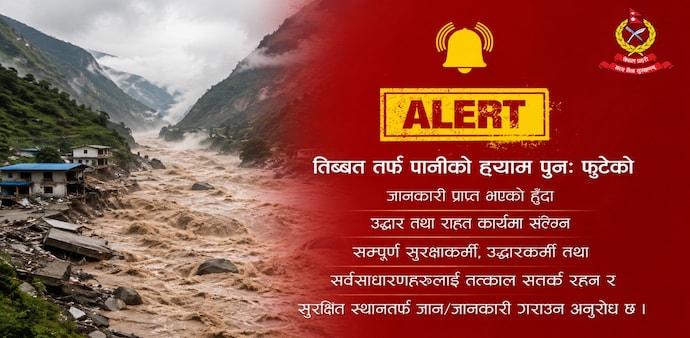
Nepal Police today issued a fresh warning to security personnel, rescue workers and the general public after receiving information that a water dam or artificial lake on the Tibetan side had burst again, raising fears of another surge of floodwater into Nepal.
In a post on X (formally twitter), Nepal Police urged everyone involved in rescue and relief operations to remain on immediate alert and move to safer locations. Authorities also appealed to people in vulnerable areas to inform others about the developing danger and avoid locations that could be affected by rising water levels.
READ THIS: Himalayan disaster: No warning, no trigger. What triggered the deadly Nepal-Tibet floods?
The warning comes just days after a devastating flash flood struck the Nepal-Tibet border region, leaving widespread destruction across Nepal’s Rasuwa district. The disaster was triggered by a glacier collapse and subsequent flooding, destroying homes, roads, bridges and hydropower infrastructure.
The latest alert has added to concerns that the disaster could trigger further flooding downstream. Nepalese authorities have already temporarily halted some rescue operations after water levels rose in a newly formed lake created by debris from the earlier disaster. ANI reported that helicopter rescue operations were suspended as a precaution after the dammed lake began overflowing.
The situation remains particularly dangerous for rescue teams working in the affected areas, where unstable terrain, damaged infrastructure and the possibility of sudden water surges are complicating relief operations. Nepal’s National Disaster Risk Reduction and Management Authority has also warned of renewed flooding risks as water levels continue to rise in the affected area.
With the threat of another major water surge, authorities are urging residents and emergency personnel to prioritise safety, move to higher ground and closely follow official evacuation and emergency instructions. The latest warning underscores the continuing uncertainty in the Himalayan border region as rescue teams race to assist those affected by the catastrophic floods.
August 26 tragedy
An avalanche of ice and rock thundered down a mountain slope on August 26, plunging into a glacial lake and unleashing a wall of water that tore through villages across Nepal. Flash floods wiped out entire settlements, leaving at least 475 people dead and 1500+ still missing, as reported by ANI.
Rescue teams face an escalating crisis as search efforts begin. Officials warn the death toll will rise sharply once search teams access the most remote, devastated zones, where entire communities were swept away in minutes.
Climate experts at the Kathmandu-based International Centre for Integrated Mountain Development (ICIMOD) confirmed that an avalanche originating from a glacier, in all probability, caused Wednesday's flash flood.
Nepal Police today issued a fresh warning to security personnel, rescue workers and the general public after receiving information that a water dam or artificial lake on the Tibetan side had burst again, raising fears of another surge of floodwater into Nepal.
In a post on X (formally twitter), Nepal Police urged everyone involved in rescue and relief operations to remain on immediate alert and move to safer locations. Authorities also appealed to people in vulnerable areas to inform others about the developing danger and avoid locations that could be affected by rising water levels.
READ THIS: Himalayan disaster: No warning, no trigger. What triggered the deadly Nepal-Tibet floods?
The warning comes just days after a devastating flash flood struck the Nepal-Tibet border region, leaving widespread destruction across Nepal’s Rasuwa district. The disaster was triggered by a glacier collapse and subsequent flooding, destroying homes, roads, bridges and hydropower infrastructure.
The latest alert has added to concerns that the disaster could trigger further flooding downstream. Nepalese authorities have already temporarily halted some rescue operations after water levels rose in a newly formed lake created by debris from the earlier disaster. ANI reported that helicopter rescue operations were suspended as a precaution after the dammed lake began overflowing.
The situation remains particularly dangerous for rescue teams working in the affected areas, where unstable terrain, damaged infrastructure and the possibility of sudden water surges are complicating relief operations. Nepal’s National Disaster Risk Reduction and Management Authority has also warned of renewed flooding risks as water levels continue to rise in the affected area.
With the threat of another major water surge, authorities are urging residents and emergency personnel to prioritise safety, move to higher ground and closely follow official evacuation and emergency instructions. The latest warning underscores the continuing uncertainty in the Himalayan border region as rescue teams race to assist those affected by the catastrophic floods.
August 26 tragedy
An avalanche of ice and rock thundered down a mountain slope on August 26, plunging into a glacial lake and unleashing a wall of water that tore through villages across Nepal. Flash floods wiped out entire settlements, leaving at least 475 people dead and 1500+ still missing, as reported by ANI.
Rescue teams face an escalating crisis as search efforts begin. Officials warn the death toll will rise sharply once search teams access the most remote, devastated zones, where entire communities were swept away in minutes.
Climate experts at the Kathmandu-based International Centre for Integrated Mountain Development (ICIMOD) confirmed that an avalanche originating from a glacier, in all probability, caused Wednesday's flash flood.