
Khamenei buried at Mashhad shrine; son and successor Mojtaba still absent, injured in same strike
The ceremony brought to a close nearly four decades of his leadership and a week of state mourning that unfolded against the backdrop of renewed conflict between Tehran and Washington
- Jul 10, 2026,
- Updated Jul 10, 2026 8:34 AM IST
After a week of mass processions across Iran and Iraq, Ayatollah Ali Khamenei was buried in the early hours of Friday at the Shrine of Imam Reza in Mashhad, the holiest site in Shi'ite Islam and his hometown. The ceremony brought to a close nearly four decades of his leadership and a week of state mourning that unfolded against the backdrop of renewed conflict between Tehran and Washington. His son and proclaimed successor, Mojtaba Khamenei, was nowhere to be seen.
Khamenei was killed on February 28 in the opening strikes of the war launched by the United States and Israel. A ceasefire was agreed last month, though tensions have since resurfaced sharply.
The final procession
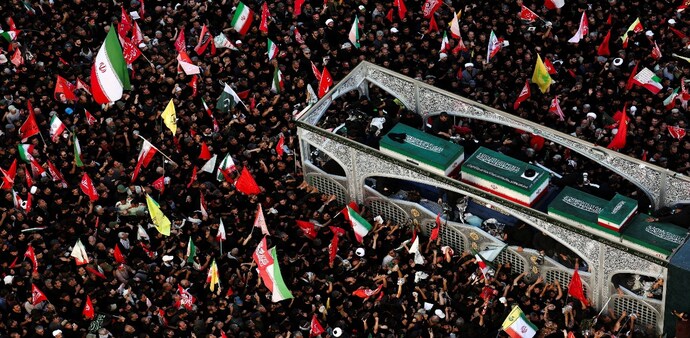
On Thursday, Khamenei's coffin was carried through the packed streets of Mashhad on a truck, escorted by white-turbaned clerics as tens of thousands of black-clad mourners lined the route, waving Iranian flags, holding photographs of the late leader, and raising red placards bearing revolutionary slogans.
As the procession neared the shrine, the crowd chanted calls for revenge against President Donald Trump. "I swear by the blood of the supreme leader, Trump, we will kill you!" rang out from sections of the crowd, while some women held signs reading "Kill Trump." Inside the shrine's courtyard, chants of "Death to America" mixed with funeral laments broadcast over loudspeakers.
A helicopter lifted Khamenei's coffin over the densely packed crowd for the final stretch into the shrine. His eldest son, Mostafa, led the funeral prayer before male mourners carried the flag-draped coffin inside. Many in the crowd held candles, reached toward the coffin and wept. Iran's official news agency IRNA confirmed that Khamenei and four family members killed alongside him were all buried by early Friday morning.
The body had been carried through Tehran, the clerical centre of Qom, and the Iraqi shrine cities of Najaf and Karbala before reaching Mashhad, with large crowds attending each stage of the journey.
Mojtaba remains absent
The most closely watched detail of the week's events was what was missing: any appearance by Mojtaba Khamenei, who was proclaimed supreme leader by a clerical assembly in early March, one week after his father's death. He has not appeared in public since the war began and has issued only written statements, with no image, video, or audio released by authorities.
Senior sources in Tehran told Reuters that Mojtaba suffered serious injuries in the same strike that killed his father, sustaining facial disfigurement and significant limb injuries. He is recovering, the sources said, but has not regained sufficient health to appear publicly. State security services are also restricting his exposure over concerns about potential future strikes by the United States.
End of an era and its complications
Khamenei's 37-year tenure ended at a moment of profound uncertainty for Iran. His rule was marked by the consolidation of political, military, and economic authority within the office of the supreme leader, achieved in close coordination with the Islamic Revolutionary Guard Corps. The elected president and parliament were progressively sidelined. Mojtaba assumed the position with the backing of the Guards, which many analysts now regard as the dominant force in Iran's strategic decision-making.
His death also comes shortly after nationwide protests against the Islamic Republic, driven largely by economic grievances amid crippling sanctions, were suppressed by security forces in a crackdown that killed thousands of demonstrators.
After a week of mass processions across Iran and Iraq, Ayatollah Ali Khamenei was buried in the early hours of Friday at the Shrine of Imam Reza in Mashhad, the holiest site in Shi'ite Islam and his hometown. The ceremony brought to a close nearly four decades of his leadership and a week of state mourning that unfolded against the backdrop of renewed conflict between Tehran and Washington. His son and proclaimed successor, Mojtaba Khamenei, was nowhere to be seen.
Khamenei was killed on February 28 in the opening strikes of the war launched by the United States and Israel. A ceasefire was agreed last month, though tensions have since resurfaced sharply.
The final procession
On Thursday, Khamenei's coffin was carried through the packed streets of Mashhad on a truck, escorted by white-turbaned clerics as tens of thousands of black-clad mourners lined the route, waving Iranian flags, holding photographs of the late leader, and raising red placards bearing revolutionary slogans.
As the procession neared the shrine, the crowd chanted calls for revenge against President Donald Trump. "I swear by the blood of the supreme leader, Trump, we will kill you!" rang out from sections of the crowd, while some women held signs reading "Kill Trump." Inside the shrine's courtyard, chants of "Death to America" mixed with funeral laments broadcast over loudspeakers.
A helicopter lifted Khamenei's coffin over the densely packed crowd for the final stretch into the shrine. His eldest son, Mostafa, led the funeral prayer before male mourners carried the flag-draped coffin inside. Many in the crowd held candles, reached toward the coffin and wept. Iran's official news agency IRNA confirmed that Khamenei and four family members killed alongside him were all buried by early Friday morning.
The body had been carried through Tehran, the clerical centre of Qom, and the Iraqi shrine cities of Najaf and Karbala before reaching Mashhad, with large crowds attending each stage of the journey.
Mojtaba remains absent
The most closely watched detail of the week's events was what was missing: any appearance by Mojtaba Khamenei, who was proclaimed supreme leader by a clerical assembly in early March, one week after his father's death. He has not appeared in public since the war began and has issued only written statements, with no image, video, or audio released by authorities.
Senior sources in Tehran told Reuters that Mojtaba suffered serious injuries in the same strike that killed his father, sustaining facial disfigurement and significant limb injuries. He is recovering, the sources said, but has not regained sufficient health to appear publicly. State security services are also restricting his exposure over concerns about potential future strikes by the United States.
End of an era and its complications
Khamenei's 37-year tenure ended at a moment of profound uncertainty for Iran. His rule was marked by the consolidation of political, military, and economic authority within the office of the supreme leader, achieved in close coordination with the Islamic Revolutionary Guard Corps. The elected president and parliament were progressively sidelined. Mojtaba assumed the position with the backing of the Guards, which many analysts now regard as the dominant force in Iran's strategic decision-making.
His death also comes shortly after nationwide protests against the Islamic Republic, driven largely by economic grievances amid crippling sanctions, were suppressed by security forces in a crackdown that killed thousands of demonstrators.