
'Lacks basic conditions of a free contest': Brahma Chellaney blasts Bangladesh polls without Awami League
The Awami League - the party that led the country to independence in 1971 and was most recently headed by former Prime Minister Sheikh Hasina - has been barred from contesting.
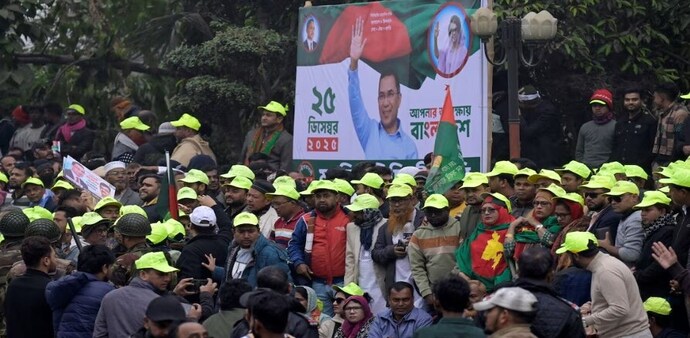
- Feb 9, 2026,
- Updated Feb 9, 2026 6:09 PM IST
As Bangladesh prepares to vote on Thursday, one of its largest and oldest political parties will not be on the ballot.
The Awami League - the party that led the country to independence in 1971 and was most recently headed by former Prime Minister Sheikh Hasina - has been barred from contesting. The election is shaping up as a contest between the Bangladesh Nationalist Party and the Bangladesh Jamaat-e-Islami.
Geostrategist Brahma Chellaney on Monday described the vote as falling short of democratic standards. In a comparison with Japan's recent election, he wrote that while Japan had delivered a decisive mandate, the contest in Bangladesh "lacks even the basic conditions of a free and fair contest".
"Japan is set to lock in a new strategic orientation at home and abroad after the LDP’s historic landslide victory in yesterday’s election. By contrast, another election scheduled for Thursday in Bangladesh — the world's most densely populated country outside the micro-states — lacks even the basic conditions of a free and fair contest," he wrote on X. The secular Awami League has been banned outright, precisely to prevent it from winning, the geostrategist added.
Japan's governing Liberal Democratic Party secured a two-thirds supermajority in its lower house election, winning 316 seats in the 465-member chamber, according to NHK. Prime Minister Sanae Takaichi said after the result that she was prepared to pursue policies to make Japan "strong and prosperous." Chellaney called the outcome a consolidation of strategic direction - in contrast, he argued, to the uncertainty surrounding Bangladesh's poll.
He went further, suggesting that the credibility of the process is already in doubt. The United States, he said, has remained silent. "Despite the election lacking any semblance of legitimacy, the U.S. has remained conspicuously silent, underscoring the widening divergence between American and Indian interests in India's own strategic backyard," he said.
According to him, Washington's silence is consistent with its support for the 2024 overthrow of the Awami League government led by Sheikh Hasina and its subsequent backing of the Yunus regime.
Chellaney also questioned whether the election would bring stability. Rather than reviving the economy or calming political tensions, he warned it was "more likely to deepen fear and division" and accelerate "the country's drift toward Islamist radicalism." "The torching of homes belonging to minority communities has already underscored how Islamist groups have used intimidation and violence to suppress participation and entrench fear," he said.
The election in Bangladesh is set for Thursday, February 12.
As Bangladesh prepares to vote on Thursday, one of its largest and oldest political parties will not be on the ballot.
The Awami League - the party that led the country to independence in 1971 and was most recently headed by former Prime Minister Sheikh Hasina - has been barred from contesting. The election is shaping up as a contest between the Bangladesh Nationalist Party and the Bangladesh Jamaat-e-Islami.
Geostrategist Brahma Chellaney on Monday described the vote as falling short of democratic standards. In a comparison with Japan's recent election, he wrote that while Japan had delivered a decisive mandate, the contest in Bangladesh "lacks even the basic conditions of a free and fair contest".
"Japan is set to lock in a new strategic orientation at home and abroad after the LDP’s historic landslide victory in yesterday’s election. By contrast, another election scheduled for Thursday in Bangladesh — the world's most densely populated country outside the micro-states — lacks even the basic conditions of a free and fair contest," he wrote on X. The secular Awami League has been banned outright, precisely to prevent it from winning, the geostrategist added.
Japan's governing Liberal Democratic Party secured a two-thirds supermajority in its lower house election, winning 316 seats in the 465-member chamber, according to NHK. Prime Minister Sanae Takaichi said after the result that she was prepared to pursue policies to make Japan "strong and prosperous." Chellaney called the outcome a consolidation of strategic direction - in contrast, he argued, to the uncertainty surrounding Bangladesh's poll.
He went further, suggesting that the credibility of the process is already in doubt. The United States, he said, has remained silent. "Despite the election lacking any semblance of legitimacy, the U.S. has remained conspicuously silent, underscoring the widening divergence between American and Indian interests in India's own strategic backyard," he said.
According to him, Washington's silence is consistent with its support for the 2024 overthrow of the Awami League government led by Sheikh Hasina and its subsequent backing of the Yunus regime.
Chellaney also questioned whether the election would bring stability. Rather than reviving the economy or calming political tensions, he warned it was "more likely to deepen fear and division" and accelerate "the country's drift toward Islamist radicalism." "The torching of homes belonging to minority communities has already underscored how Islamist groups have used intimidation and violence to suppress participation and entrench fear," he said.
The election in Bangladesh is set for Thursday, February 12.