
Lebanon and Israel hold rare direct talks in Washington, both cite Hezbollah as the problem
US Secretary of State Marco Rubio framed it as a historic opening while tempering expectations, no breakthrough was on the table, not yet
- Apr 15, 2026,
- Updated Apr 15, 2026 7:30 AM IST
Two nations that have been technically at war for decades sat across a table in Washington on Tuesday. It lasted over two hours. Nobody declared peace. But something shifted.
Lebanon and Israel held their first direct diplomatic talks in years, brokered by the United States, in the shadow of an ongoing conflict between Israeli forces and the Iran-backed Hezbollah. US Secretary of State Marco Rubio framed it as a historic opening while tempering expectations, no breakthrough was on the table, not yet.
An unlikely alignment
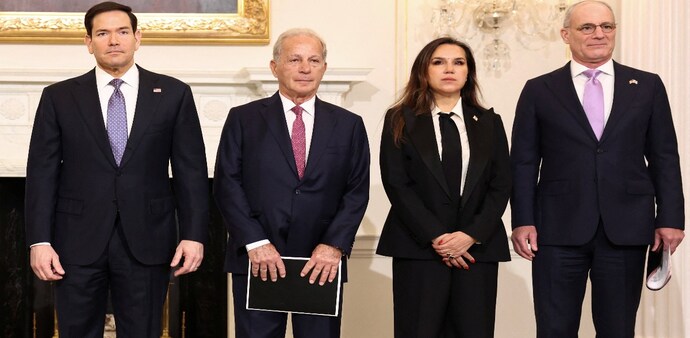
The talks, held at the State Department, brought together Israeli Ambassador Yechiel Leiter and Lebanese Ambassador Nada Hamadeh Moawad. Two ambassadors. Two countries with no formal relations and a long history of hostility.
What emerged, at least from the Israeli side, was something that was not anticipated.
Leiter described a convergence neither side had publicly acknowledged before. "We discovered today that we're on the same side of the equation. That's the most positive thing we could have come away with," he said. "We are both united in liberating Lebanon from an occupation power dominated by Iran called Hezbollah."
He pointed to what he saw as a significant shift in Lebanon's stance. "The Lebanese government made it very clear that they will no longer be occupied by Hezbollah," Leiter said. "Iran has been weakened. Hezbollah is dramatically weakened. This is an opportunity."
The Lebanese side offered no immediate public comment.
What the talks did not resolve
The diplomatic tone in Washington stood in contrast to what was happening elsewhere.
Hezbollah, which opposed the talks and had no seat at the table, continued attacks on northern Israel even as the meeting was underway. Israeli forces remained active in southern Lebanon. Neither the Israeli military nor the Western-backed Lebanese army has managed to disarm the group, which retains considerable military capability and deep political roots across the country.
Hezbollah's absence was not incidental; it was the defining constraint. Any agreement reached without its involvement faces an obvious ceiling, given the group's centrality to both the conflict and any workable settlement.
A longer road
Rubio was careful not to oversell the moment. "We understand we're working against decades of history and complexities," he said, describing the goal as something "very positive" and "very permanent" — without specifying what that would look like or when.
The State Department called the talks "productive" and confirmed that both sides agreed to continue direct negotiations at a time and venue to be decided.
Two nations that have been technically at war for decades sat across a table in Washington on Tuesday. It lasted over two hours. Nobody declared peace. But something shifted.
Lebanon and Israel held their first direct diplomatic talks in years, brokered by the United States, in the shadow of an ongoing conflict between Israeli forces and the Iran-backed Hezbollah. US Secretary of State Marco Rubio framed it as a historic opening while tempering expectations, no breakthrough was on the table, not yet.
An unlikely alignment
The talks, held at the State Department, brought together Israeli Ambassador Yechiel Leiter and Lebanese Ambassador Nada Hamadeh Moawad. Two ambassadors. Two countries with no formal relations and a long history of hostility.
What emerged, at least from the Israeli side, was something that was not anticipated.
Leiter described a convergence neither side had publicly acknowledged before. "We discovered today that we're on the same side of the equation. That's the most positive thing we could have come away with," he said. "We are both united in liberating Lebanon from an occupation power dominated by Iran called Hezbollah."
He pointed to what he saw as a significant shift in Lebanon's stance. "The Lebanese government made it very clear that they will no longer be occupied by Hezbollah," Leiter said. "Iran has been weakened. Hezbollah is dramatically weakened. This is an opportunity."
The Lebanese side offered no immediate public comment.
What the talks did not resolve
The diplomatic tone in Washington stood in contrast to what was happening elsewhere.
Hezbollah, which opposed the talks and had no seat at the table, continued attacks on northern Israel even as the meeting was underway. Israeli forces remained active in southern Lebanon. Neither the Israeli military nor the Western-backed Lebanese army has managed to disarm the group, which retains considerable military capability and deep political roots across the country.
Hezbollah's absence was not incidental; it was the defining constraint. Any agreement reached without its involvement faces an obvious ceiling, given the group's centrality to both the conflict and any workable settlement.
A longer road
Rubio was careful not to oversell the moment. "We understand we're working against decades of history and complexities," he said, describing the goal as something "very positive" and "very permanent" — without specifying what that would look like or when.
The State Department called the talks "productive" and confirmed that both sides agreed to continue direct negotiations at a time and venue to be decided.