
More sailors died here: Not Strait of Hormuz but this critical corridor is the deadliest shipping route in the world
As maritime security company Ambrey and the International Maritime Organization, the corridor, critical for global grain supplies and oil, has become increasingly dangerous for oil tankers, cargo ships and grain carriers navigating attacks involving drones, missiles and explosive-laden boats.
- Oct 26, 2026,
- Updated Oct 26, 2026 8:55 AM IST
With the Iran war waging for eight months now, the Strait of Hormuz has become the proverbial eye of the storm. As the war continues in the region, ship wrecks and body count in the strait pile up. Even then, it is not the most deadly shipping route in the world. That epithet goes to the Black Sea.
The Black Sea has become the world’s deadliest shipping route for merchant sailors, with at least 40 seafarers killed this year, surpassing the 24 confirmed fatalities in the Strait of Hormuz as Russia and Ukraine intensify attacks on vessels and port infrastructure.
According to a report in Financial Times, more than 570 vessels have been struck in the Black Sea this year. As maritime security company Ambrey and the International Maritime Organization, the corridor, critical for global grain supplies and Russian oil, has become increasingly dangerous for oil tankers, cargo ships and grain carriers navigating attacks involving drones, missiles and explosive-laden boats.
MUST READ | Strait of Hormuz could become ‘redundant’ in the next five years: HSBC Group CEO
“For me, the Black Sea and calling at Ukrainian ports is near suicidal,” said Oleg Grygoriuk, chair of the Marine Transport Workers’ Trade Union of Ukraine, describing the constant threat to crews.
The escalation has been particularly sharp since the summer. Around 387 ships were struck between July and September, more than five times the number recorded in the previous quarter, Ambrey said. During the third quarter, attacks averaged more than four a day, as per the report.
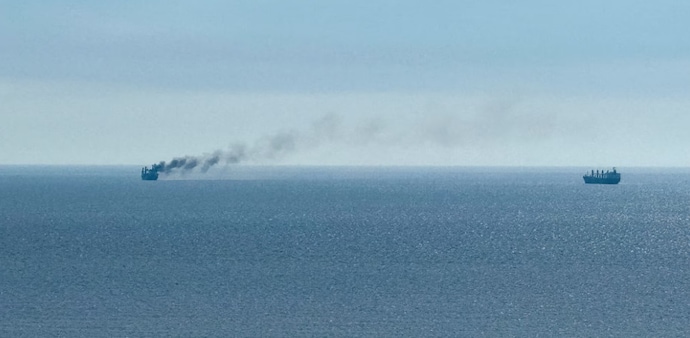
Recent incidents have highlighted the risks. On October 15, two drones hit the chemical tanker Wine Trader off Romania’s Black Sea coast. Another chemical tanker, Yara J, was struck the same night near the entrance to the Sulina Canal. Romanian authorities subsequently reported another tanker attack off the country’s coast that left one sailor dead and three missing.
DON'T MISS | Brent hits $110 as Hormuz ship attacks, Houthi strikes on Saudi trigger oil rally
Ukraine’s campaign against Russian vessels has contributed to the escalation, with Kyiv saying it struck more than 300 Russian vessels in 11 weeks. Russia, meanwhile, has intensified attacks on ships visiting Ukrainian ports, accounting for around 90% of strikes on shipping over the preceding 45 days, according to Ambrey.
The violence has also disrupted trade. Ukraine’s Greater Odesa ports handled fewer than 10 ships last month, compared with around 400 in July, according to private port operator TIS. Ukrainian maritime agricultural exports fell to 1.4 million tonnes in August, roughly 75% below prewar levels.
The risks are also driving up insurance costs. War insurance for Black Sea vessels could reach 15% of a ship’s hull value, almost double the rate for vessels in the Gulf, underwriters told the Financial Times.
MUST READ | Global oil reserves under pressure as Hormuz crisis raises fears of another supply shock
For seafarers, the danger extends beyond attacks to pressure from shipowners and low wages. Some contracts for Syrian sailors offer as little as $800 a month, with additional payments for time spent in the war zone.
Reporting remains incomplete, but shipping groups warn that the Black Sea’s escalating violence threatens crews, trade and global grain supplies.