
Netanyahu out? Israel's president picks rival Gadi Eisenkot to form government
Eisenkot, a former military chief and Netanyahu's main challenger, will have 28 days to assemble a governing coalition, with a possible two-week extension
- Nov 8, 2026,
- Updated Nov 8, 2026 10:34 AM IST
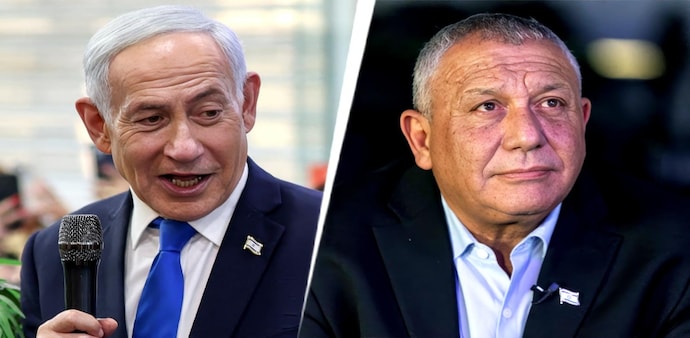
Israeli Prime Minister Benjamin Netanyahu faces a major challenge to his hold on power after President Isaac Herzog on Saturday announced that opposition leader Gadi Eisenkot would get the first opportunity to form a new government.
Eisenkot, a former military chief and Netanyahu's main challenger, will have 28 days to assemble a governing coalition, with a possible two-week extension.
The decision brings him a step closer to replacing Israel's longest-serving prime minister, although neither political bloc has secured a parliamentary majority.
"Now is the time to form a national emergency government. I will do everything to ensure we are worthy," Eisenkot wrote on X following Herzog's announcement.
Don't Miss: Israel Elections 2026: How Arab parties became kingmakers in Netanyahu-Eisenkot rivalry
Netanyahu loses majority, but remains largest party
The October 27 elections left Israel's 120-member parliament, the Knesset, divided.
Netanyahu's Likud emerged as the single largest party with 27 seats, but his religious-nationalist bloc secured only 53, falling short of the 61 required for a majority.
Eisenkot's Yashar party won 21 seats, while his four-party opposition bloc secured 48. Two Arab-led parties made historic gains, winning a combined 19 seats and emerging as potential kingmakers.
During consultations with Herzog, parties representing 67 lawmakers recommended Eisenkot to form the government, compared with 46 who backed Netanyahu. Seven lawmakers made no recommendation.
Herzog is scheduled to formally give Eisenkot the mandate on Sunday, November 8.
Arab parties emerge as kingmakers
Eisenkot faces difficult coalition negotiations, particularly over whether to seek the support of Arab-led parties.
An Arab party has participated in an Israeli governing coalition only once, and any such arrangement could prove politically divisive after more than three years of war following the October 7, 2023 Hamas-led attacks.
Eisenkot has indicated that potential partners must accept conditions including recognising Hamas as a terrorist organisation and supporting the destruction of its military and governing capabilities.
He could also seek a minority government supported externally by Arab parties or attempt to build a broader coalition with other Jewish parties. However, some of his allies oppose cooperation with the Arab parties.
Netanyahu calls for unity government
Shortly before Herzog's announcement, Netanyahu appealed for a "national unity government" and warned against "hastily swearing in a government with terrorist supporters", referring to the possibility of Arab-led parties supporting Eisenkot.
Netanyahu and his allies have repeatedly portrayed those parties as threats to national security. The prime minister has also made allegations of election irregularities involving Arab parties without substantiated evidence.
Eisenkot's Yashar party rejected Netanyahu's appeal and urged Likud to break its alliance with what it called "radical parties".
The opposition party said any government led by Eisenkot would include only lawmakers who accepted its stated principles.
Deep disagreements remain between Netanyahu and Eisenkot, including over military draft exemptions for ultra-Orthodox men and demands for a formal investigation into the failures surrounding the October 7 attacks.
Eisenkot's appointment does not immediately remove Netanyahu from office. If he fails to secure a parliamentary majority, another candidate could be given an opportunity to form a government.