
No empire lasts forever: China's military parade signals bid to rewrite global balance of power
The People’s Liberation Army (PLA), once seen as lagging behind the West, now stands as the world’s largest armed force, backed by a navy bigger than any other and a vast industrial base that eclipses the combined production of the next nine manufacturing powers.
- Sep 4, 2025,
- Updated Sep 4, 2025 7:14 PM IST
For much of the post–World War II era, the United States stood as the undisputed global superpower, shaping the world order through unmatched political, economic, and military might. But history has shown time and again that no empire lasts forever. Today, a resurgent China is testing the limits of America’s dominance, not just in trade and technology, but on the battlefield of military innovation.
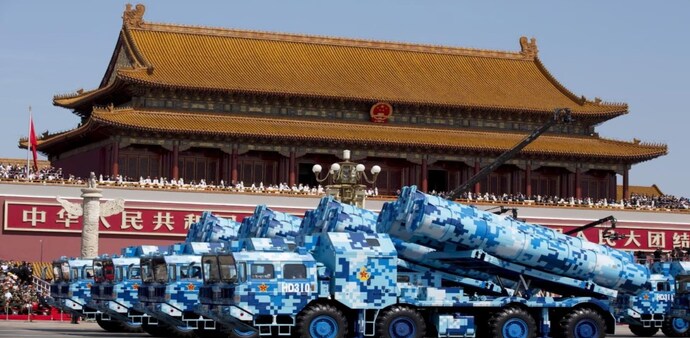
On September 3, 2025, Beijing staged its largest-ever military parade, commemorating the 80th anniversary of the War of Resistance Against Japanese Aggression. As President Xi Jinping presided over the spectacle in Tiananmen Square, the world watched a powerful display of tanks, hypersonic missiles, stealth aircraft, and submarine-launched ballistic missiles. The event was more than a celebration of history — it was a projection of China’s growing military sophistication and ambition.
For decades, China was dismissed as a technological imitator, accused of intellectual property theft and heavy reliance on subsidies. That narrative no longer captures reality. From robotics and electric vehicles to drones and artificial intelligence, China has emerged as a leader in next-generation industries — advances now spilling decisively into the military domain.
The People’s Liberation Army (PLA), once seen as lagging behind the West, now stands as the world’s largest armed force, backed by a navy bigger than any other and a vast industrial base that eclipses the combined production of the next nine manufacturing powers. Its capacity to churn out “good-enough” weapons at scale is increasingly viewed as a strategic edge against the United States, whose military relies heavily on fewer, highly advanced — and costly — platforms.
NATO officials have taken note. At the recent IISS Prague Defence Summit, NATO Secretary-General Mark Rutte warned that China, alongside Russia, is rapidly expanding its arms production and capabilities, challenging Western military supremacy. In Washington, the Pentagon faces a sobering dilemma: accelerate its modernization in areas such as hypersonics, AI-driven warfare, and space systems, or risk being outpaced.
Adding to the concern are recent developments beyond the parade. Late in 2024, satellite images showed new Chinese stealth fighter prototypes undergoing test flights. Soon after, reports surfaced of an innovative powered barge capable of deploying heavy military hardware on unprepared coasts — a potential game-changer for operations against Taiwan. Research papers, including Access Denied? The Sino-American Contest for Military Primacy in Asia, warn that current U.S. defense postures could leave its forces vulnerable to catastrophic defeat in the event of a Taiwan crisis.
For the United States, China’s military parades are more than theater. They are strategic messaging tools designed to reshape perceptions of power. They force Washington to grapple with an uncomfortable truth: America now faces a peer competitor capable of matching — and in some areas, surpassing — its technological advances.
The lesson is one as old as history itself. Empires rise, empires fall, and no nation can expect to dominate forever. As China’s star ascends, the United States must decide how to respond in a world where its military supremacy can no longer be taken for granted.
For much of the post–World War II era, the United States stood as the undisputed global superpower, shaping the world order through unmatched political, economic, and military might. But history has shown time and again that no empire lasts forever. Today, a resurgent China is testing the limits of America’s dominance, not just in trade and technology, but on the battlefield of military innovation.
On September 3, 2025, Beijing staged its largest-ever military parade, commemorating the 80th anniversary of the War of Resistance Against Japanese Aggression. As President Xi Jinping presided over the spectacle in Tiananmen Square, the world watched a powerful display of tanks, hypersonic missiles, stealth aircraft, and submarine-launched ballistic missiles. The event was more than a celebration of history — it was a projection of China’s growing military sophistication and ambition.
For decades, China was dismissed as a technological imitator, accused of intellectual property theft and heavy reliance on subsidies. That narrative no longer captures reality. From robotics and electric vehicles to drones and artificial intelligence, China has emerged as a leader in next-generation industries — advances now spilling decisively into the military domain.
The People’s Liberation Army (PLA), once seen as lagging behind the West, now stands as the world’s largest armed force, backed by a navy bigger than any other and a vast industrial base that eclipses the combined production of the next nine manufacturing powers. Its capacity to churn out “good-enough” weapons at scale is increasingly viewed as a strategic edge against the United States, whose military relies heavily on fewer, highly advanced — and costly — platforms.
NATO officials have taken note. At the recent IISS Prague Defence Summit, NATO Secretary-General Mark Rutte warned that China, alongside Russia, is rapidly expanding its arms production and capabilities, challenging Western military supremacy. In Washington, the Pentagon faces a sobering dilemma: accelerate its modernization in areas such as hypersonics, AI-driven warfare, and space systems, or risk being outpaced.
Adding to the concern are recent developments beyond the parade. Late in 2024, satellite images showed new Chinese stealth fighter prototypes undergoing test flights. Soon after, reports surfaced of an innovative powered barge capable of deploying heavy military hardware on unprepared coasts — a potential game-changer for operations against Taiwan. Research papers, including Access Denied? The Sino-American Contest for Military Primacy in Asia, warn that current U.S. defense postures could leave its forces vulnerable to catastrophic defeat in the event of a Taiwan crisis.
For the United States, China’s military parades are more than theater. They are strategic messaging tools designed to reshape perceptions of power. They force Washington to grapple with an uncomfortable truth: America now faces a peer competitor capable of matching — and in some areas, surpassing — its technological advances.
The lesson is one as old as history itself. Empires rise, empires fall, and no nation can expect to dominate forever. As China’s star ascends, the United States must decide how to respond in a world where its military supremacy can no longer be taken for granted.