
'No way Trump can...': Analyst decodes Iran's 10-point plan to US, Israel
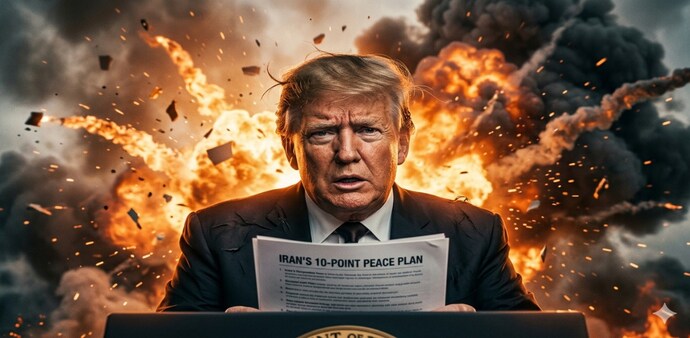
Reacting to Tehran's 10-point plan, geopolitical affairs analyst Sushant Sareen suggested that accepting these proposals would spell disaster for Washington. Here's why
- Apr 7, 2026,
- Updated Apr 7, 2026 3:15 PM IST
On Monday, Iran rejected a 45-day ceasefire proposal and said that it wants a permanent end to the war. For this, Tehran has sent a 10-point peace proposal to the US through Pakistan, which reportedly includes guarantees such as the Hormuz fee of $2 million per ship and lifting of all US sanctions on Iran.
Reacting to Tehran's 10-point plan, geopolitical affairs analyst Sushant Sareen suggested that accepting these proposals would spell disaster for Washington.
In a social media post, Sareen said that not only would this spell disaster for the US, but it would also be "difficult to stomach" for the Arabs.
"Accepting Iran's proposals would mean conceding defeat and making it the regional hegemon. No way Trump can claim victory if he accepts these points. The Arabs will also find it difficult to stomach these demands of Iran. But then stranger things are known to have happened," he wrote on X.
DON'T MISS | $2 million per ship, no attack on allies: What Iran is demanding in 10-point proposal to US
What is the 10-point peace plan sent by Iran?
The proposal sent by Iran demands significant concessions from the US and Israel. Tehran has demanded an ironclad assurance that Iran will not be targeted again.
It also sought an end to Israel's strikes against Hezbollah, the lifting of all US sanctions, and rejected a 45-day temporary ceasefire for a final resolution.
It proposes lifting its de facto blockade of the strategically vital waterway Strait of Hormuz. A notable clause in the proposal includes a fee of roughly $2 million per ship passing through Hormuz, which will be shared with Oman as it borders the strait.
It also sought the establishment of new rules and mechanisms for secure maritime transit. Iran will also be using a portion of these funds to rebuild the infrastructure damaged as a result of US and Israeli strikes, rather than demanding direct financial compensation.
Meanwhile, US President Donald Trump described Iran's proposal as a "significant step" but "not good enough" to end the conflict. Dismissing Iran's plan to charge around $2 million per ship, Trump suggested that the US should be the one charging tolls instead.
Further, the US President warned that if his conditions aren't met by the deadline, he will order strikes to destroy "every bridge" and "every power plant" in Iran out of business.
On Monday, Iran rejected a 45-day ceasefire proposal and said that it wants a permanent end to the war. For this, Tehran has sent a 10-point peace proposal to the US through Pakistan, which reportedly includes guarantees such as the Hormuz fee of $2 million per ship and lifting of all US sanctions on Iran.
Reacting to Tehran's 10-point plan, geopolitical affairs analyst Sushant Sareen suggested that accepting these proposals would spell disaster for Washington.
In a social media post, Sareen said that not only would this spell disaster for the US, but it would also be "difficult to stomach" for the Arabs.
"Accepting Iran's proposals would mean conceding defeat and making it the regional hegemon. No way Trump can claim victory if he accepts these points. The Arabs will also find it difficult to stomach these demands of Iran. But then stranger things are known to have happened," he wrote on X.
DON'T MISS | $2 million per ship, no attack on allies: What Iran is demanding in 10-point proposal to US
What is the 10-point peace plan sent by Iran?
The proposal sent by Iran demands significant concessions from the US and Israel. Tehran has demanded an ironclad assurance that Iran will not be targeted again.
It also sought an end to Israel's strikes against Hezbollah, the lifting of all US sanctions, and rejected a 45-day temporary ceasefire for a final resolution.
It proposes lifting its de facto blockade of the strategically vital waterway Strait of Hormuz. A notable clause in the proposal includes a fee of roughly $2 million per ship passing through Hormuz, which will be shared with Oman as it borders the strait.
It also sought the establishment of new rules and mechanisms for secure maritime transit. Iran will also be using a portion of these funds to rebuild the infrastructure damaged as a result of US and Israeli strikes, rather than demanding direct financial compensation.
Meanwhile, US President Donald Trump described Iran's proposal as a "significant step" but "not good enough" to end the conflict. Dismissing Iran's plan to charge around $2 million per ship, Trump suggested that the US should be the one charging tolls instead.
Further, the US President warned that if his conditions aren't met by the deadline, he will order strikes to destroy "every bridge" and "every power plant" in Iran out of business.